
AI humanizers promise something tempting: paste robotic text, click a button, and get writing that looks human. But students should ask a harder question before trusting any tool with an assignment, essay, or blog draft: does it only fool detectors, or does it also keep the writing clear, accurate, and usable?
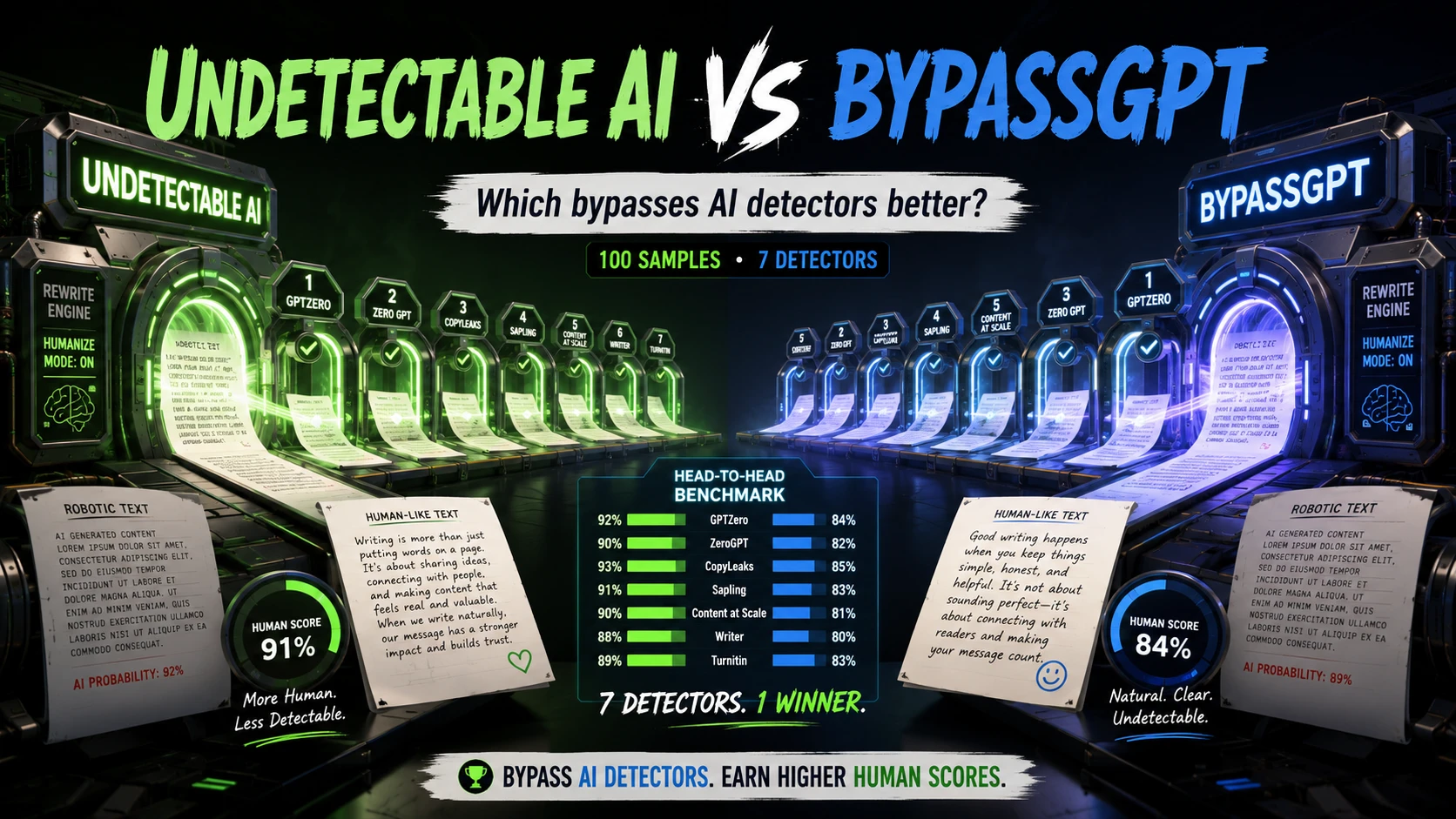
To answer that, this test compared Undetectable AI and BypassGPT across seven AI detectors: Copyleaks, GPTZero, Grammarly, Originality.ai, Sapling, Turnitin, and ZeroGPT. Each tool was tested on 100 samples. The detector scores were converted into human scores, so a higher score means the detector judged the rewritten text as more human-written.
TL;DR
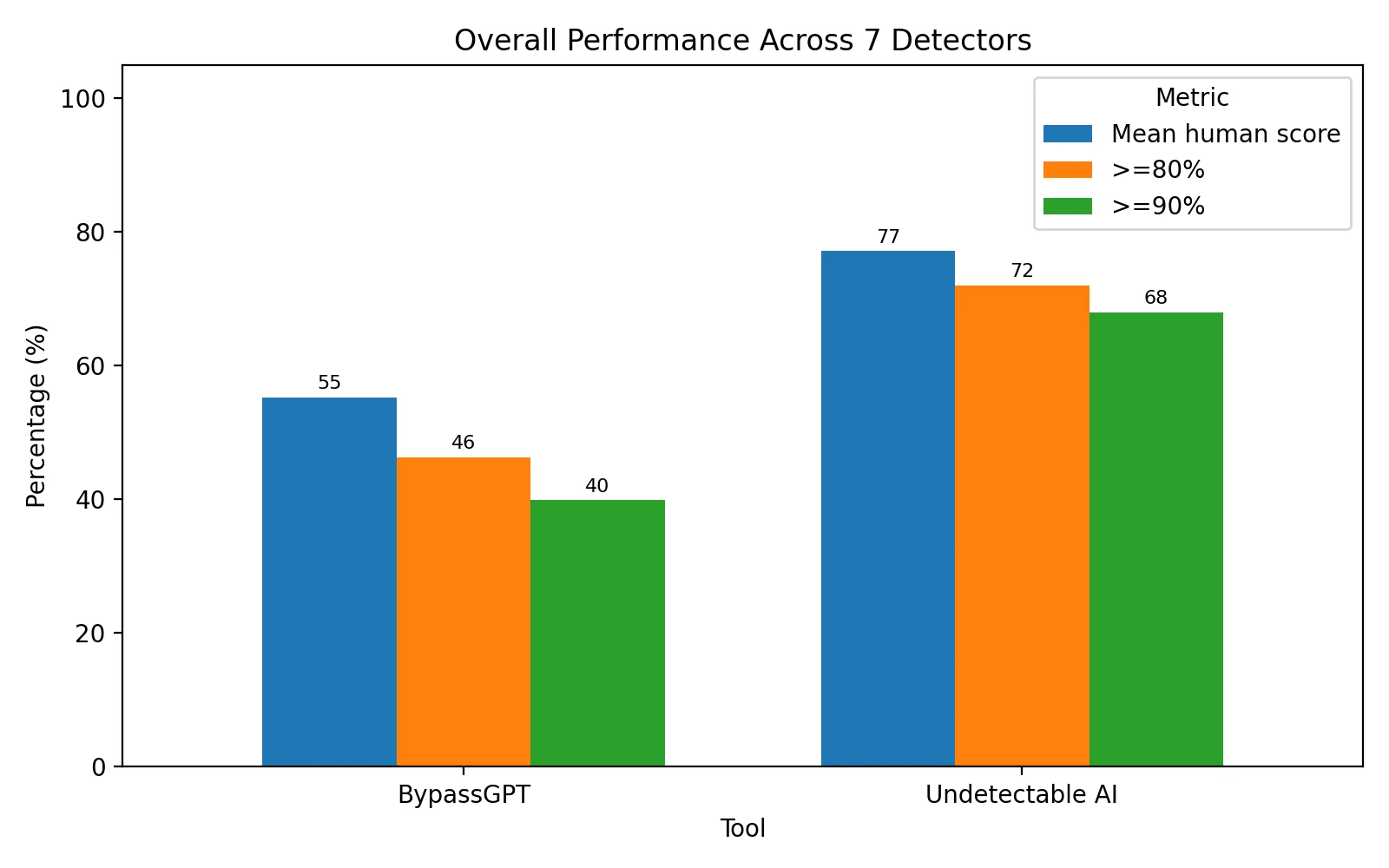
- Undetectable AI scored higher overall. Its average human score across the seven detectors was 77.1%, compared with 55.3% for BypassGPT.
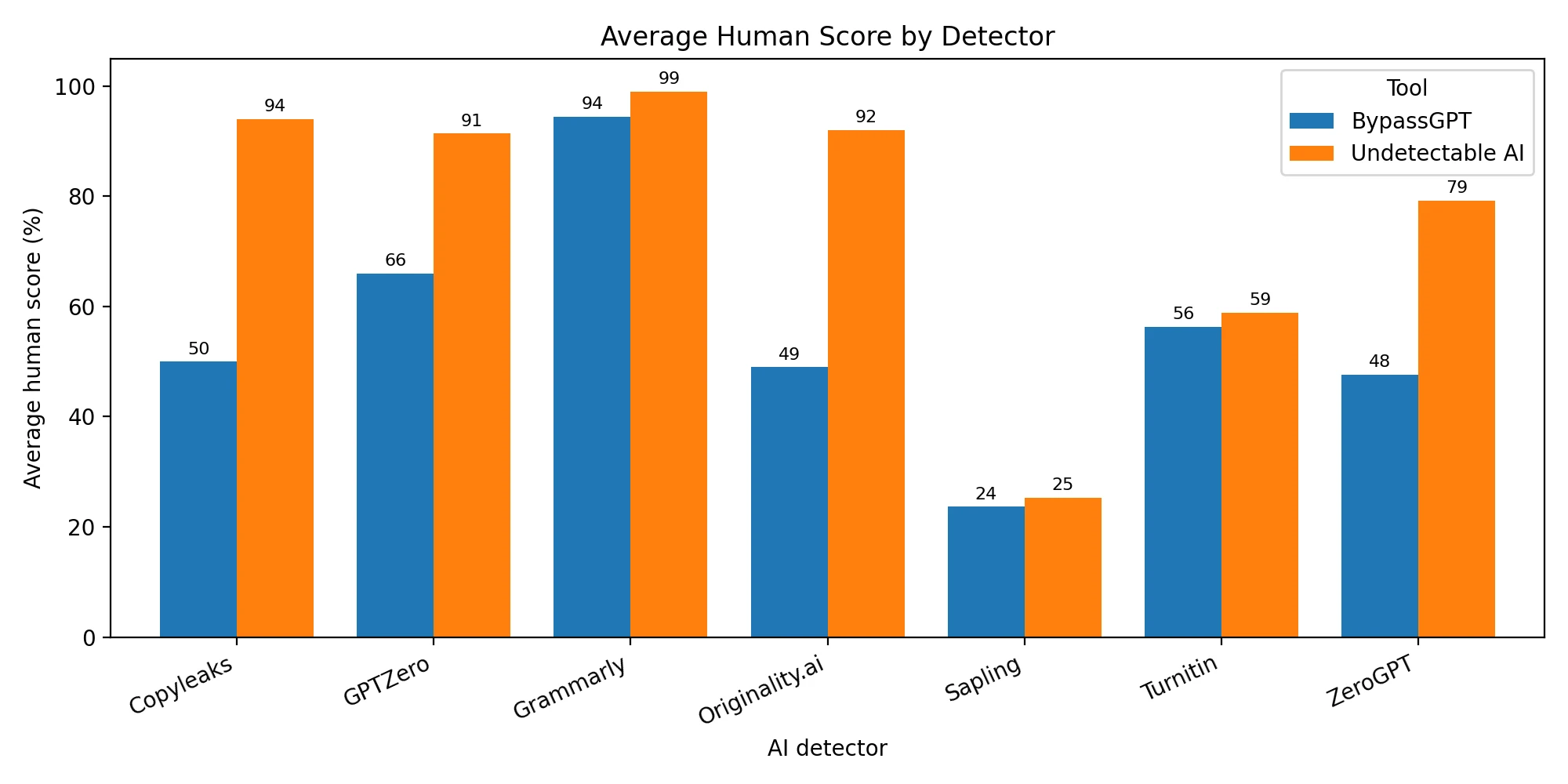
- Undetectable AI beat BypassGPT on every detector average. The biggest gaps appeared in Copyleaks, Originality.ai, GPTZero, and ZeroGPT.
- Grammarly was the easiest detector for both tools. BypassGPT averaged 94.4%, while Undetectable AI averaged 99.0%.
- Sapling was the hardest detector for both tools. BypassGPT averaged 23.7%, and Undetectable AI averaged only 25.3%.
- Detector score is not the same as writing quality. Undetectable AI had stronger detector results, but it also produced more awkward, expanded, and sometimes garbled rewrites.
How should you read these scores?
The average human score is the simplest way to compare the tools. If a tool gets 90%, the detector is mostly reading that output as human. If it gets 20%, the detector is still reading most of that output as AI-like. I also looked at the 80%+ rate, which means the share of samples that received a strong human score. This is not an official pass mark. It is just a useful line for comparing performance.
Also Read: [STUDY] Can Copyleaks Detect Undetectable AI?
Which tool performed better across the seven detectors?
Undetectable AI was clearly stronger in the detector-bypass part of the test. Its biggest wins were on Copyleaks, where it scored 94.0% against BypassGPT's 50.0%, and Originality.ai, where it scored 92.0% against 49.0%. It also performed much better on ZeroGPT, scoring 79.2% compared with BypassGPT's 47.6%.
BypassGPT was not useless. It performed very well against Grammarly, with a 94.4% average human score. It also reached 66.0% on GPTZero and 56.3% on Turnitin. But its results were uneven. It looked strong against one detector and weak against another, which makes it risky if students do not know which detector will be used.
Also Read: [STUDY] Can Undetectable AI Bypass Grammarly's AI Detector?
What did the detector-by-detector results show?
| Detector | BypassGPT average human score | Undetectable AI average human score | Winner |
|---|---|---|---|
| Copyleaks | 50.0% | 94.0% | Undetectable AI |
| GPTZero | 66.0% | 91.4% | Undetectable AI |
| Grammarly | 94.4% | 99.0% | Undetectable AI |
| Originality.ai | 49.0% | 92.0% | Undetectable AI |
| Sapling | 23.7% | 25.3% | Undetectable AI, but both were weak |
| Turnitin | 56.3% | 58.9% | Undetectable AI, but close |
| ZeroGPT | 47.6% | 79.2% | Undetectable AI |
Which tool had more strong human scores?
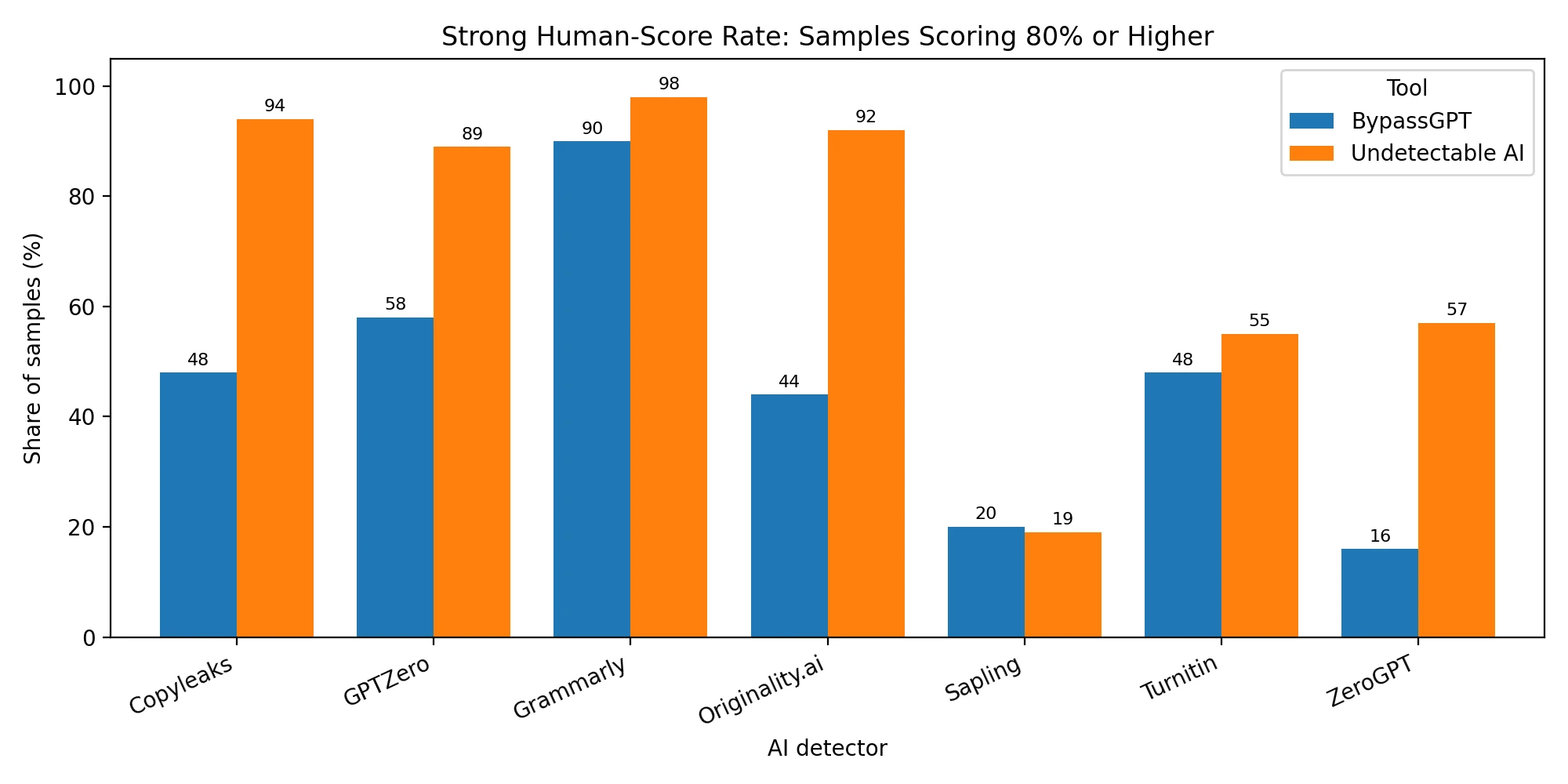
Looking only at samples that scored 80% or higher makes the difference clearer. Undetectable AI had an average 80%+ rate of 72.0% across the seven detectors. BypassGPT had an average 80%+ rate of 46.3%.
That means Undetectable AI did not just win because of a few high-scoring samples. It produced strong human-score results more consistently. The only places where the race was close were Sapling and Turnitin. On Sapling, both tools struggled badly. On Turnitin, Undetectable AI won by only a small margin.
Also Read: Can Undetectable AI Bypass Turnitin? A 100-Sample Test Students Should Read Carefully
Did higher detector scores mean better writing?
No. This is the most important part for students. A detector can give a high human score even when the rewrite is clumsy, too long, or meaningfully changed. That is why the rewritten text was checked separately for formatting issues, number changes, meaning drift, repeated words, and obviously broken phrases.
BypassGPT had a different problem from Undetectable AI. It usually kept the length close to the original, but it often damaged structure. In many list-style samples, it removed visible numbering like 2, 3, and 4. That matters because assignments, guides, and blog sections often depend on the order of points. If the meaning is still mostly there but the structure is broken, the rewrite still needs manual editing.
Undetectable AI preserved numbering and layout better, but its language quality was less stable. It expanded the writing by about 22% on average, and 32 out of 100 samples had major length drift. Some rewrites also included awkward or broken phrases such as "The them to over heat," "A the railways," "construction main function," and "world,Amazon." These are not tiny style problems. They make the text look careless, and in a student submission, they could attract attention even if an AI detector gives a high human score.
Also Read: [STUDY] Can BypassGPT Really Slip Past ZeroGPT? I Tested 100 Rewrites to Find Out.
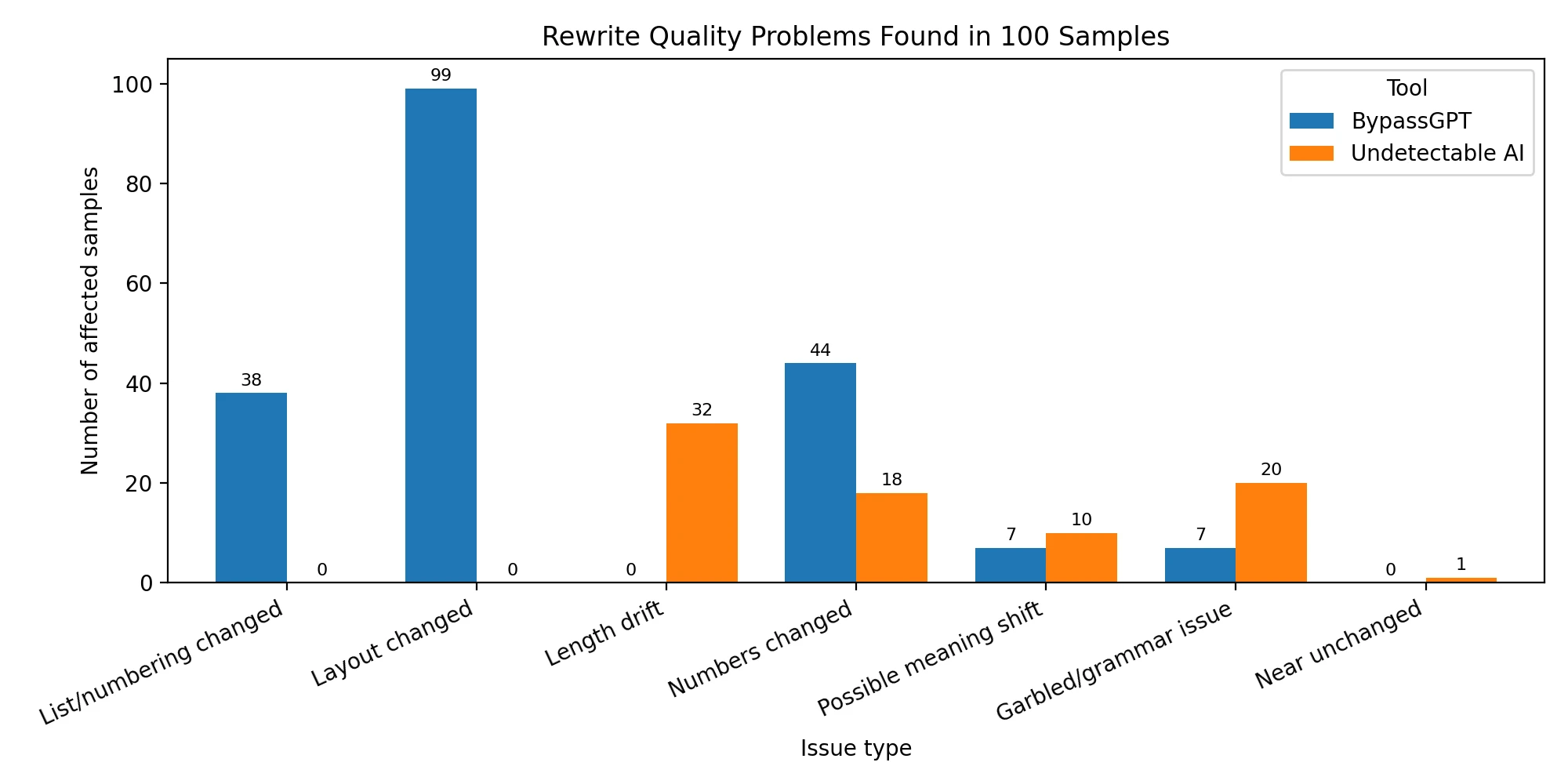
What problems appeared in BypassGPT rewrites?
- It frequently removed list numbers from samples that originally had numbered points.
- It changed paragraph layout in most samples by adding extra blank breaks or changing the structure.
- It changed visible numbers in 44 out of 100 samples, often because numbered lists were removed.
- It had fewer severe garbled phrases than Undetectable AI, but it still created occasional awkward lines.
What problems appeared in Undetectable AI rewrites?
- It scored much higher on detectors, but it often became longer than the original.
- It had 20 samples with garbled, grammar, or formatting issues based on the rewrite-quality check.
- It sometimes introduced messy sentence order, repeated words, or strange phrasing.
- It had 10 samples with possible meaning-shift signals, such as changes in negation patterns.
Also Read: [STUDY] Can BypassGPT.ai Really Bypass Copyleaks?
So, is Undetectable AI better than BypassGPT?
For bypassing AI detectors in this dataset, yes. Undetectable AI was the stronger tool overall. It won all seven detector averages and had a much higher strong-score rate. If the only question is which tool produced higher human scores, Undetectable AI is the clear winner.
But if the question is which tool creates safer, cleaner writing for students, the answer is more complicated. Undetectable AI's higher detector scores came with more quality risk. BypassGPT was weaker against detectors, but it usually stayed closer to the original length and had fewer obviously garbled phrases. Still, BypassGPT's formatting problems are serious if the original text uses lists, steps, or numbered sections.
Also Read: [100 Samples Test] Can BypassGPT Really Bypass Originality.ai?
What should students learn from this test?
The biggest lesson is simple: do not confuse a human score with human-quality writing. A detector score is only one signal. Teachers, editors, and readers do not grade only by detector results. They notice broken logic, missing numbers, weird grammar, and paragraphs that sound like they were forced through a machine.
If you use AI tools for writing support, the responsible approach is to use them for brainstorming, organization, and editing help, then check the final work yourself. In this test, Undetectable AI was better at bypassing detectors, while BypassGPT was less consistent. But neither tool was reliable enough to trust blindly. The best writing still needs human judgment, not just a higher human score.