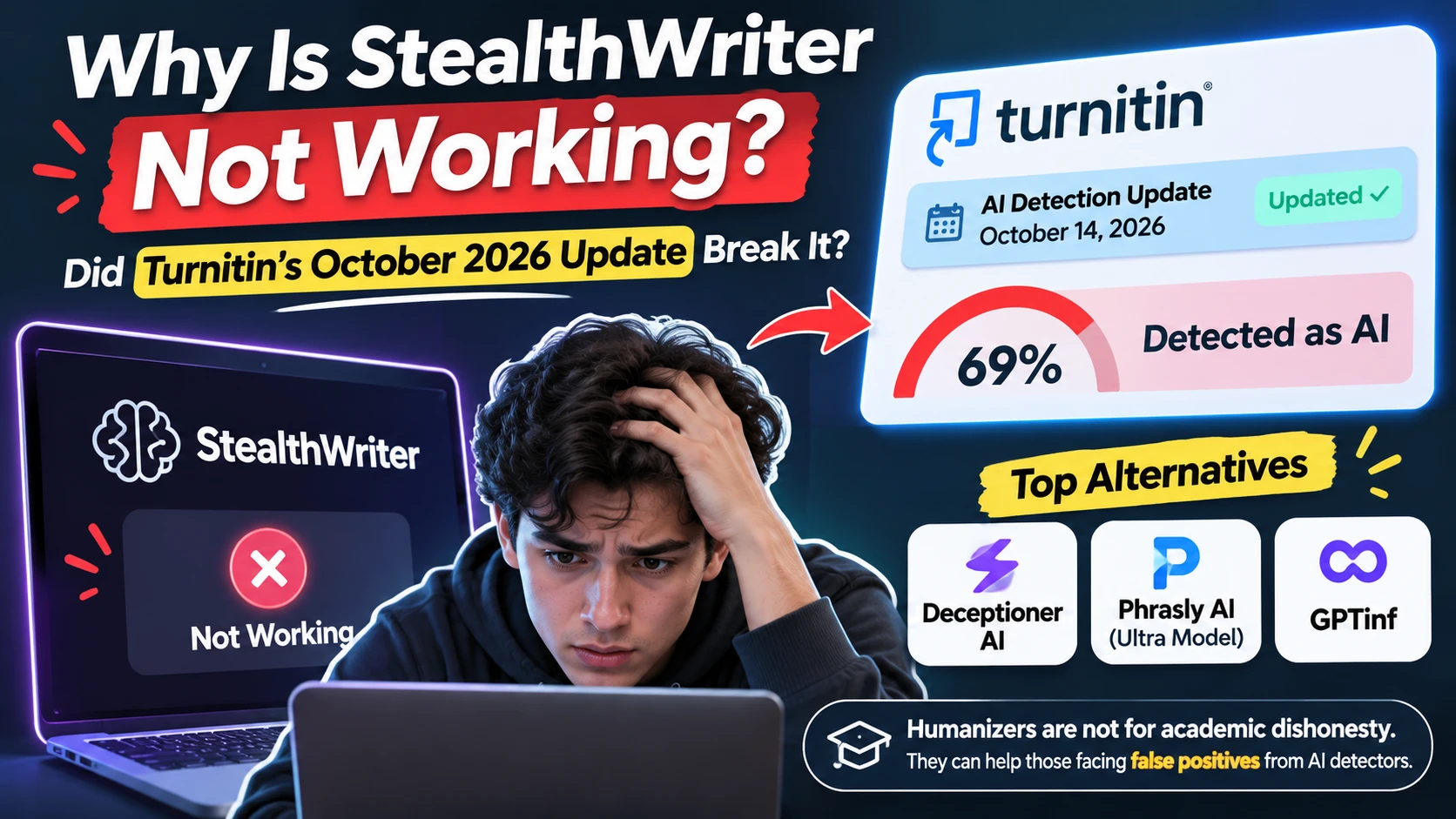

If you have been searching for "why is StealthWriter not working?", you are not alone. Students who use StealthWriter AI to make AI-assisted drafts sound more natural are reporting that their writing is still being marked as AI-generated by Turnitin. Some users say this started happening even with StealthWriter's Ghost models, which previously gave them better results.
The timing is important: Turnitin updated its English AI writing detection model on October 14, 2026. Complaints posted in StealthWriter's official Discord later that month suggest that users noticed a change. But there is a difference between a reasonable explanation and a confirmed cause. Here is what we actually know.
What Changed in Turnitin?
Turnitin's official AI detection release notes confirm several relevant updates:
- August 27, 2025: Turnitin added detection for text likely modified using AI bypasser tools.
- February 12, 2026: It updated its detection model to improve recall while keeping false positives low.
- August 4, 2026: It changed its report to show one blue highlight category for likely AI-generated content, including AI-paraphrased text. This was mainly a reporting change, not proof of a new detection breakthrough on that date.
- October 14, 2026: Turnitin announced improved detection in its English AI writing model, with no visible changes to the report.
The October model applies to newly processed submissions; previous reports are not recalculated unless the writing is resubmitted. Turnitin also explicitly says its English detector can identify text that may have been changed by paraphrasers and bypassers. That makes the October update a plausible explanation for why older rewriting methods seem less reliable.
Also Read: Is StealthWriter AI Detector Accurate?
What Are StealthWriter Users Saying on Discord?
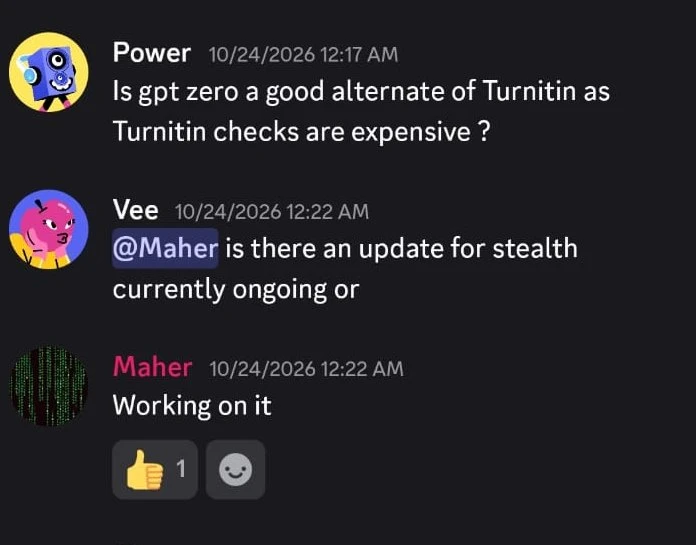
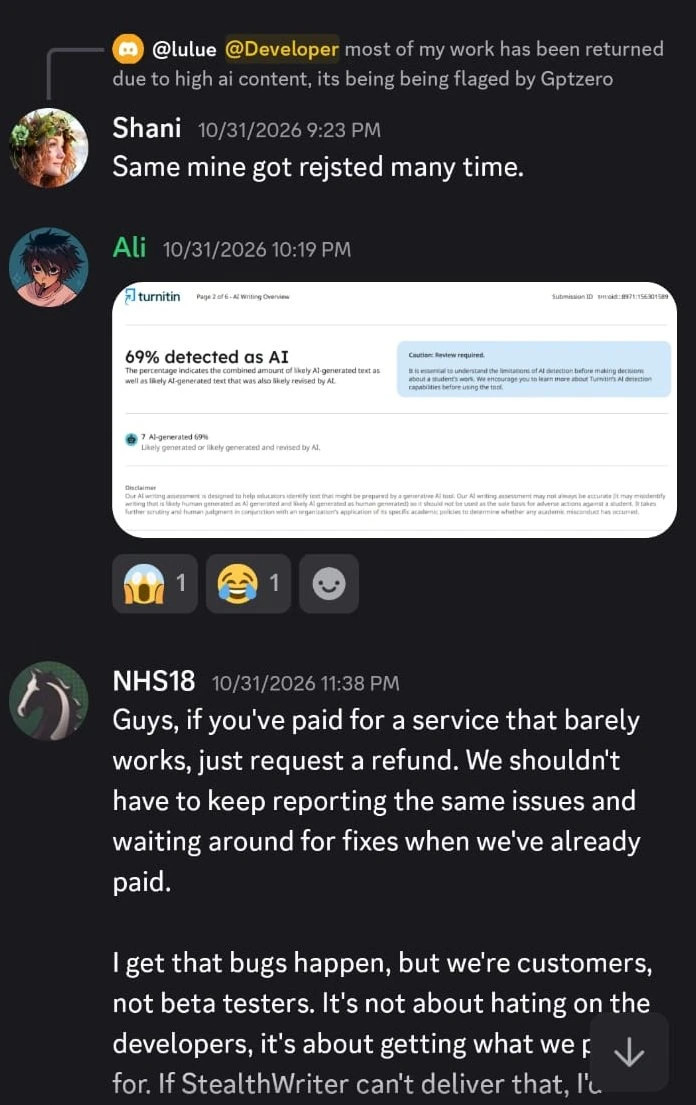
Discord screenshots dated October 24 and October 31, 2026 show several users reporting problems. In one exchange, a user asks StealthWriter owner Maher about an update. Maher replies, "Working on it." The message indicates that a problem was being addressed, but gives no release date or technical explanation.
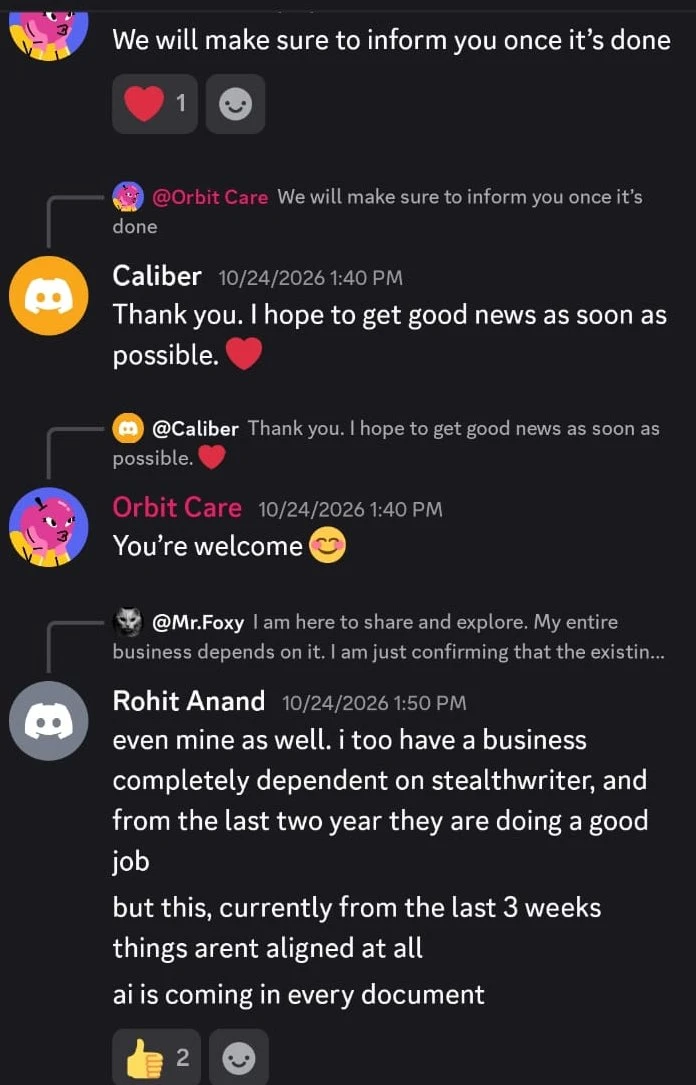
In another discussion, staff member Orbit Care says the community will be informed when the work is done. A user describes relying on the service for business writing and says AI scores have recently appeared across documents. This suggests the complaints are not limited to a single student or assignment.
Also Read: Is StealthWriter Safe for Students?
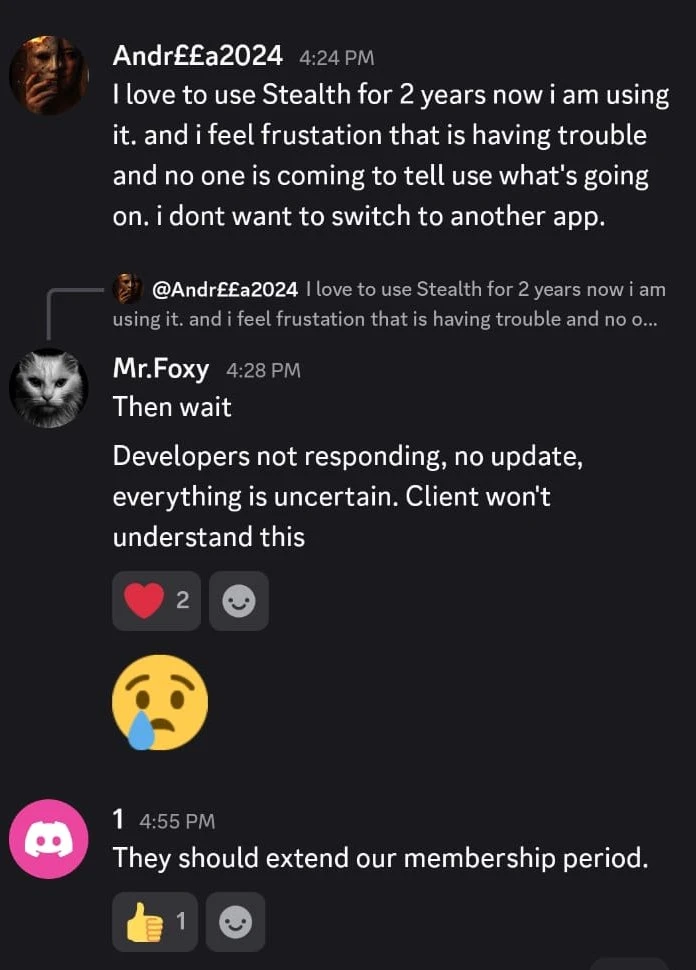
Other members express frustration about unclear timelines, ask for membership extensions, and suggest using alternatives. On October 31, one user shares a Turnitin report showing 69% detected as AI. That is one user's reported result, not an independently verified test of StealthWriter's overall performance.
Why Might StealthWriter Be Getting Flagged?
The most plausible explanation is a mismatch between StealthWriter's rewriting methods and Turnitin's newer detection system. A humanizer can change words, grammar, and sentence structure, but a detector may still identify patterns associated with machine-generated text. A tool that performed well against an older detector is not guaranteed to work against an updated one.
There is another possibility. Because StealthWriter is a popular humanizer, Turnitin's developers may have encountered writing resembling its outputs while improving their classifier. Repeated styles or rewriting patterns could become easier to recognize over time. However, there is no public confirmation that Turnitin trained specifically on StealthWriter outputs, so this remains a hypothesis, not a fact.
That could explain why users report that multiple Ghost models are not reliably producing the results they expected in one attempt. Some October 24 complaints describe problems lasting roughly three weeks, so the October 14 model update might not explain every reported failure. It also does not mean StealthWriter's website is completely broken: the tool may still rewrite text, while failing to produce the detector scores users previously associated with it. Slow processing and usage-limit complaints are separate service issues.
Also Read: StealthWriter vs Pangram: Can a "Humanized" Rewrite Really Escape Detection?
Three StealthWriter Alternatives Worth Knowing
If you need a writing assistant while problems are being investigated, these are three other humanizers. Their marketing claims are not guarantees, and none can promise a particular Turnitin result.
1. DecEptioner AI
DecEptioner offers rewriting with controls for readability and different AI detectors, including Turnitin. We also have a free option for testing its writing quality. Since we don't target all the detectors at once, we have the highest odds of bypassing Turnitin while maintaining the text's readability. You can signup with a free account and try it yourself.
2. Phrasly AI (Ultra model)
Phrasly introduced its Ultra model in September 2026. Phrasly markets Ultra as an easy way to pass Turnitin and claims a greater than 99% pass rate in its own tests; that figure is not an independently verified guarantee. But readability can suffer, particularly when aggressive rewriting produces unnatural wording, awkward transitions, or changes in meaning. Phrasly itself warns that results vary. Do not assume a low detector score means the writing is accurate, readable, or suitable for submission.
3. GPTinf
GPTinf combines a humanizer with a grammar checker, paraphraser, readability checker, and other editing tools. This makes it useful for reviewing the clarity and consistency of a draft, not just its detection score. Like other rewriting products, it can make mistakes and cannot verify that an institution will consider a document independently written.
What Should Students Do If Turnitin Flags Their Work?
First, remember that an AI score is not proof of cheating. Turnitin's own guidance says its system can misidentify human writing and that the score should not be the sole basis for action against a student.
If you wrote the work yourself and believe the result is a false positive, keep your outlines, research notes, citations, drafts, and document version history. Ask your instructor to review the writing process and the institution's AI policy, rather than relying only on a percentage. If you used AI for permitted tasks, such as brainstorming or language polishing, disclose that use as your course requires.
Humanizers should not be used for academic dishonesty. Students sometimes look for them because legitimate writing has been unfairly flagged. That concern is real, but rewriting prohibited AI-generated work to hide its origin is different from correcting a false positive. The strongest protection is honest authorship, clear records of your process, and compliance with your institution's rules.
Final Verdict: Is StealthWriter Going to Work Again?
As of November 2, 2026, the screenshots show that users have reported problems and that Maher acknowledged ongoing work. They do not establish when a fix will arrive or prove exactly what caused the change. The October 14 Turnitin model update is the leading explanation based on the public timeline, while the idea that Turnitin learned StealthWriter-specific patterns remains unconfirmed.
For now, judge any writing tool by clarity, factual accuracy, and whether it supports your own work—not by promises of a guaranteed Turnitin bypass.