
Can Phrasly tell whether a piece of writing came from a person or an AI tool? We tested it on 160 passages with known authorship. The detector missed more than one in four AI-written passages, a problem if you are submitting coursework.
It also called three human-written passages AI-generated. One of those received a full 100% AI score. Here is what the numbers mean for your assignments.
How We Tested Phrasly
Our dataset contains 82 AI-written passages and 78 human-written passages, on science, history, finance, health, and everyday advice. For each passage, we recorded Phrasly's verdict and its displayed AI score. We then compared the recorded verdict with the text's known category.
We used the verdict column to count correct and incorrect classifications, rather than inventing a score cutoff. A 33% score is not necessarily a final AI verdict. The dataset does not document every text's original source, AI model, or editing history, so this is a test of these samples, not a guarantee of performance on all student work.
Also Read: Is Phrasly's AI Detector Accurate for Turnitin?
Phrasly AI Detector Accuracy: The Results
| Measurement | Result |
|---|---|
| Total passages tested | 160 |
| Overall accuracy | 83.75% |
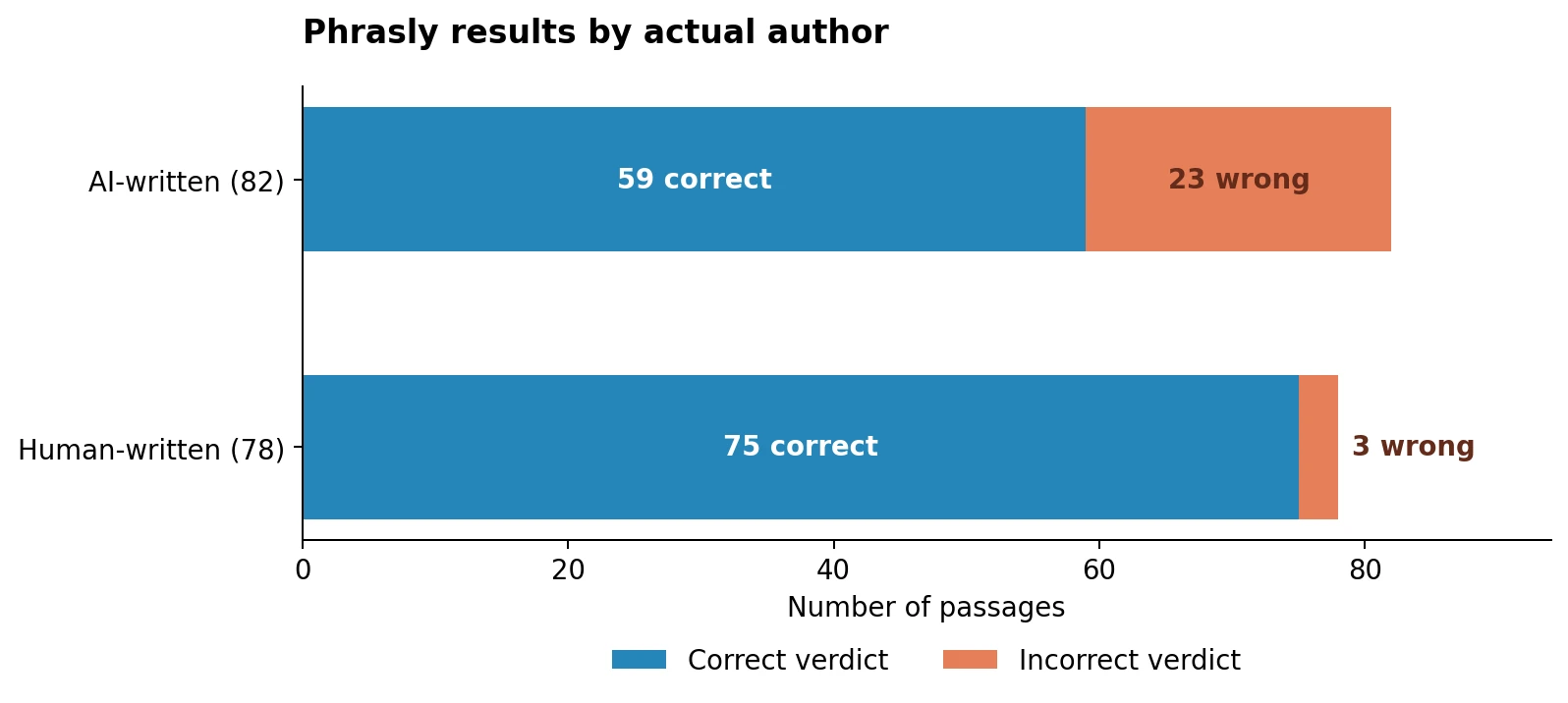
| AI passages correctly detected | 59 of 82 (71.95%) |
| Human passages correctly detected | 75 of 78 (96.15%) |
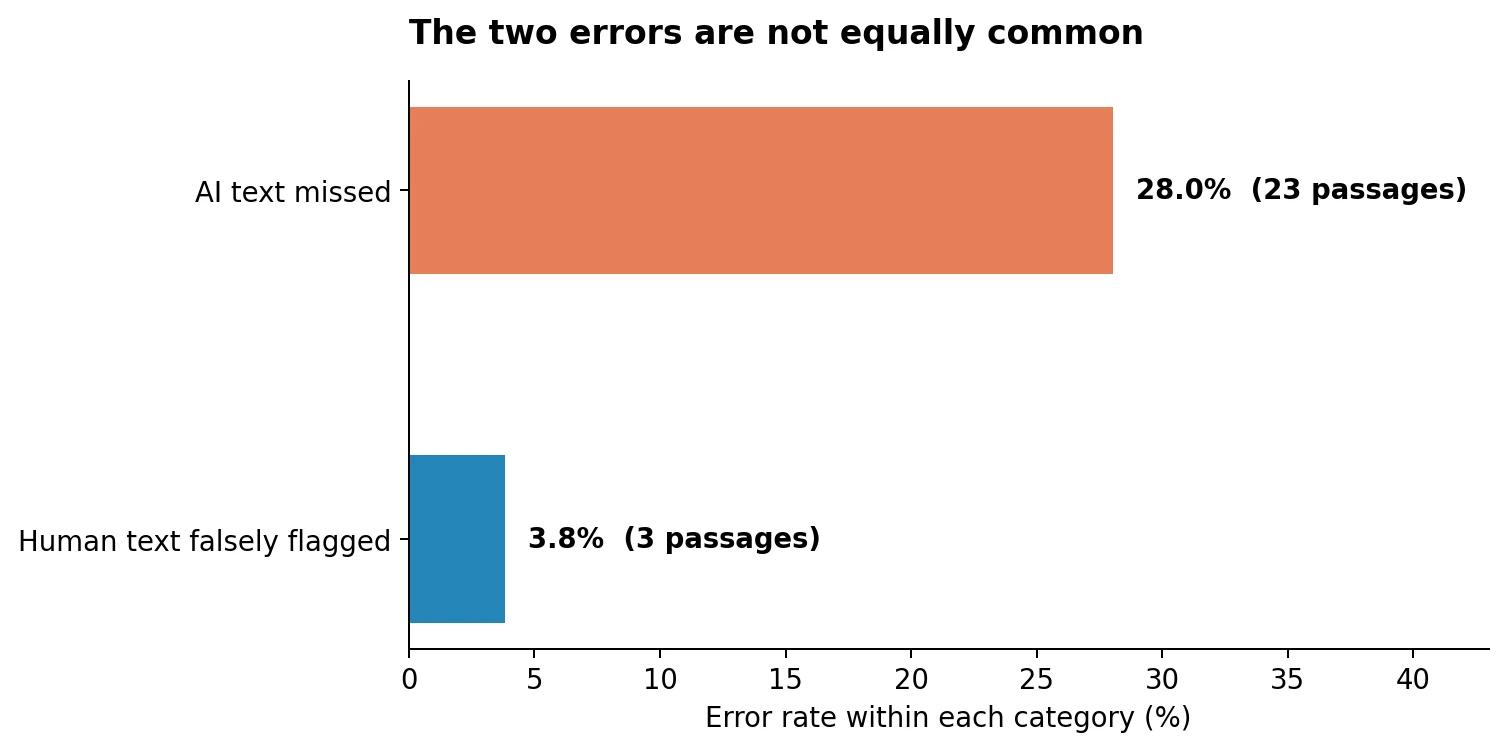
| AI passages wrongly marked human | 23 of 82 (28.05%) |
| Human passages wrongly marked AI | 3 of 78 (3.85%) |
Phrasly classified 134 passages correctly and 26 incorrectly. Its precision on AI verdicts was 95.16%: of the 62 passages it flagged as AI, 59 actually belonged to that group. That looks reassuring, but precision can change dramatically when AI writing is less common than it was in our nearly balanced test set.
Also Read: [STUDY] Can Phrasly AI Bypass Turnitin?
Why the Missed AI Passages Matter
The biggest weakness was the false negative rate. Phrasly labelled 23 AI-written passages as human-written. These were ordinary explanatory articles, not obscure technical fragments.
For example, an AI-written article about choosing car insurance scored just 20% AI. Another about submarine sonar scored 28%, and a passage about Nelson Mandela scored 27%. An AI-written article on ways to earn Ethereum received 33%. In the dataset, all four ended up in the human-verdict category.
That matters for teachers and students. A low AI score does not prove someone wrote the text themselves. It only means this detector found relatively little evidence that persuaded its scoring system.
Also Read: [STUDY] Can Phrasly AI Humanizer Outsmart Sapling? A Data-Driven Test
Does a 100% AI Score Mean Certainty?
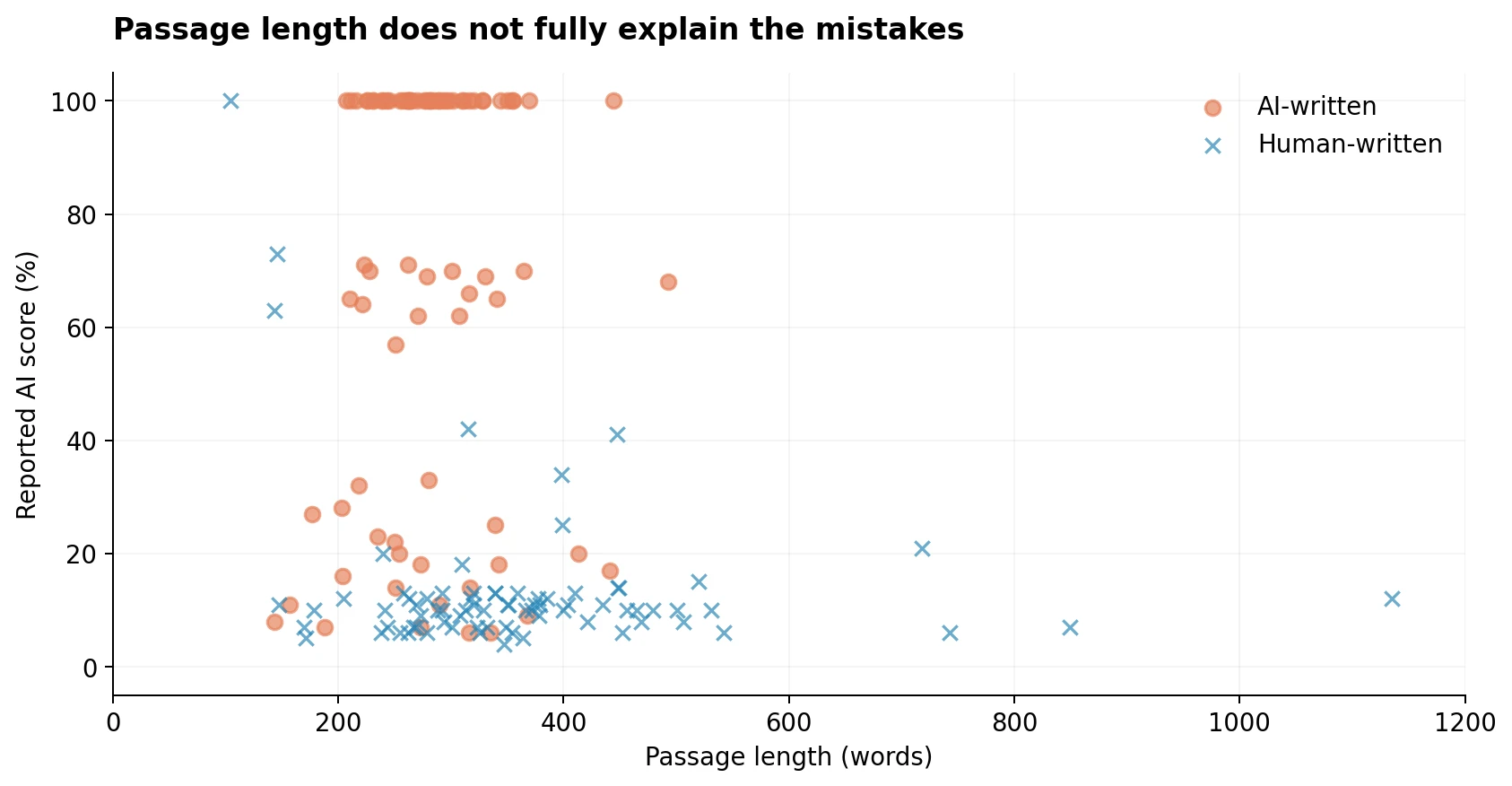
No. The scores were strongly clustered. Forty-four AI passages received a 100% AI score. But one human-written passage, about ideas for decorating a meditation room, also received 100% and was incorrectly labelled AI.
That case is a warning. A bold percentage can look like a scientific probability, but the data does not establish that a 100% score means a 100% chance of AI authorship. You should read it as a tool's output, not as proof.
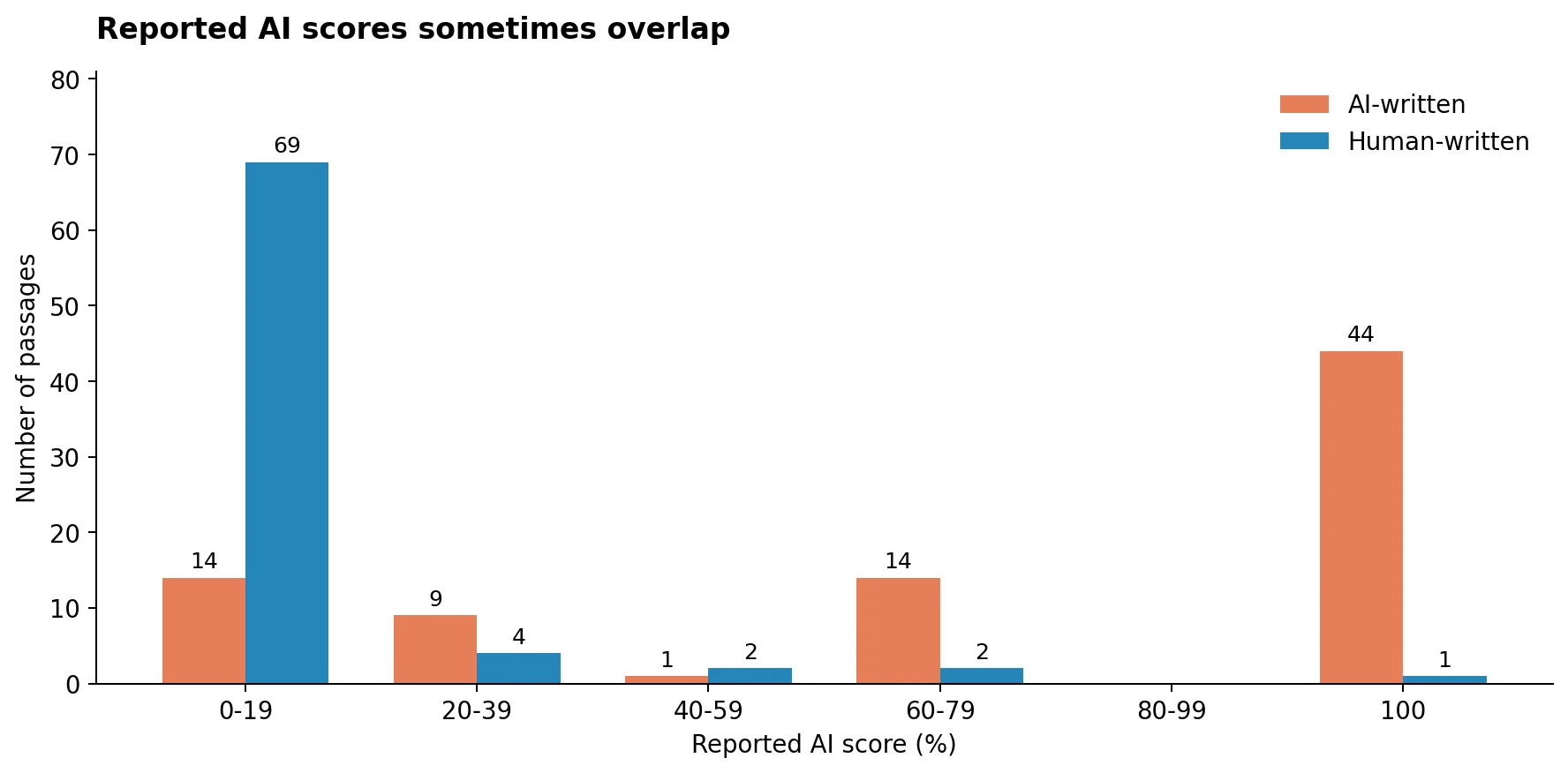
We also found 14 AI-written passages in the 0% to 19% score range. Those scores are similar to what Phrasly gave many human-written articles. This overlap makes detector scores poor proof of authorship.
What About False Accusations?
Phrasly performed better at recognizing human writing. It correctly identified 75 of 78 human-written samples, a 96.15% success rate. That is encouraging, but the three mistakes are still serious when the result could lead to a misconduct allegation.
Besides the meditation-room article, the detector incorrectly flagged human passages about generational differences at work and the benefits of bilingualism for children. Their scores were 73% and 63%, respectively. Neither proves cheating.
Does the Length of the Text Affect the Result?
We also compared passage length with the reported scores. The AI-written texts ranged from 143 to 493 words, while the human-written texts ranged from 104 to 1,135 words. Some incorrectly flagged human passages were short, but many short texts were classified correctly.
The plot does not show a simple length rule that explains Phrasly's mistakes. Subject matter, tone, phrasing, and the detector's own scoring process may play roles, but this dataset alone cannot tell us which factor caused any particular verdict.
Is Phrasly Good Enough for Students to Use?
It can be a quick check of how one detector reacts to your essay. But do not rewrite honest work just to chase a lower number, and do not assume a low score protects you from accusations elsewhere.
For students, the safer approach is to keep outlines, notes, references, and revision history. If a teacher questions a passage, those records explain your writing process much better than an AI score. For educators, a detector flag should start a conversation, not settle a disciplinary decision.
Our test also had limits. It included no separate category for heavily edited AI drafts, mixed human-AI writing, or work written under timed classroom conditions. The sample was relatively small and almost evenly split between human and AI text, unlike many real classrooms. Results could change on different assignments or newer models.
Final Verdict
Phrasly got 83.75% of our 160 samples right. It was especially good at recognizing human-written passages, but its 28.05% miss rate on AI text and three false accusations prevent us from recommending it as proof of authorship.
If you are a student, use Phrasly for curiosity or an extra perspective, not as a judge of whether your work is safe to submit. If you are a teacher, look at the writing process and the actual work before drawing conclusions. A detector can raise a question. It cannot reliably answer that question on its own.