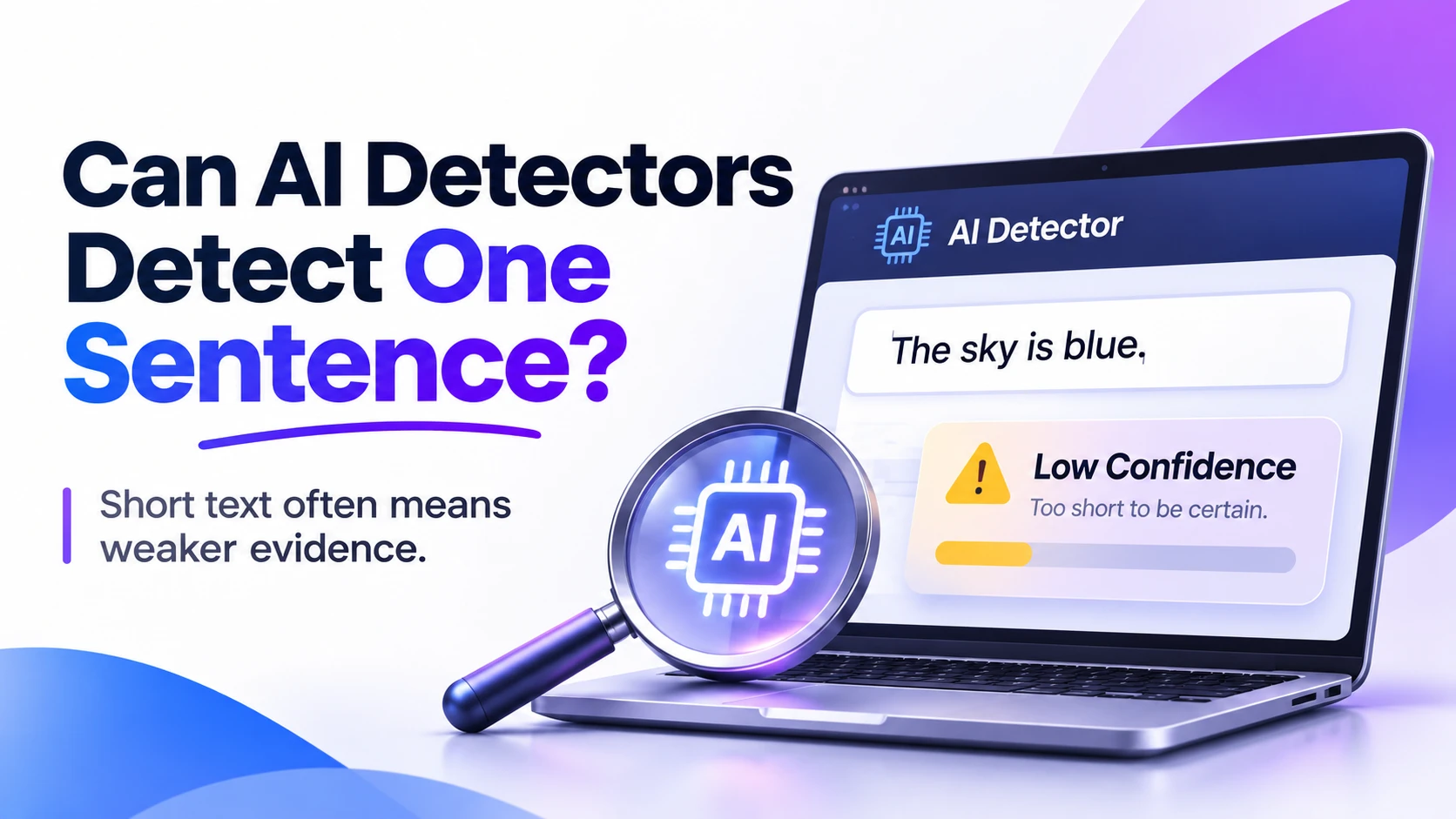

Yes, some AI detectors will let you check a single sentence. That does not mean the result is dependable.
The problem is simple: AI detectors need patterns. A full article gives them vocabulary choices, sentence rhythms, transitions, repetition, structure, and many other signals to examine. One short sentence gives them very little evidence. A perfectly ordinary sentence such as “The results suggest that further research is needed” could have been written by a student, a researcher, ChatGPT, or almost anyone else.
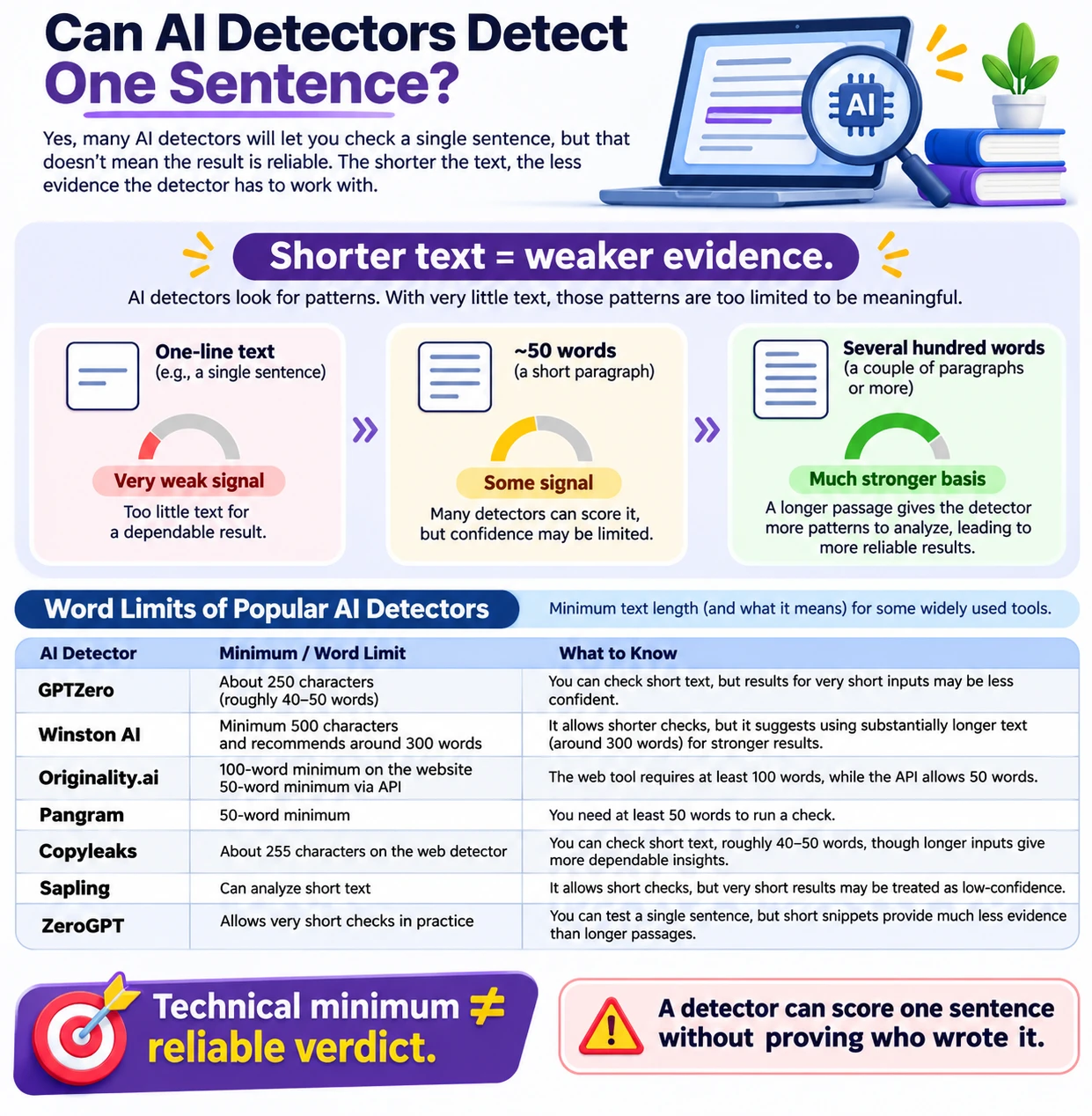
This is where people often make a mistake. They confuse the minimum amount of text a detector accepts with the amount of text needed for a useful result. Those are two very different things. A detector might technically accept 40 or 50 words while still being far less confident than it would be with several hundred words.
How Short Can Popular AI Detectors Actually Go?
Different detectors handle short text differently. Some enforce a hard minimum, while others will happily produce a score from a tiny sample even when that score should be treated cautiously.
| AI Detector | Minimum or Short-Text Rule | What It Means |
|---|---|---|
| GPTZero | About 250 characters, roughly 40–50 words | A long sentence might qualify, but more text gives the detector much more evidence. |
| Winston AI | 500 characters | Short samples can produce uncertain results. Longer passages are recommended. |
| Originality.ai | 100 words on the website; 50 words through the API | A normal one-sentence check usually will not meet the website minimum. |
| Pangram | About 50 words | The minimum exists because very short samples do not provide enough signal for reliable classification. |
| Copyleaks | About 255 characters on its web detector | Some long sentences qualify, but single-sentence classification is still weak evidence. |
| Sapling | Can analyze very short text | Very short results may be treated as low-confidence. |
| ZeroGPT | Allows very short checks in practice | You may receive a score, but short snippets provide far less evidence than longer passages. |
Free and paid plans usually change scan limits, document uploads, reporting features, and monthly usage. Paying for a detector does not magically solve the short-text problem. A premium detector still has to make a prediction from the words you provide. If you give it twelve words, there simply is not much information to work with.
Also Read: Best AI Detectors for Academic Writing: False Positives, Pricing, Limits and Real-World Problems
Why One Sentence Can Produce Strange AI Scores
An AI detector is not discovering who physically typed a sentence. It is estimating whether the language resembles patterns associated with AI-generated or human-written text.
That difference becomes important with short samples. In a 500-word article, one predictable phrase has limited influence on the overall result. In a 15-word sentence, that same phrase could represent most of the sample.
This is why short checks can produce both false positives and false negatives. A concise human sentence may look highly predictable and get flagged. An AI-generated sentence with unusual wording may pass as human. Run the same sentence through several detectors and you can sometimes receive completely different answers.
A confidence percentage does not solve the problem either. Seeing “92% AI” feels definitive, but the number is still an output produced from limited evidence. It should not be interpreted like a DNA test or proof that a particular person used ChatGPT.
Also Read: Why Do AI Detectors Have Different Results?
Why Are People Checking Individual Sentences?
One common situation is academic writing. A student scans an essay, sees one sentence highlighted, copies that sentence into another detector, and starts worrying when the second detector flags it as well.
The problem is that removing the sentence from its surrounding paragraphs removes context. Instead of getting a stronger second opinion, you may actually be giving the detector less useful information.
Job seekers do the same thing with résumé summaries, cover-letter lines, and application answers. Marketers test headlines. Freelancers check product descriptions. Employees check individual sentences from reports. Writers test introductions. Some people even paste email subject lines, Reddit comments, Instagram captions, or text messages into an AI detector after somebody says they “sound like AI.”
Most of those checks are not particularly useful.
Take a message such as “Sounds good, I’ll send it tomorrow morning.” Millions of people could naturally write that sentence, and an AI model could generate it just as easily. There is simply not enough linguistic information to make a serious authorship judgment.
The same applies to headlines and captions. “Five Ways to Improve Your Productivity” is predictable because headlines often follow predictable formats, not because it must have been generated by AI.
If somebody uses a detector result from a tiny sample as proof, the sensible response is not that AI detectors are always wrong. The stronger argument is that short-text classification is too weak to establish authorship on its own.
Also Read: Can AI Detectors Detect Filipino?
Do Not Humanize One Sentence and Assume the Problem Is Solved
Another increasingly common habit is taking one sentence highlighted by an AI detector, rewriting or “humanizing” it, checking the new sentence again, and then pasting it back into the original document once the detector labels it human.
That does not guarantee anything.
A detector scanning the full document evaluates patterns across the surrounding paragraphs too. A sentence that receives a human result in isolation may behave differently when inserted into several hundred words of text. The overall vocabulary, sentence structure, transitions, repetition, and writing style can all influence the document-level result.
This approach can also make the writing worse. Replacing individual flagged sentences turns editing into a game of whack-a-mole instead of improving the actual document.
If you are revising AI-assisted writing, work with a meaningful section. Rewrite the complete document when practical, or at least revise a couple of connected paragraphs together. Add your own reasoning, examples, qualifications, evidence, and natural transitions. Remove generic statements you would never normally make.
The goal should be coherent writing, not getting one isolated sentence to display a green label.
What About Text Messages, Captions and One-Line Posts?
Checking them is usually a waste of time.
A one-line WhatsApp message, LinkedIn comment, Instagram caption, email subject line, YouTube comment, or short social post contains very little authorship information. There is also rarely a meaningful reason to prove whether such casual text was AI-assisted.
If somebody runs your 12-word message through a detector and declares that it was AI-written, the result itself is not strong evidence. Short texts are precisely where classification becomes most fragile.
That does not mean every short-text result is automatically wrong. It means the result is too uncertain to support a serious conclusion by itself.
Can a Very Long Sentence Be Detected?
This is where the answer becomes more interesting.
A sentence can technically contain 50, 80, or even 150 words. At that point, several detectors may accept it because you have crossed their character or word minimums.
But the fact that the text contains only one period is not what matters. The important factor is how much linguistic evidence is available. A 70-word sentence gives a detector considerably more material than a 10-word sentence, even though both are technically “one sentence.”
So the better question is not simply, “Can AI detectors detect one sentence?” It is, “How much text does the detector actually have to analyze?”
When Is a Short AI Detector Check Worth Doing?
There is nothing wrong with experimenting. If you have a 60-word paragraph, product description, or unusually long sentence and a detector accepts it, you can look at the result as one signal.
Just do not turn that signal into certainty.
If the result matters academically or professionally, scan a larger section. Better yet, scan the complete document when possible. Pay attention to the quality and consistency of the actual writing rather than obsessing over individual highlighted sentences.
So, Can AI Detectors Detect One Sentence?
Some can score one sentence. That is not the same as reliably determining who wrote it.
GPTZero, ZeroGPT, Winston AI, Sapling, and some other tools can process relatively short samples under the right conditions. Detectors such as Originality.ai and Pangram impose larger minimums because extremely short text simply does not provide enough useful signal.
The rule worth remembering is simple: the shorter the text, the less weight you should give the result.
For essays, reports, articles, applications, and other serious writing, scan a substantial section or the complete document. For captions, subject lines, comments, headlines, and one-line messages, an AI detector usually does not have enough evidence to justify a confident accusation.
AI detectors can be useful screening tools. They are not authorship machines, and one short sentence rarely gives them enough information to act like one.