
If you are checking an essay, research paper, dissertation or thesis, the hardest part is not finding an AI detector. It is working out which detector is actually useful for academic writing.
A detector can look excellent on a vendor benchmark and still struggle with the exact kind of text students produce: formal paragraphs, technical terminology, repeated disciplinary phrases, literature reviews, abstracts and heavily edited prose. Long papers create another practical problem. A free checker that accepts 500 words at a time is not really a free dissertation checker if you have to split a 15,000-word paper into dozens of pieces.
For this comparison, I looked at current pricing and usage limits, vendor-published false-positive data, recent independent academic research, privacy and workflow features, and public complaints from students and educators on Reddit. I also separated detectors that are genuinely free from products that merely offer a trial.
One important rule shaped the shortlist: I did not recommend detectors whose own documentation explicitly says formulaic, predictable, rote or essay-like human writing is more likely to produce false positives. That matters because academic writing is often formal and standardized by design.
Short answer - Best Options
| Detector | Free access | Paid price / access | Useful limit for academic writing | Best reason to use it | Main caveat |
|---|---|---|---|---|---|
| Pangram | Yes, 2,000 words/day | $20/month Individual; 300,000 words/month | High monthly allowance; file upload and OCR | Best overall mix of recent academic evidence, interpretability and long-form capacity | Vendor benchmarks and independent studies use different model versions and datasets |
| Turnitin | No public student plan | Institutional licensing; public price not listed | 300 to 30,000 words of qualifying prose per submission | Most relevant when your university actually uses Turnitin | Students usually cannot buy direct access; score must not be treated as proof |
| GPTZero | Yes, 10,000 words/month; 10,000 characters/scan | Essential $14.99/month; 150,000 words/month | Paid scans up to 50,000 characters; Professional up to 150,000 | Strong reporting, authorship tools and current work on mixed/paraphrased AI | Character limits are easy to confuse with word limits |
| Winston AI | Trial only: 2,000 credits for 14 days | Essential $18/month; 100,000 credits/month | Paid plans list up to 200,000 characters per scan | Long scans, document/OCR support and published low vendor false-positive results | The free tier is a trial, not an ongoing free detector |
| Copyleaks | No strong ongoing free plan on current pricing page | $16.99/month Personal; 25,000 words | Multiple-file scanning; 30+ AI-detection languages | Multilingual work, integrations and sensitivity controls | Entry monthly quota is small for repeated dissertation scans |
| QuillBot | Yes, 1,200 words/scan, 6 scans/day | Premium removes detector word and daily scan limits | Good for sections; Premium is far better for long papers | Convenient free second opinion with explainers | Free tier becomes tedious for a long dissertation |
| Scribbr | Yes, unlimited checks, 1,200 words/submission | Premium AI check bundled with plagiarism check, roughly $19.95 to $39.95 | Premium scans up to 25,000 words | Useful no-sign-up free checker and academic-focused interface | Free version requires section-by-section checking |
| GPTInf | Yes, free and unlimited | Detector remains free; paid plans mainly expand rewriting tools | No advertised detector word cap; PDF and Word supported | Best genuinely free option for very long text | I found much less independent academic validation than for the top institutional tools |
| StealthWriter | Yes, 10 AI scans/day and 1,000 words/input on free account | Starter $20/month; 50 scans/day; 5,000 words/input | 5,000 words/input on paid plans | Useful if you already use the platform and want a built-in detector | Independent academic validation is limited |
| Undetectable AI | Yes, detector is free and no sign-up is required | Paid plans mainly apply to the humanizer | Public detector page does not give a dependable per-scan ceiling | Fast, frictionless cross-check | Less transparent long-document capacity and limited independent academic benchmarking |
The number most people misunderstand: false-positive rate
A false positive is human-written text classified as AI. For academic use, this is often the most important error because a false flag can trigger an uncomfortable conversation, an appeal or an academic-integrity investigation.
But a published false-positive rate is not a universal property of a detector. It depends on the model version, threshold, language, text length, discipline and dataset. A detector can post a tiny false-positive rate on one benchmark while missing a large amount of AI text on another. That is why “99% accurate” is not enough information.
| Detector | Published false-positive evidence | What it actually tells you |
|---|---|---|
| Pangram | Pangram reports about 0.009% on a large internal human-writing benchmark for its newer model. It separately reports very low rates for academic essays and scientific abstracts. | Impressive vendor result, reinforced by a 2026 academic study where all 40 human papers were correctly treated as human. Do not assume the internal rate transfers unchanged to every university discipline. |
| GPTZero | GPTZero 4o reports 1 false positive in 10,402 diverse student essays in the PERSUADE set. A separate Graphite benchmark cited by GPTZero produced a materially higher 1.36% FPR. | A good example of why the dataset matters. “The FPR” is not one fixed number. |
| Copyleaks | Copyleaks V11 reports 0.30% FPR in its default Balanced mode, 0.16% in Extra Safe and 0.66% in Extra Sensitive. | The user can trade false alarms against missed AI. Aggressive detection is not free: sensitivity changes the error profile. |
| Turnitin | Turnitin has historically reported a document-level FPR below 1% when at least 20% of a document is AI writing, with an older sentence-level figure around 4%. Scores from 1% to 19% are now hidden behind *% to reduce low-score false-positive harm. | Turnitin itself acknowledges that false positives exist. Its reporting design deliberately avoids pretending that small scores are precise. |
| Winston AI | Winston reports 0.03% FPR on its Curia evaluation and 0.50% on an older Luka evaluation. Its Luka category breakdown reported 100% human recognition for the tested essays/theses and medical papers. | Useful evidence, but primarily vendor-owned evaluation. It should not be treated as the same thing as a university-controlled benchmark. |
| QuillBot | A 2026 GPTZero bypasser benchmark reported 0.63% FPR for the tested QuillBot version. Scribbr’s comparative test produced zero false positives on its five human samples. | The evidence is encouraging but the human sample in the Scribbr comparison is tiny, and the GPTZero result comes from a competitor’s benchmark. |
| Scribbr | Scribbr’s own comparative test produced zero false positives on five human samples; its premium detector reached 84% overall accuracy in that test. | Helpful as a practical comparison, but five human samples are far too few to estimate a real academic false-positive rate. |
| GPTInf, StealthWriter, Undetectable AI | No equally strong, current, academic-paper false-positive benchmark was found for all three during this review. | Use them as secondary checks rather than treating a clean result as stronger evidence than a documented writing history. |
The most revealing recent academic test
A 2026 higher-education study tested Pangram, Turnitin, Copyleaks and GPTZero on 160 academic papers: 40 fully human, 40 fully AI-generated, 40 hybrid, and 40 AI-generated papers that had been “humanized.” The human papers were written by ESL graduate students before ChatGPT existed, which makes the human set particularly useful.
All four tools correctly treated all 40 human papers as human in that dataset. The surprise came on the AI papers. Pangram detected almost all of the fully AI, hybrid and humanized papers under the study’s inclusive scoring. The other three tools were much weaker on the particular AI texts used in that experiment.
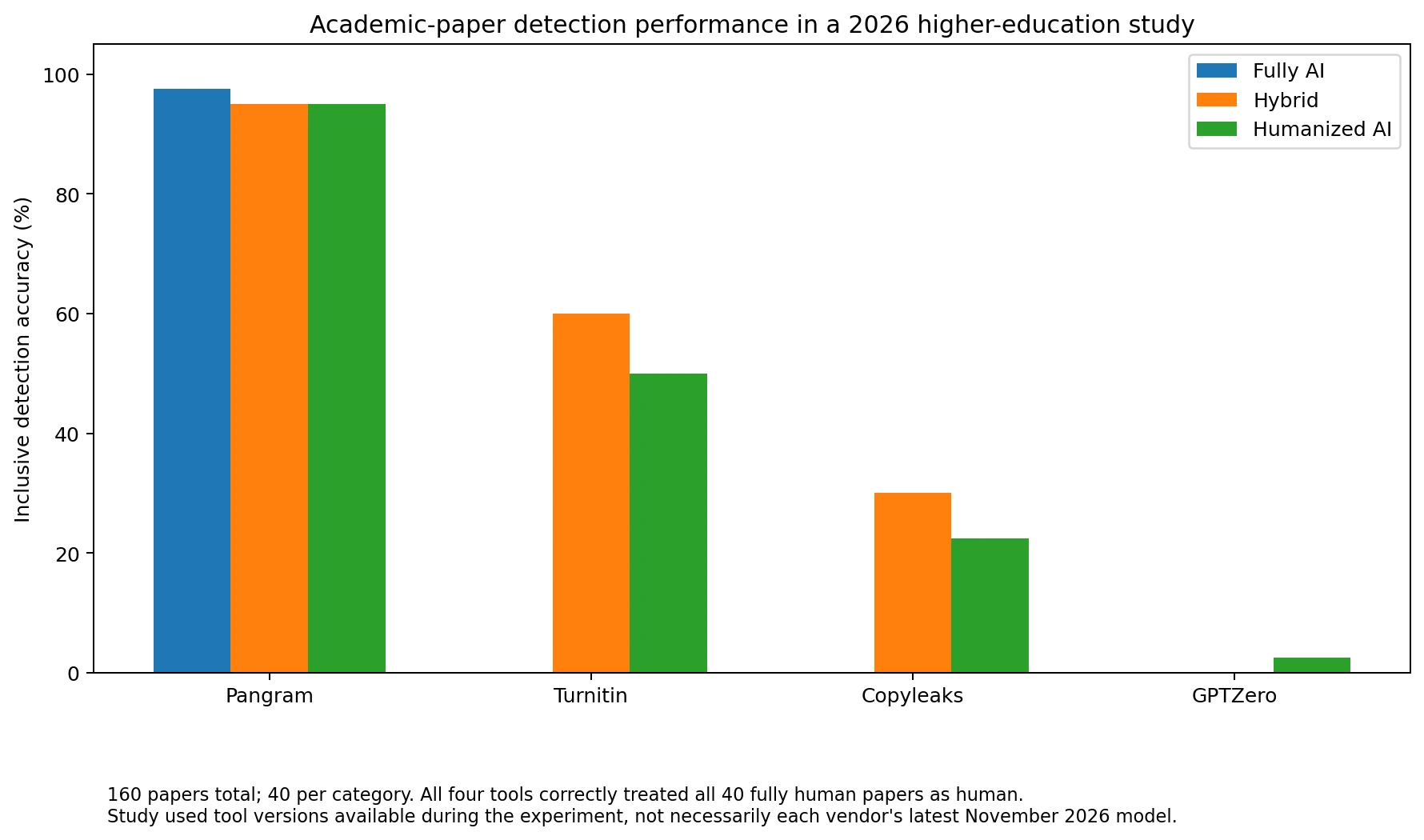
Chart based on the 2026 higher-education study of 160 academic papers. These results are a snapshot of the tool versions and models tested in that experiment, not a permanent ranking.
1. Pangram
Pangram currently has the best combination of three things that matter here: a useful free plan, enough capacity for long academic work, and unusually relevant independent academic evidence.
The free plan gives you 2,000 words per day with no payment method, plus file uploads, OCR, interpretability features, Google Docs integration and detection in more than 20 languages. The $20 Individual plan raises the allowance to 300,000 words per month. That is enough to scan a 20,000-word dissertation repeatedly without worrying about a tiny monthly quota.
The strongest reason to put Pangram first is not its marketing claim. It is the 2026 academic-paper study discussed above, where an earlier Pangram version performed exceptionally well on AI, hybrid and humanized papers while producing no false positives on the 40 human papers.
Pangram also publishes detailed internal false-positive testing instead of only saying “99% accurate.” Its newer model reports a 0.009% observed false-positive rate across a very large human-writing benchmark. That number is still vendor data, so it should not be mixed casually with independent studies, but the transparency is useful.
Best for: students, researchers and educators who want one detector for both short essays and long papers.
2. Turnitin: the most relevant detector when your university uses it
Turnitin is different from every consumer checker on this list because the practical question is often not “Is Turnitin the best?” It is “Is Turnitin the system my institution will actually see?”
Students generally cannot purchase the AI writing detector as a normal personal subscription. It is licensed to institutions. Eligible AI reports require 300 to 30,000 words of long-form prose, files under 100 MB, and supported file types such as DOCX, PDF, TXT and RTF. Turnitin currently supports several major languages including English, Spanish, Japanese, Arabic, German, Dutch and Turkish.
One of Turnitin’s better design decisions is suppressing exact AI percentages from 1% to 19%. Instead of displaying a precise-looking low number, it shows *%. Turnitin made that change specifically because false positives are more problematic in the low-score range.
The Reddit side of the story is less comfortable. Students repeatedly describe being asked to defend papers after a high AI score, while some educators describe testing older or known-human writing and seeing unexpected flags. Those posts do not establish Turnitin’s real false-positive rate, but they expose the operational risk: a probabilistic score becomes much more dangerous when an instructor treats it as a verdict instead of a prompt for review.
Best for: institutions already using it, and students trying to understand the system their university actually uses.
3. GPTZero: excellent reporting, but do not confuse characters with words
GPTZero’s free plan is genuinely ongoing: 10,000 words per month. The catch is the per-scan limit, which is 10,000 characters, not 10,000 words. For a long essay, that difference matters.
The Essential plan is currently $14.99 per month, includes 150,000 words per month and raises the per-scan ceiling to 50,000 characters. Premium is $23.99 per month with 300,000 words per month, while Professional reaches 500,000 words per month and 150,000 characters per scan.
GPTZero is particularly interesting for academic use because it has moved beyond a single AI percentage. Its Advanced Scan highlights sentences, it has an AI-paraphrasing signal, and its Authorship tools can capture how a document was written. If a student is falsely flagged, revision history and writing-process evidence are often more persuasive than arguing over whether a detector should have said 18% or 28%.
The evidence is mixed in a useful way. The October 2026 GPTZero 4o release reports only one false positive in 10,402 diverse student essays on the PERSUADE set. Yet a separate benchmark cited by GPTZero showed a 1.36% FPR, and the earlier-version detector performed poorly on the AI set in the 2026 academic-paper study. That is not a contradiction so much as a lesson in dataset and version dependence.
Best for: people who want detailed explanations and writing-process evidence rather than a bare score.
4. Winston AI: strong long-document capacity, but the “free plan” is really a trial
Winston is easy to misclassify as a free detector. Its $0 tier gives 2,000 credits for 14 days. That is a trial, not a permanent free allowance.
The Essential plan costs $18 per month and includes 100,000 credits per month. Paid plans advertise up to 200,000 characters per scan, plus document scanning, OCR, shareable PDF reports and AI image detection. Winston also publishes a 0.03% false-positive result for its Curia evaluation and an older 0.50% result for the Luka model.
The Luka breakdown is relevant to this article because essays and theses in its verified-human set were reportedly identified as human 100% of the time. Still, these are Winston’s published evaluations. They are useful evidence, not a substitute for independent testing on the type of papers you actually care about.
Best for: researchers and educators who need large scans, OCR and report generation and do not mind paying.
5. Copyleaks: powerful multilingual features, but watch the quota and sensitivity setting
Copyleaks costs $16.99 per month on its Personal monthly plan and includes 100 unified credits, equivalent to up to 25,000 scanned words or 100 images. Annual billing is much more generous overall: $13.99 per month billed annually with up to 300,000 words across the year.
Features include AI detection in more than 30 languages, multi-file upload, browser extensions, a Google Docs add-on and combined AI/plagiarism workflows. For multilingual departments, that is a serious advantage.
Copyleaks also publishes something most comparisons ignore: its sensitivity settings change the error trade-off. V11 reports 0.16% false positives in Extra Safe mode, 0.30% in Balanced and 0.66% in Extra Sensitive. The more aggressive mode is designed to catch humanized or spun AI text, but the reported false-positive rate rises with it.
Reddit complaints often center on human writing being classified as AI, particularly older writing or text translated into English. Again, those are anecdotes, not a measured error rate. But they are exactly the sort of edge cases universities should test internally before adopting a single threshold for everyone.
Best for: multilingual environments and users who need AI plus plagiarism detection in one workflow.
6. QuillBot: one of the easiest free cross-checks
QuillBot gives free users up to 1,200 words per scan and six detector scans per day. That is 7,200 words of theoretical daily checking if you use the full limit each time. Premium removes both the detector word limit and daily scan limit.
The free detector is convenient because it provides category-level feedback and explainers instead of only a number. Scribbr’s 2026 comparison gave QuillBot 78% overall accuracy and no false positives on its five human samples. Five human texts are not enough to establish a trustworthy false-positive rate, but the result is useful as a small comparative test.
For a 2,000-word essay, QuillBot is easy. For a 20,000-word dissertation, the free tier means repeated splitting, rescanning and keeping track of sections. The paid version is much more sensible for long academic work.
Best for: students wanting a quick free second opinion on individual sections.
7. Scribbr: genuinely free checking with a clear 1,200-word ceiling
Scribbr’s free detector allows unlimited free checks, requires no sign-up and accepts up to 1,200 words per submission. It also says it does not store or share the submitted text. For students who want to check a few sections without creating an account, that is a clean proposition.
The premium AI detector is bundled with Scribbr’s plagiarism-checking workflow. Scribbr currently describes premium checks in the roughly $19.95 to $39.95 range depending on the plagiarism-check package, and its help documentation says the AI detector can scan up to 25,000 words.
Scribbr’s own 2026 comparison placed its premium detector first at 84% overall accuracy, with no false positives among five human samples. Because Scribbr is evaluating its own product, and because the human sample is small, treat that as product research rather than neutral proof.
Best for: no-sign-up free checks and one-off academic papers where a plagiarism check is also useful.
8. GPTInf: the most interesting truly free long-form option
GPTInf is better known as a humanizer, but its detector is unusually generous. The company advertises the AI detector as free and unlimited, with no registration, no paywall and no word limit. It accepts PDF and Word files and returns sentence-level labels such as AI, Mixed and Human.
This is exactly the kind of product that deserves attention when you are checking a dissertation and do not want to pay just because your document is long. The limitation is evidence. I did not find the same depth of independent academic benchmarking that exists for Pangram, Turnitin, GPTZero or Copyleaks.
That makes GPTInf useful as a second opinion, especially for long documents, but not the detector I would use alone for a high-stakes authorship decision.
Best for: free long-document screening.
9. StealthWriter: a useful free detector bundled into a humanizer platform
StealthWriter is another example of a humanizer company providing detection as a free feature. Its current free account includes 10 AI scans per day and up to 1,000 words per input. The $20 Starter plan raises that to 50 scans per day and 5,000 words per input.
That is better than a tiny demo, so I count it as genuinely free ongoing access. The public no-login detector can be more restrictive, while the account-based free tier is the useful one.
Reddit discussion around StealthWriter tends to focus more on the humanizer than the detector. Users complain that rewrites can alter grammar, punctuation or scientific phrasing, and that “humanized” output can still be flagged by other detectors. That is a good reminder not to treat a humanizer’s own detector as proof that another institution’s detector will agree.
Best for: users already in the StealthWriter ecosystem who want a free built-in check.
10. Undetectable AI: free and frictionless, but less transparent for long papers
Undetectable AI’s detector is free and requires no sign-up. Its paid plans primarily apply to the humanizer, which starts at $9.99 month-to-month or an advertised $5 per month equivalent on annual billing for 10,000 humanizer words.
The detector is easy to access and the company publishes testing that presents strong performance. The problem for this particular use case is that the public detector page does not give a clear, stable per-scan word ceiling for long academic documents, and the independent academic evidence is not as strong as it is for the top few tools.
Use it as a quick comparison point, not as the sole authority on a thesis.
What Reddit complaints reveal that benchmark tables do not
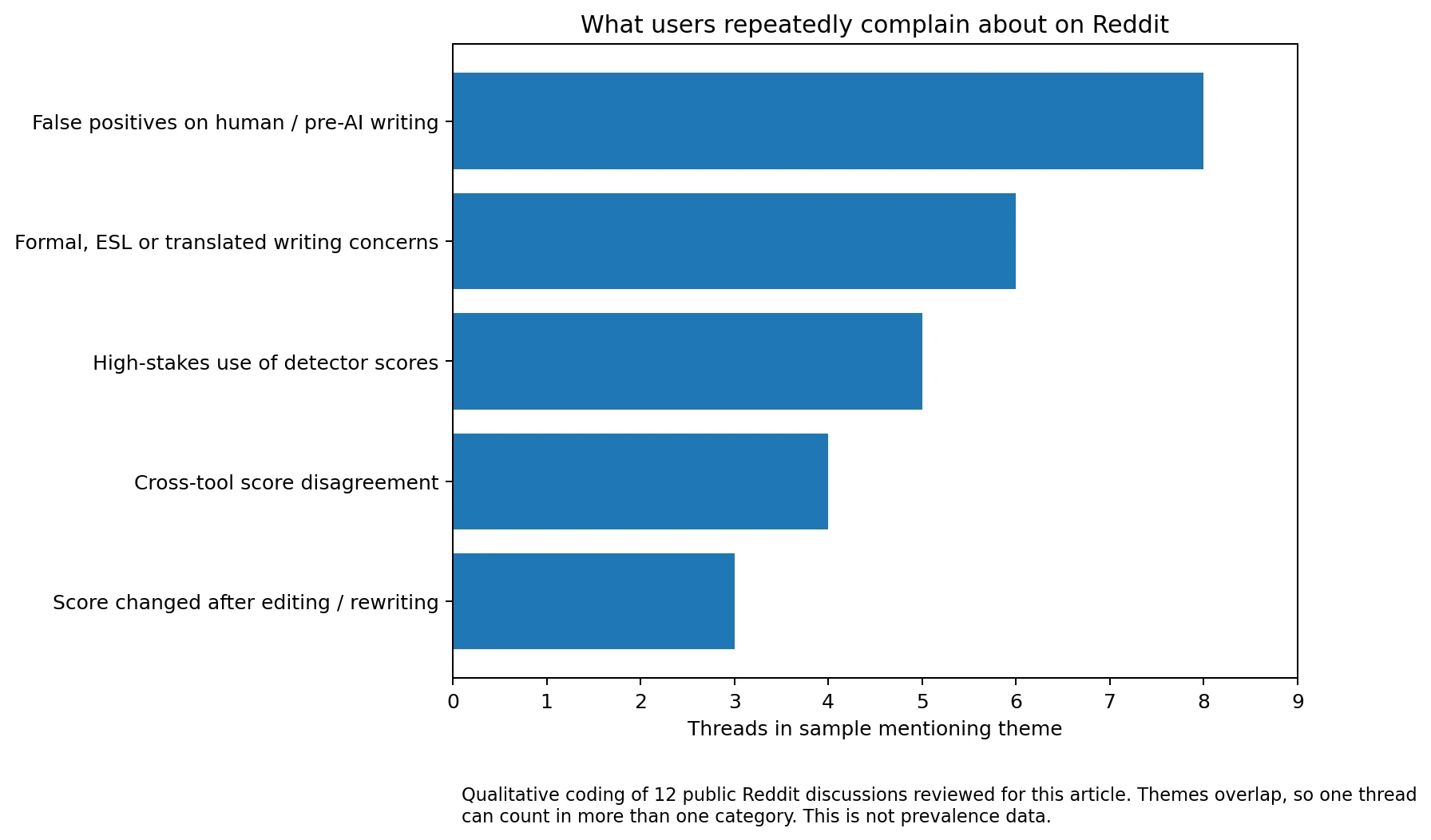
I reviewed a small qualitative sample of 12 public Reddit discussions from students, teachers, professors and writers. This is not scientific prevalence data. People with bad experiences are more likely to post, and some communities contain promotional accounts. Still, the discussions are useful for spotting recurring failure modes that formal benchmark tables rarely capture.
1. The same paper can receive wildly different scores
Several users ran one document through multiple detectors and received results ranging from essentially human to overwhelmingly AI. One 2026 poster reported a self-written paper receiving 22% AI in Turnitin, 68% AI probability in GPTZero, and a Copyleaks result suggesting only 31% human. Another ran a revised paper through roughly 20 tools and reported scores ranging from 0% to 100% AI.
The lesson is not that the highest or lowest score is correct. The lesson is that these tools use different models, thresholds and definitions. A 40% result from one detector is not interchangeable with 40% from another.
2. Formal and second-language writing comes up repeatedly
Professors and students repeatedly describe concerns about clear, standardized, academic prose being treated as suspicious. Reddit anecdotes include old pre-ChatGPT articles, legal writing, PubMed-style abstracts and work written by non-native English speakers. A recent systematic review of academic AI detection reaches a similar broader conclusion: abstracts, literature reviews and examination responses can be vulnerable because concise, formal and standardized structure can overlap with features detectors associate with AI.
This is exactly why this guide excludes tools that explicitly warn that essay-like, rote, predictable or highly structured human writing is more likely to trigger false positives.
3. Editing and translation can change scores
Students report scores moving after grammar correction, paraphrasing or translation. That is not surprising. Detectors analyze the text that exists after editing, not the history of how it was produced. If an editing tool makes sentences more uniform, predictable or polished, a detector may react to the changed statistical pattern even when the underlying ideas are human.
4. The most damaging problem is institutional misuse
The worst Reddit stories are not really about a detector being wrong. They are about a detector score being treated as enough evidence to accuse a student. The better practice is the opposite: use the score to decide what to review, then look at drafts, version history, citations, notes, source files, supervisor feedback and whether the student can explain the work.
Why Sapling and Originality.ai are not in the academic shortlist
Sapling: Sapling’s own detector documentation says false positives are more likely when text is shorter, more general and more essay-like. Its API documentation also acknowledges that human-written but rote text can be misclassified as AI. Those are exactly the conditions that make me uncomfortable recommending it specifically for academic prose, even though its API and long-text capabilities are otherwise useful.
Originality.ai: Originality’s own help material acknowledges that highly structured or predictable human writing can receive a high AI score. Academic writing often rewards structure, conventional transitions and formulaic sections. Originality has strong detection research in other contexts, but it does not fit the screening rule used for this academic-only list.
Free detector or “free trial”? They are not the same thing
| Tool | Free status | What you actually get |
|---|---|---|
| Pangram | Truly free ongoing | 2,000 words/day plus file/OCR and interpretability features |
| GPTZero | Truly free ongoing | 10,000 words/month, but only 10,000 characters per scan |
| QuillBot | Truly free ongoing | 1,200 words/scan, 6 scans/day |
| Scribbr | Truly free ongoing | Unlimited checks, 1,200 words/submission, no sign-up |
| GPTInf | Truly free ongoing | Advertised unlimited detector with no word limit |
| StealthWriter | Truly free ongoing | Free account: 10 scans/day, 1,000 words/input |
| Undetectable AI | Truly free ongoing | No-sign-up detector; public long-document ceiling is unclear |
| Winston AI | Trial | 2,000 credits for 14 days |
| Copyleaks | Paid for practical ongoing use | Personal plan starts at $16.99/month on monthly billing |
| Turnitin | Institutional access | No ordinary public student subscription |
Long papers change the value equation
Price alone is a poor comparison for a 1,000-word essay. For a thesis, monthly throughput matters. Among entry paid plans that publish directly comparable monthly word allowances, Pangram offers substantially more scanning volume per dollar than GPTZero Essential or Copyleaks Personal.
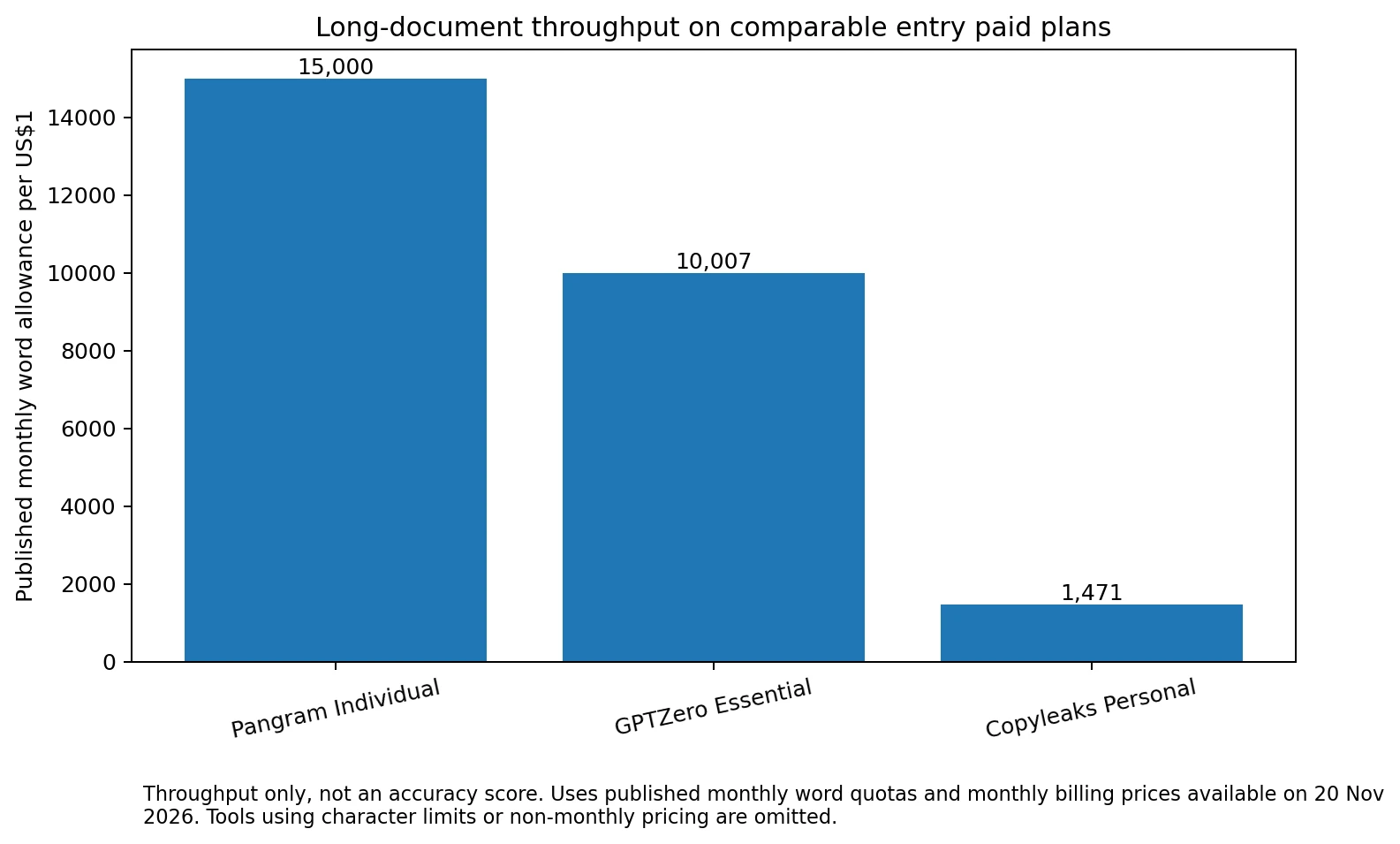
Do not read that chart as an accuracy ranking. A cheaper million words is useless if the detector performs poorly on your kind of text. It simply shows why a student checking a 30,000-word thesis should look at quotas, not just subscription price.
How I would check an academic paper in practice
For a normal essay, start with one strong detector rather than running the text through ten sites and panicking over the highest score. Pangram is my first choice from this research. If your institution uses Turnitin, remember that no public checker can promise the same score Turnitin will produce.
For a long dissertation, use a service that can handle large coherent sections. Avoid chopping the paper into tiny paragraphs because detectors generally have less signal on short text. If you use a free tool with a 1,200-word cap, split by logical sections rather than arbitrary character counts.
If a passage is flagged, do not immediately rewrite it to “beat” the detector. That can create a bizarre loop in which authentic academic prose becomes less precise just to satisfy a probabilistic classifier. Instead, review whether the section is unusually generic, whether an AI writing tool actually influenced it, whether citations are correct, and whether you have drafts or revision history that document authorship.
If the stakes are high, compare a second detector, but treat disagreement as evidence that the classification is uncertain. Do not average percentages from different tools. Their scores are not calibrated to a common scale.
The biggest mistake: using detection as proof of authorship
The strongest conclusion from the research is not that AI detectors are useless. Several are substantially better than the crude detectors available in 2023. Current systems can provide useful signals, particularly on long, unedited AI text.
The problem is what happens after the score appears.
A detector can tell you that a passage statistically resembles writing in its AI training class. It cannot reconstruct who sat at the keyboard, which ideas came from the student, whether a sentence was manually rewritten, or whether a language editor changed the rhythm of a paragraph. Recent research on more than 135,000 pairs of non-native academic manuscripts and professionally edited versions found enormous variation in false-positive behavior across 13 detectors, with editing style itself acting as a confounding factor.
That is why the best evidence of authorship is often not another detector. It is the writing process: outlines, notes, drafts, source annotations, document history, tracked changes, supervisor comments and the writer’s ability to explain the argument and sources.
Final recommendations
Best overall for academic writing: Pangram. It combines a useful free tier, high long-form capacity, interpretability and the strongest recent independent academic-paper result I found.
Best if your university already uses it: Turnitin. It is institutionally relevant and has sensible safeguards such as hiding low AI percentages, but students should not treat the result as an infallible verdict.
Best for detailed reports and authorship evidence: GPTZero. Its newer model has much stronger student-writing benchmark data than older versions, and its writing-history tools are arguably more useful in disputes than a percentage alone.
Best genuinely free option for large text: GPTInf. The unlimited detector is unusually generous, although its academic validation is thinner.
Best free no-sign-up checker for smaller sections: Scribbr. Unlimited free checks with a 1,200-word submission limit make it easy to use, while premium can handle much larger documents.
Best multilingual institutional alternative: Copyleaks. Its language coverage and sensitivity controls are excellent, but the monthly Personal quota is restrictive for repeated long-paper checking.
Whichever detector you choose, the safest interpretation is the same: an AI score is a screening signal, not a confession, fingerprint or authorship certificate.
How this comparison was researched
This article was checked against current vendor pricing, product documentation and help-center pages available on November 20, 2026. False-positive claims were kept separate by evidence type: vendor benchmarks, independent academic studies and user anecdotes were not treated as interchangeable. The academic comparison draws particularly on a 2026 higher-education experiment involving 160 papers and a 2026 systematic review of 90 studies. The Reddit section is a qualitative review of 12 public discussions and is included to identify recurring user problems, not to estimate statistical prevalence.