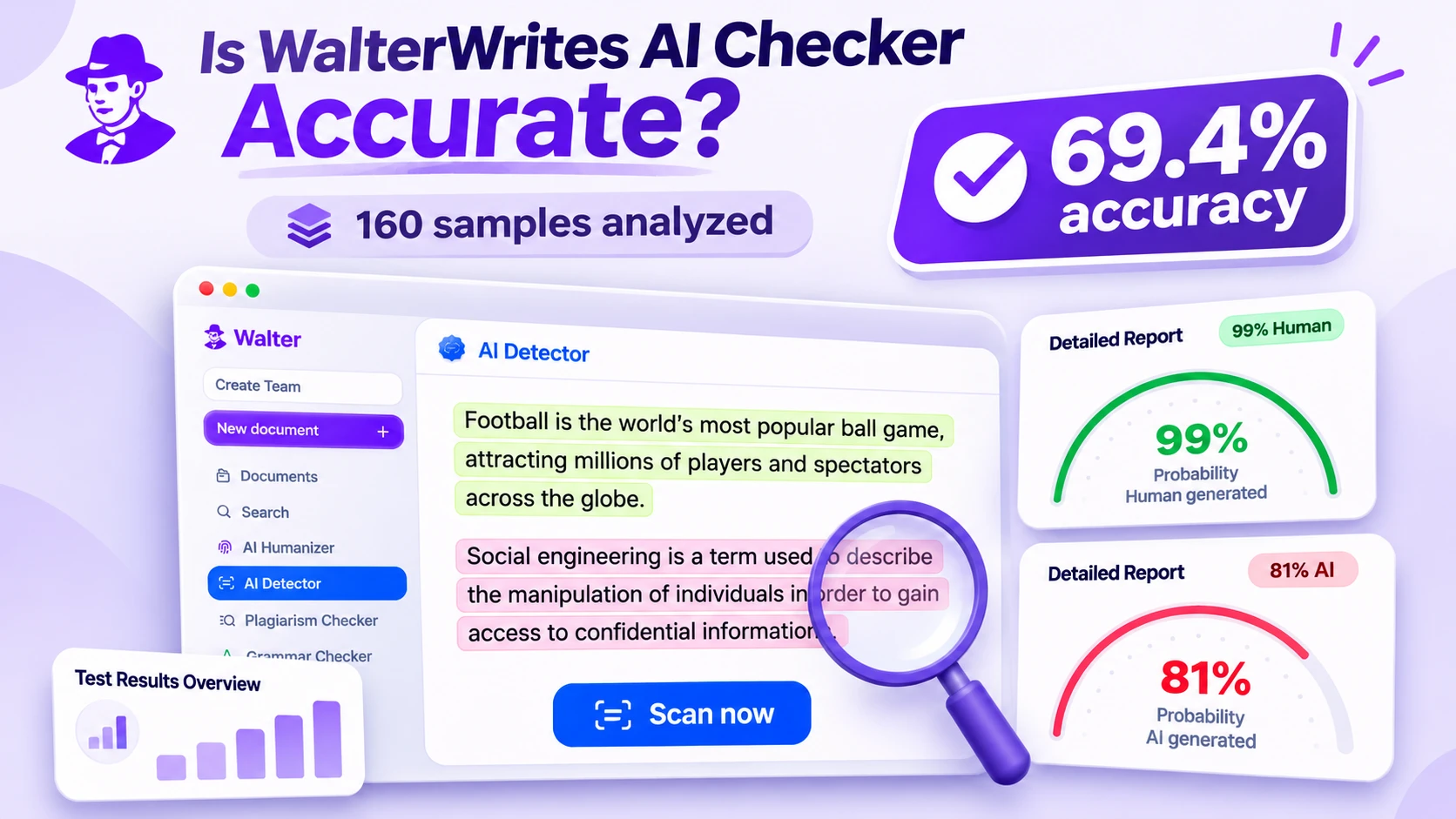

WalterWrites promises to tell you whether a piece of writing was produced by a person or by AI. Its results look convincing: a percentage, a colored gauge, and highlighted sentences. But can you trust that percentage before submitting an assignment?
We tested the WalterWrites AI checker using 160 texts with known authorship labels. Some were written by humans, while others were generated by AI. We recorded the detector's verdict and its AI score for each sample. The results were mixed, and students should pay particular attention to how often the checker missed AI-written content.
How We Tested WalterWrites
Our dataset contained 82 AI-written texts and 78 human-written texts. The passages covered topics including science, technology, literature, health, and everyday advice. We compared the known label for each text with WalterWrites' answer. These results assume the authorship labels in our dataset are correct; we did not independently verify each text. We treated an AI verdict as a positive detection and a Human verdict as a negative one.
The AI score runs from 0 to 100. A higher score indicates that WalterWrites considers the passage more likely to be AI-generated. In our results, scores of 50 or more received an AI verdict, while lower scores received a Human verdict.
Also Read: [HOT] Is Pangram The Best AI Detector?
WalterWrites AI Detector Accuracy: The Results
| Measure | Result |
|---|---|
| Total texts tested | 160 |
| Correct classifications | 111 |
| Overall accuracy | 69.4% |
| AI texts correctly detected | 39 of 82 (47.6%) |
| AI texts incorrectly called human | 43 of 82 (52.4%) |
| Human texts correctly recognized | 72 of 78 (92.3%) |
| Human texts incorrectly called AI | 6 of 78 (7.7%) |
WalterWrites got about seven out of ten answers right overall. That sounds reasonable until you separate the two types of writing. It correctly identified most human-written passages, but it failed to catch more than half of the AI-written passages.
In fact, WalterWrites labeled 115 of the 160 submissions as Human, even though only 78 actually belonged in that category. It was much more willing to clear a text than to flag it.
Also Read: Is Originality AI Similar to GPTInf? A Data-Based Comparison
How Often Does WalterWrites Miss AI-Written Text?
This was the detector's biggest weakness. Of the 82 AI-written samples, 43 received a Human verdict. That is a 52.4% miss rate. In other words, more than one in two AI-written passages slipped through this test.
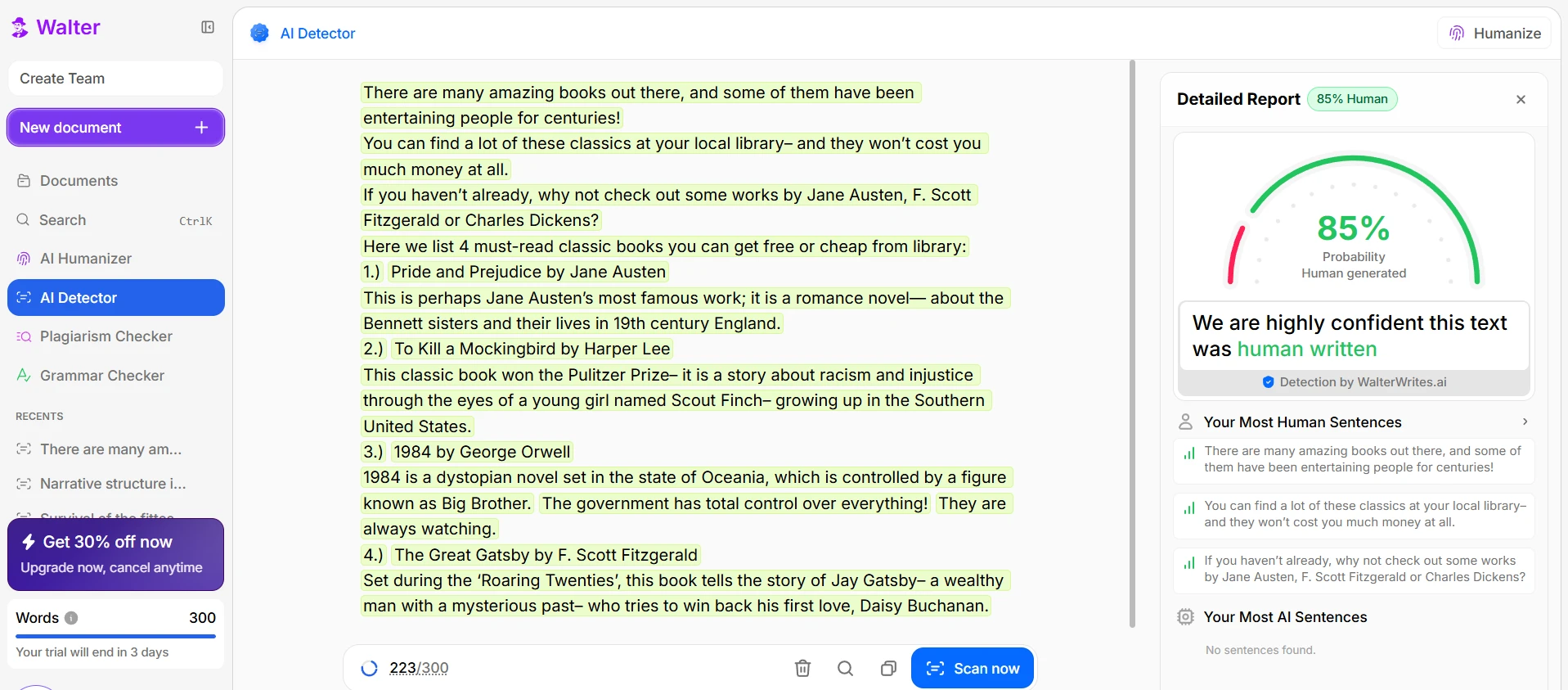
Some of those mistakes came with surprisingly confident scores. An AI-generated passage recommending classic books received a score of just 15% AI. WalterWrites presented it as 85% human and described it as human-written.
It was not an isolated case. Among the AI-written samples, 38 scored 20% AI or lower. Four scored 10% AI or lower, including two that scored just 1%. A low AI score therefore did not reliably establish human authorship in our experiment.
Across all 115 passages marked Human, 43 were actually AI-written. That means 37.4% of the checker’s reassuring Human verdicts were wrong in this particular dataset.
Also Read: Why Is AI Writing So Recognizable?
Does WalterWrites Correctly Identify Human Writing?
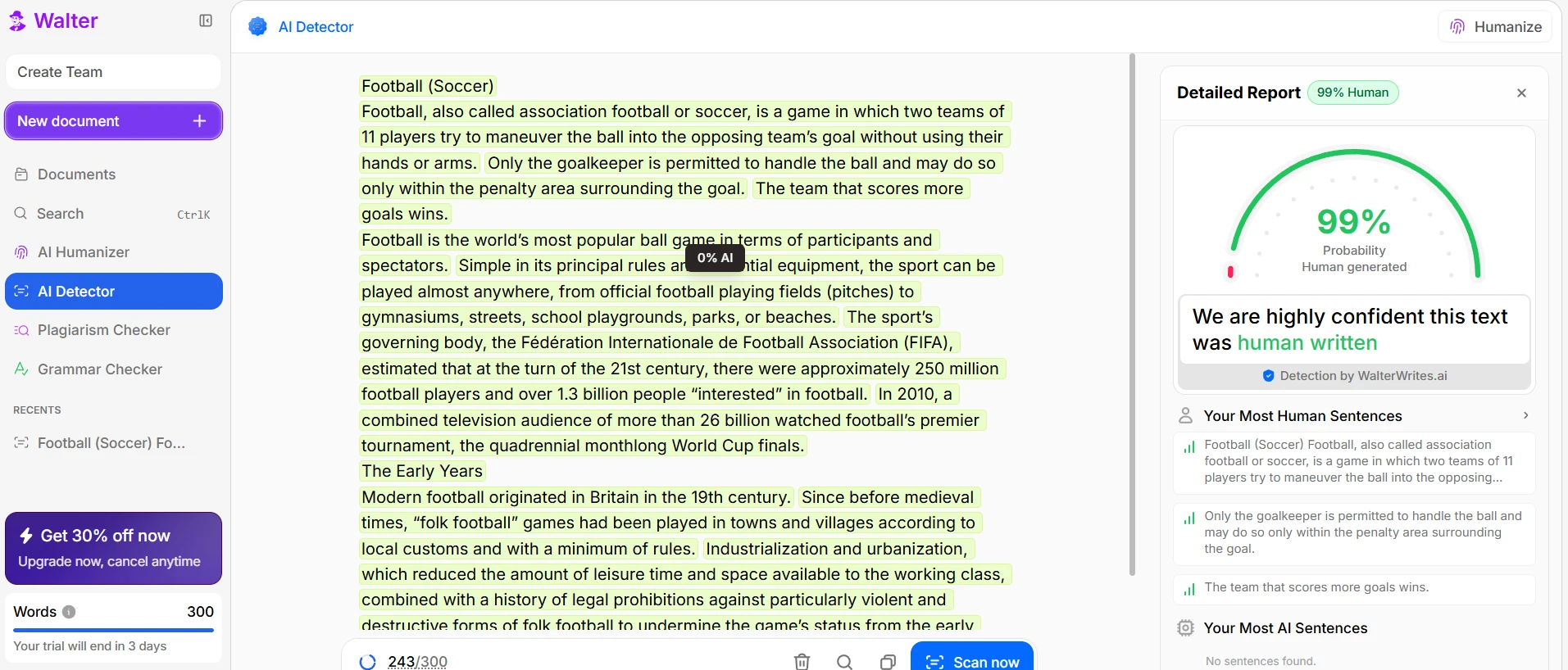
It performed considerably better here. Of the 78 human-written texts, 72 received the correct Human verdict. A football article, for example, received a 99% Human rating.
Still, six genuine human texts were incorrectly labeled AI. These included passages about climate change, stargazing, martial arts, relationships, architecture, and pre-workout meals. The pre-workout meals article received a 99% AI score despite its human label in our dataset.
For students, those six errors matter. A false positive can make someone doubt their own writing or feel pressured to rewrite perfectly legitimate work. A detector's confidence display should never replace evidence about how a document was actually written.
What About High AI Scores?
WalterWrites was more convincing when it did flag a passage. Of the 45 texts it labeled AI, 39 were genuinely AI-written. That works out to 86.7% precision in our test. The other six were human-written.
One AI-generated explanation of natural selection received a 99% AI rating. A passage about social engineering received 81% AI, while a discussion of narrative structure received 74% AI. In these examples, the detector made the correct call.
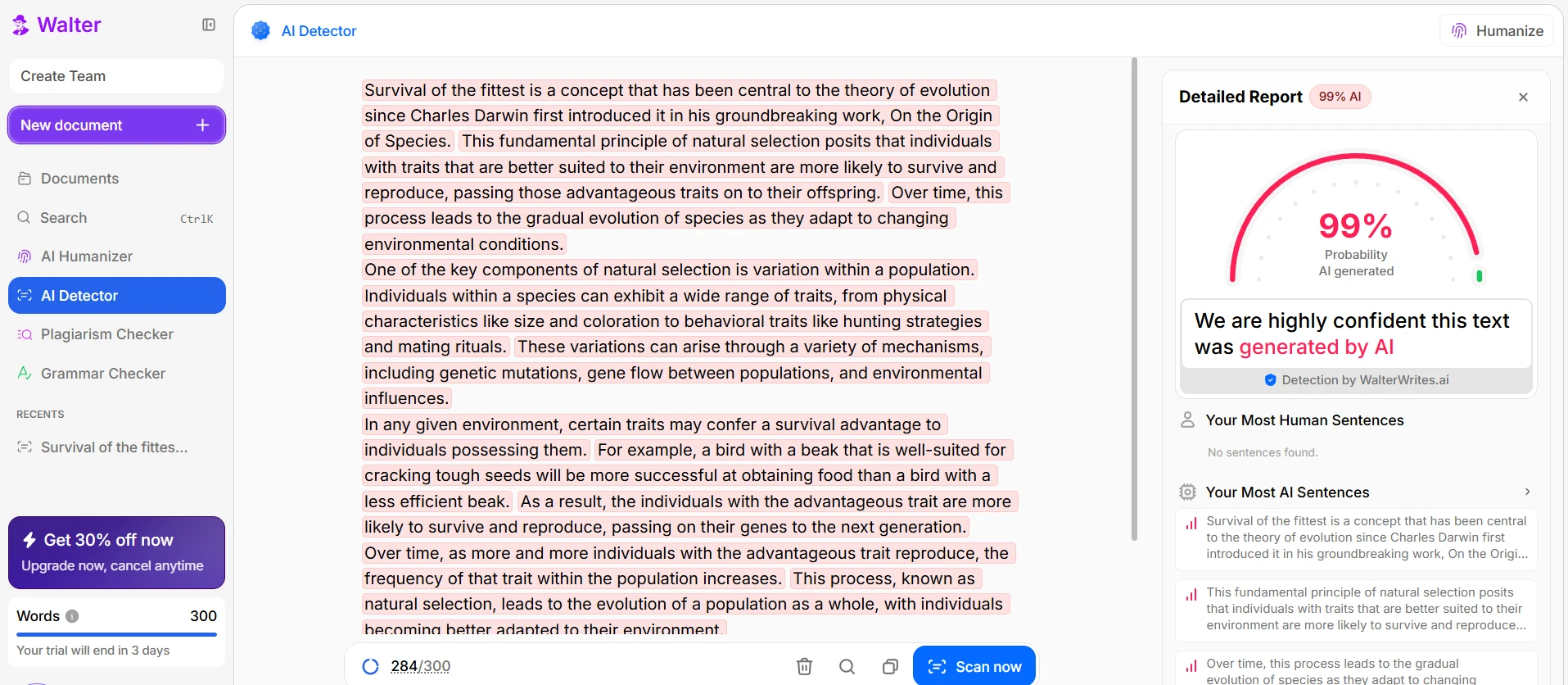
However, a 99% AI rating should not be read as proof of authorship. The number is the tool's confidence-style output, not an independently verified probability that the writing came from AI. Our sample also contained a human-written passage with the same 99% AI score.
Can Students Rely on WalterWrites Before Submitting Assignments?
Not as a final check. If WalterWrites calls your essay Human, that does not guarantee another detector will agree. If it calls your essay AI, that does not prove you used an AI tool. We did not compare WalterWrites with Turnitin or any university system, so these results cannot tell you whether their scores will match.
There is another limitation worth mentioning. The screenshots show a 300-word trial limit, while some source texts in our dataset are longer. That means some checks may have involved excerpts rather than complete documents. Our passages also came from different topics and writing styles, not a random sample of student assignments. The findings describe this dataset, not a guaranteed accuracy rate for every essay.
If you write your assignments yourself, keep your outlines, notes, references, and version history. Those records are more useful for explaining your writing process than repeatedly submitting the same paragraph to detectors until one gives you a pleasing score.
Final Verdict: Is WalterWrites AI Checker Good?
WalterWrites showed some ability to distinguish human and AI writing, especially when recognizing human texts. But 69.4% overall accuracy and a 52.4% miss rate on AI-generated passages are not strong enough to justify treating it as a dependable judge of authorship.
For students, the sensible approach is to treat WalterWrites as an optional second opinion, not a certificate that your work is safe or suspicious. Its polished report can make the answer look definitive. Our test shows that the answer often isn't.