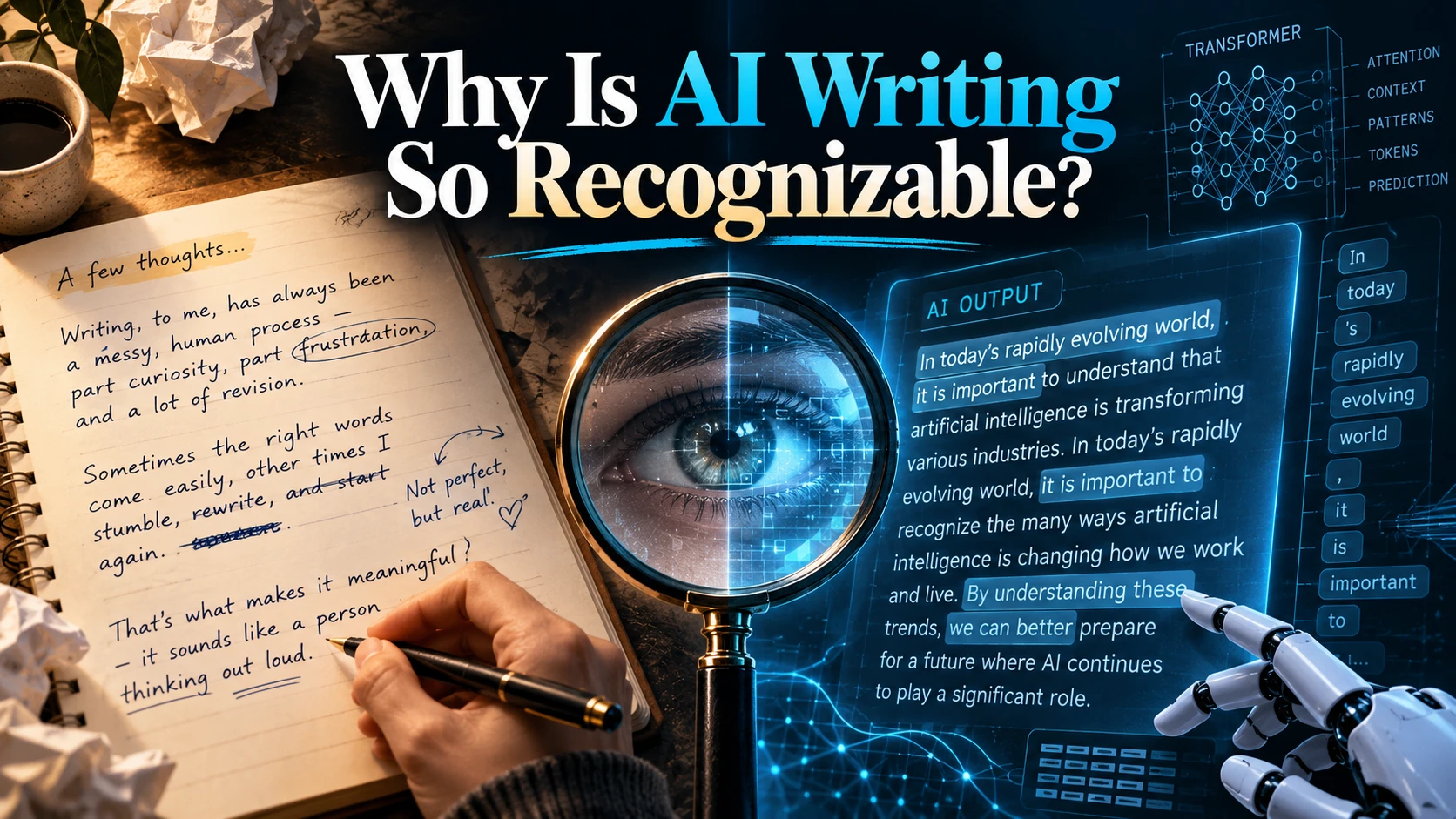

You can sometimes tell where a paragraph is going before you have finished reading it. The sentences are tidy. The ideas arrive in a sensible order. Every point gets a neat explanation, and the last line sounds like the end of a school presentation.
It could have been written by a person. But it also sounds a lot like ChatGPT.
That familiarity is strange when you think about it. Modern language models can write in hundreds of styles, translate poetry, explain physics and draft believable conversations. Why, then, do so many of their answers seem to have the same voice?
The answer is partly in how these models make sentences, partly in how they are trained to behave, and partly in the way we use them. Research also suggests that this familiar voice is not inevitable. Models can learn much more distinctive styles, although getting there is harder than telling a chatbot to “write like a human.”
How does an LLM actually write?
Most popular text-generating large language models are autoregressive. They produce text in a sequence, choosing one token after another. A token might be a whole word, part of a word, punctuation or a space attached to another piece of text.
Give a model the opening “I left my keys on the” and it estimates which tokens would make sense next. “Table” might be likely. “Roof” might be less likely. “Moon” is possible as a piece of language, but it would be an unusual choice in an ordinary story. Once the model selects a token, that token becomes part of the context for the next prediction. The process repeats until the response is complete.
This is what people mean by next-token prediction. It does not mean the model has only memorized what word follows another word. Modern models consider a much wider context and learn complex patterns involving facts, arguments, tone, grammar and narrative structure. The Transformer architecture, introduced in 2017, made it practical to learn many of these relationships using attention: a mechanism that lets the model weigh different parts of the text when building its next prediction.
Training gives the model a remarkable map of what written language tends to look like. But that map is not the same as a personal history. A person can write about a terrible bus ride because they were actually there, remember the smell of wet seats and still feel annoyed about the conductor. A model needs those details supplied to it, or it must invent something that fits the story.
Also Read: Is the Dead Internet Theory True?
The model does not always pick the most likely word
The next step matters too: decoding. A model can repeatedly choose its highest-probability option, or it can sample from a range of plausible options. Settings such as temperature and top-p affect how that choice is made.
When generation follows the safest possibilities too closely, the writing can become repetitive and bland. In The Curious Case of Neural Text Degeneration, Ari Holtzman and colleagues explored that problem and proposed nucleus sampling, a method that samples from a changing set of plausible next tokens rather than always selecting the single most likely one.
Turning up randomness is not a cure, though. It can introduce surprising word choices, but surprise by itself is not personality. An awkward metaphor or an unexpected adjective does not make a paragraph sound like something a particular person would have written.
Also Read: Do Em Dashes Mean AI Wrote It?
So why does the writing sound the same?
1. Models repeatedly reach for familiar wording
Some phrases are convenient ways to move between ideas: “It's worth noting,” “On the other hand,” “This highlights,” “A key aspect.” They make a paragraph easy to follow. They also become conspicuous when you read them all day.
Research has found measurable shifts in the vocabulary of published writing since widely available chatbots arrived. In a 2025 study of biomedical writing, researchers used changes in the frequency of certain stylistic words to estimate the influence of LLM assistance across large collections of abstracts. The method looked at population-wide patterns, not at proving that any individual paragraph was generated by AI.
A separate investigation, Why Does ChatGPT “Delve” So Much?, examined the overrepresentation of particular words. It is a useful warning against an easy explanation: not every overused term can simply be blamed on the model architecture or on a single part of training.
And none of these words belongs to AI. People used them long before chatbots. What catches the eye is their frequency and their company: the same transitions, the same phrasing, the same manner of presenting an argument.
Also Read: What Is AI Residue? Definition, Examples, and Why It's Spreading
2. The structure is often more predictable than the vocabulary
Ask a general chatbot for a discussion of almost any subject and you are likely to get a familiar shape: an opening definition, several balanced points, a few cautions, then a conclusion that repeats the central idea.
There is nothing wrong with that structure. It is useful for explaining something quickly. The trouble begins when the structure turns up even where it does not belong: in a personal story, an angry complaint, a reflective essay or a casual reply between friends.
Human writers have habits too, but their habits differ. One person jumps straight into an example. Another circles around the topic. Someone else makes a sharp claim and spends the next two paragraphs defending it. A general-purpose chatbot is usually trying to produce an answer that will satisfy many readers at once. It has little reason to make those idiosyncratic choices unless the prompt asks for them.
Also Read: Ways to Spot AI Writing in Classrooms
3. Training rewards a particular kind of helpfulness
Pretraining teaches a model from large amounts of text. After that, many chatbots go through instruction tuning and preference-based training, using human judgments or related feedback to become more helpful and responsive. The InstructGPT research is an influential early account of this approach.
These methods make chatbots easier to use. They can also encourage recurring habits: explain rather than imply, qualify bold claims, organize complex answers, avoid sounding needlessly rude and cover several sides of a question. Not every product is trained in exactly the same way, and researchers are still investigating how different training stages affect vocabulary. But it makes sense that systems rewarded for broadly acceptable answers often settle into broadly acceptable prose.
There is a difference between good customer support and good memoir writing. A single default voice cannot do both equally well.
4. Fluency can hide a lack of detail
Consider two descriptions of a failed job interview:
“The interview was a valuable learning experience that helped me identify areas for future growth.”
“I had rehearsed database questions all night. They asked me about a race condition instead. I stared at the whiteboard for so long that the interviewer eventually gave me a hint.”
Both could be written by a human or generated by AI. But the second passage has an actual event inside it. The first says something socially safe about disappointment without showing what happened.
This is not proof that models cannot write vivid details. They can. The more relevant problem is that a broad prompt usually leaves them with nothing specific to work from. The model fills the gap with plausible language. Plausible language, repeated thousands of times, starts to feel interchangeable.
Can people really recognize AI writing?
Sometimes, yes. Reliably, in every case? No.
Recognizing a familiar chatbot manner is different from establishing authorship. A reader might correctly notice stock transitions and overly balanced paragraphs. They might also accuse a careful student, a non-native English speaker or a professional technical writer of using AI because those writers happen to favor clear, conventional phrasing.
Automatic detectors have a similar problem, although they operate differently. Some examine how predictable the tokens are to another language model. Others learn statistical patterns from examples of human and machine text. Tools such as GLTR and DetectGPT helped establish approaches based on language-model probabilities.
The results depend heavily on what is being tested. In Automatic Detection of Generated Text Is Easiest When Humans Are Fooled, Daphne Ippolito and colleagues found that decoding choices could affect human judgments and automated detection in different ways. Later work, including Can AI-Generated Text Be Reliably Detected?, showed serious weaknesses in detection under practical changes to text.
Fairness matters here. In GPT Detectors Are Biased Against Non-Native English Writers, researchers found that some detectors disproportionately labeled writing by non-native English speakers as AI-generated. A polished paragraph, an unusual word choice or an AI-detector percentage is not a reliable record of who wrote something.
Would a different type of AI sound less like a chatbot?
Possibly. But changing the machinery alone is unlikely to solve the whole problem. A writing system has two separate jobs: deciding what to say and deciding how to say it. Different approaches can help with one or both.
Retrieval-grounded writing
Retrieval-augmented generation, often called RAG, gives a language model access to relevant documents, interviews, notes or other material while it writes. A piece about a local festival could then include a real vendor's description of the crowd or exact details from a reporter's notebook instead of generic remarks about community spirit.
Retrieval does not remove the model's preferred sentence patterns. It makes the material less generic because the model has something concrete to discuss. That is often a bigger improvement than changing a few adjectives.
Style-transfer and editing models
Some AI systems are built to revise existing text rather than invent an entire draft. Text style transfer tries to preserve meaning while changing attributes such as formality, voice or an author's recognizable habits. Research including Reformulating Unsupervised Style Transfer as Paraphrase Generation shows how models can separate content from at least some aspects of style.
An editor model has an advantage when there is a strong human draft to begin with: it can work around real choices already made by the writer. But a rewrite can also wash those choices away. An editing pass is not automatically more human-sounding than fresh generation.
Multimodal AI
A multimodal model can work from images, audio or video alongside text. Systems described in the Flamingo research and the BLIP-2 paper illustrate ways that language generation can be grounded in visual information.
For a travel diary, a photograph of a broken suitcase or an audio recording from a railway platform gives the model details that a bare instruction lacks. Still, many multimodal systems eventually generate their sentences through a language model. Better observations do not guarantee a distinctive voice.
Diffusion and other non-autoregressive language models
Not every language model has to build a sentence strictly from left to right. Masked diffusion models, for instance, can begin with incomplete text and repeatedly revise multiple positions. Research on Large Language Diffusion Models explores such an alternative.
That difference may offer new ways to plan and revise text. There is not yet strong evidence that merely replacing next-token generation with diffusion reliably makes writing indistinguishable from an individual's prose. These models also learn from text, and training choices can still produce shared stylistic habits.
Can a fine-tuned LLM write like a particular person?
This is where the research gets especially interesting. A model trained for everyone has to spread its attention across countless possible voices. Fine-tuning changes its parameters using a narrower collection of examples. Instead of treating one person's writing as a brief instruction, the system repeatedly learns from that person's actual choices.
Those choices go well beyond vocabulary. They include sentence length, favorite constructions, punctuation, humor, level of detail, ways of disagreeing, and what the author tends to leave unsaid.
What studies have found
The 2024 StyleTunedLM study used LoRA, a parameter-efficient fine-tuning method, to adapt language models to target styles. The researchers reported stronger reproduction of lexical and syntactic features than with instruction prompts and short example-based prompts in their evaluated settings. Their data experiments also showed that having more representative examples made a substantial difference. Style learning was weaker with small fractions of an approximately 80,000-token source collection than with most or all of that collection.
That sounds promising, but the findings do not mean a handful of someone's messages can create a convincing copy of their voice.
A large 2025 evaluation called Catch Me If You Can? Not Yet examined writing-style imitation across more than 400 real authors and over 40,000 generations. The researchers found that LLMs could approximate some structured kinds of writing, such as news or email, while struggling with less explicit, more personal styles found in blogs and forums. A model might copy visible mannerisms and still miss the way someone actually thinks through a subject.
A 2026 preregistered study of 81 writers examined what happened when people edited AI drafts to sound more like themselves. Human editing increased similarity to the participants' unassisted writing, yet the edited texts remained more stylistically uniform and more LLM-like than writing produced without that initial AI draft. That suggests something familiar to anyone who has heavily revised a chatbot response: you can improve it without always removing the influence of the first version.
There is also evidence for stronger imitation when the training material is unusually rich. A 2026 version of a preprint on models fine-tuned using authors' complete literary works reported much stronger judgments of stylistic fidelity than ordinary prompting. It is an intriguing result, not a universal guarantee. A complete literary body of work gives a system far more material than the emails and social posts available for most people, and the work's preprint status calls for caution.
What would good imitation actually require?
It helps to distinguish three tasks. Copying surface mannerisms is the easiest. Matching a writer's style across new topics is harder. Reproducing the writer's judgments, memories and sense of what matters is harder still.
A useful test should not just ask readers whether an imitation “sounds right.” It should also check authorship-attribution results, measurable writing habits, meaning preservation and how well the style holds up on topics that were absent from training. Otherwise, a model might simply memorize repeated phrases or learn the subject matter of an author's old writing.
There are practical limits too. Training examples need to be consistent enough to represent a voice, yet varied enough to cover different situations. Personal messages may contain private information or belong to someone who never agreed to have their writing used for imitation. Consent and data handling matter as much as model quality, especially when the goal is to mimic a living person.
What actually makes AI-assisted writing feel less generic?
The research points toward a less glamorous answer than a magic model setting: start with material worth saying.
Give a model the real interview question, the sentence from a notebook, the odd exchange with a friend, the observation that changed your mind. Let it help sort those details. Then decide which ones belong, which arguments deserve more room, and where the piece should stop.
That does not require every sentence to be rough or every paragraph to be unpredictable. Real people write cleanly. They use transitions. They repeat themselves. Some even sound exactly like a chatbot's default style. Natural writing is not defined by deliberate mistakes.
What makes a voice recognizable as someone's is its pattern of decisions. A person notices certain things and ignores others. They get impatient at particular moments. They know what can be left unexplained. They may choose an ugly but accurate sentence over a graceful one that says too little.
Fine-tuning, better source material and careful editing can help machines reproduce parts of that behavior. The strongest evidence suggests that individual style can be learned to a meaningful degree. It also shows that imitation remains uneven, especially when the writer's character lives in subtle choices rather than conspicuous phrases.
Perhaps that is why so much AI writing is recognizable. It is not necessarily bad writing. It is writing that has become good at sounding acceptable to almost anybody, and therefore sounds a little less like somebody in particular.