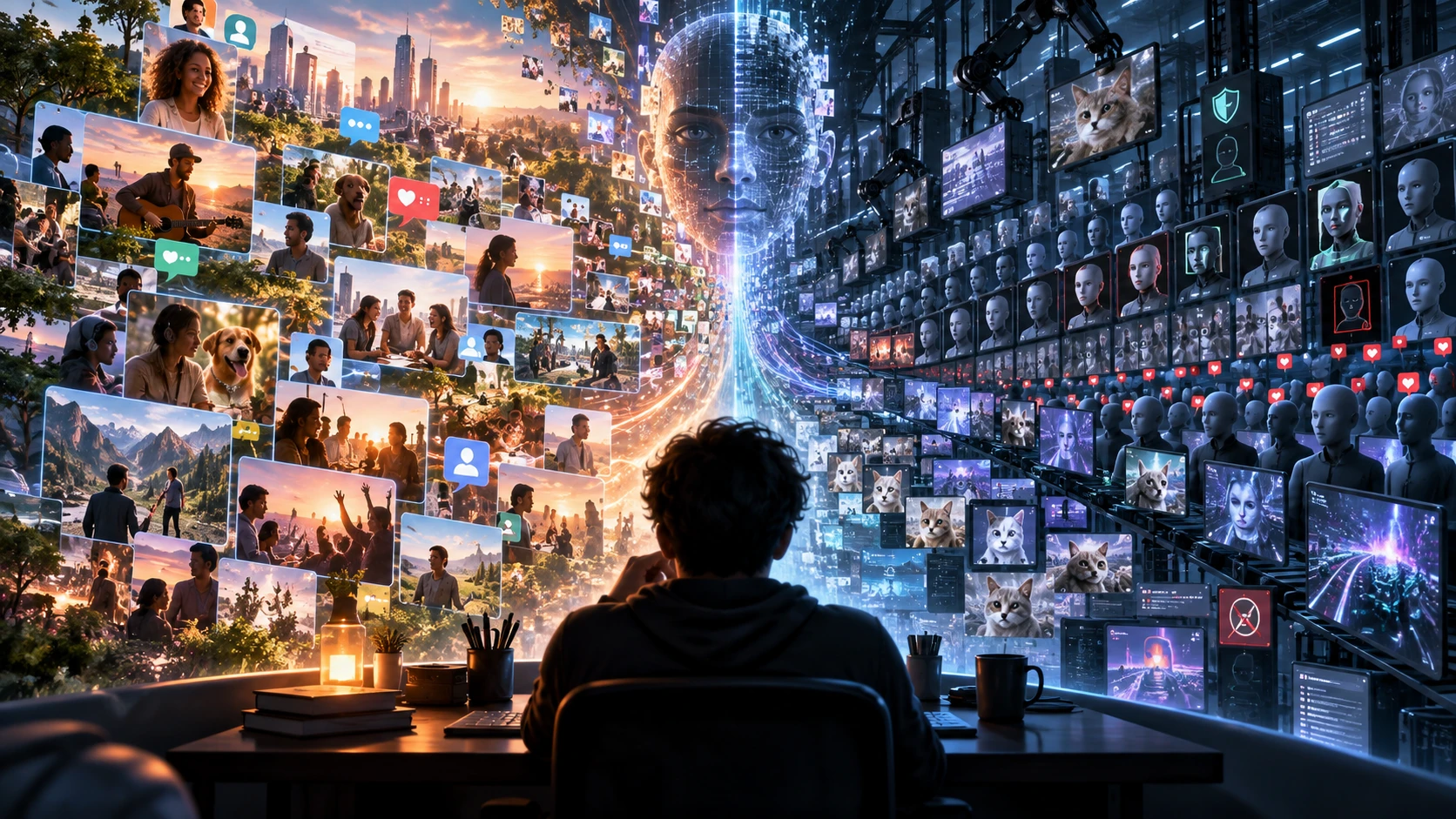

The “dead internet theory” sounds like classic conspiracy bait: most of the web is supposedly bots talking to bots while algorithms manufacture the illusion of a living public square. The phrase spread from a 2021 forum post, and its strongest version still goes too far. There is no good evidence that most people you encounter on Reddit, X, YouTube, or the wider social web are fake.
But the uncomfortable part is that the theory has aged better than it had any right to. In 2026, machines really do generate a huge share of web traffic. Synthetic text and images have become measurable parts of social feeds. Platforms are rewriting rules around “inauthentic” and mass-produced content. And even Reddit co-founder Alexis Ohanian told TechCrunch, “The dead internet theory is real.”
The internet is not “mostly bots” in the way people think
The most important distinction is between traffic, content, and accounts. They are not the same thing. A search crawler fetching a page is bot traffic, but it is not pretending to be your friend in a comment section.
Still, the traffic numbers are startling. In July 2026, Cloudflare reported that more than 50% of internet traffic was now non-human. It also said 52% of crawler requests were for AI training in June 2026, up from 22% in spring 2025. In some heavily crawled categories, Cloudflare said human traffic had fallen by as much as 40% in less than a year. That is not proof of a dead social internet, but it is evidence of an increasingly machine-heavy web.
The research on actual social content is much less apocalyptic. A large study of 51 Reddit communities covering 2022–2024 found machine-generated text was still marginal overall, although it reached peaks of 9% in some communities and months. The synthetic posts were concentrated among a small fraction of users and sometimes earned engagement comparable to human writing.
On X, an ACM-published study of political content during the 2024 U.S. election found about 12% of shared images were detected as AI-generated. More strikingly, roughly 10% of users sharing AI images were responsible for 80% of them. That concentration matters: a relatively small number of high-output accounts can make a feed feel far more synthetic than platform-wide averages suggest.
Also Read: Do Em Dashes Mean AI Wrote It?
AI slop changes the feeling of the web before it changes the percentages
“AI slop” is not simply “content made with AI.” It is the cheap, repetitive, high-volume material produced mainly to capture attention: interchangeable listicles, uncanny Shorts, generic comments, fake stories, and endless variations on whatever the algorithm rewarded yesterday.
A 2025 Kapwing audit gives a sense of the scale on YouTube. The company reviewed trending channels across countries and also created a fresh YouTube account to inspect its first 500 Shorts. It found roughly one-third of those Shorts qualified as “brainrot,” while its broader estimate put AI slop or brainrot at 21–33% of the feed. This was not a peer-reviewed study, and its classification is necessarily subjective, but it captures something users recognize immediately: extremely cheap content can occupy a lot of recommendation real estate.
Interestingly, YouTube itself does not treat “made with AI” as synonymous with bad. YouTube CEO Neal Mohan told Wired, as quoted in the same Kapwing investigation, “What's important is that it was done by a human being.” The company’s public line is essentially that originality and value matter more than the percentage of a video generated by software.
The anecdotes are even more blunt. In one Reddit discussion, a user described seeing five replies with nearly identical phrasing and the same opening sentence. Another said AI might push them to use the internet only for TV and gaming; another said they had already dropped social networks because feeds felt scraped and reposted.
On X, one user openly asked for a browser extension that would remove “all AI slop” from the timeline. On YouTube, creator explainers about the platform’s “inauthentic content” rules have themselves become part of the conversation about whether mass-produced AI channels are finally being squeezed.
None of those stories are statistics. But they explain why the internet can feel “dead” before bots become a majority of social participants. Humans notice repetition, missing context, strangely frictionless prose, and accounts producing far more than a person plausibly could. Once suspicion becomes the default, even genuine posts lose some of their social value. The damage is not merely fake content; it is the collapse of confidence that the stranger replying to you actually bothered to think before pressing Post.
Also Read: Does Using Grammarly Affect AI Detection?
The platforms are getting stricter because the problem is real
YouTube now explicitly says monetized content must not be mass-produced, generic, repetitive, or manipulative. In July 2025 it renamed its “repetitious content” rule to “inauthentic content.” Its current spam policy goes further, prohibiting automated or synthetic mass-production, coordinated flooding, fake engagement, and technical tricks intended to evade detection.
In May 2026, YouTube also expanded AI labeling. Creators get the first chance to disclose realistic synthetic media, but YouTube can apply labels using its own detection systems. Valid C2PA credentials indicating that a video was generated with AI can also produce disclosures that creators cannot simply remove.
X’s Authenticity policy bans unauthorized automation, mass-registered inauthentic accounts, coordinated engagement manipulation, and deceptive fake personas. Reddit’s own numbers show how large the enforcement burden has become. In its second-half 2025 transparency report, 54% of admin content removals were for spam. Reddit issued 3.18 million temporary or permanent account bans, up roughly 21%, partly because of large-scale spam attacks. Some 76.7% of community bans were spam-related.
Yet every crackdown creates an arms race. Imperva notes that advanced bots can use real browsers, simulate clicks, and produce realistic user-like signatures. The obvious spammer posting the same crypto link 500 times is relatively easy to catch. A coordinated network that behaves slowly, varies its wording, and looks like ordinary browser traffic is much harder.
This is also where humans sometimes notice things machines miss. Repeated sentence structures, comments that technically fit a topic but misunderstand the conversation, strange account histories, or several accounts suddenly expressing the same thought in slightly different language can set off a human reader’s alarm bells. The Reddit example with five nearly identical replies illustrates that nicely. That does not mean humans are universally better bot detectors; at internet scale, they clearly are not. It means contextual judgment can still catch patterns that a numerical spam score misses.
Also Read: Ways to Spot AI Writing in Classrooms
The smartest anti-slop ideas do not rely on guessing
One promising shift is from “Can an algorithm detect fake content?” to “Can the origin of this content be verified?” YouTube’s “Captured with a camera” disclosure uses C2PA provenance metadata to show that compatible hardware or software recorded media and preserved information about its origin.
It is not foolproof. YouTube itself warns about “air-gapping”: someone can display synthetic material on a screen and then photograph or film that screen. But provenance is still fundamentally different from asking an AI detector to stare at pixels and guess. It creates a chain of evidence about where media came from.
Another surprisingly practical idea is letting humans help train the defenses. In September 2026, LinkedIn said more than one million members had used its new “Seems Like AI Slop” button within the first two weeks. LinkedIn says its recent efforts reduced views of content classified as AI slop by 40%, while its systems were blocking hundreds of thousands of automated comment attempts every day. That is a useful hybrid: machines provide scale while humans provide the “something about this is off” signal.
Then there is Web3-style proof of personhood. World is building privacy-preserving “proof of human” credentials, while the revived Digg team has discussed zero-knowledge proofs for trusted online communities. Systems like these could make a classic Sybil attack—one operator pretending to be thousands of independent people—much more expensive without necessarily publishing everybody’s legal identity.
But Web3 cannot solve the whole problem. A verified human can still run ten AI tools, post junk, sell an account, or join an engagement farm. A blockchain or zero-knowledge credential may help answer, “Is there a unique human behind this account?” It cannot answer, “Is this human interesting, honest, knowledgeable, or worth listening to?”
Also Read: Free AI Detectors With No Word Limit: What Actually Works in 2026?
So, is the dead internet theory true?
Literally, no. The evidence does not show that the social internet is mostly fake people, or that some hidden actor has replaced human conversation with bots. The strongest form of dead internet theory remains a conspiracy theory.
As a warning, however, it was eerily prescient. Non-human traffic has crossed 50% on major internet infrastructure. Synthetic media is already measurable in mainstream communities. A relatively small number of automated or industrial-scale accounts can dominate particular topics. Recommendation systems can distribute cheap material much faster than human creators can produce thoughtful work. And AI has pushed the cost of making another article, comment, picture, voice, or video toward zero.
The psychological effect can arrive long before the numerical majority. When every polished comment might have been generated, trust becomes expensive. When feeds fill with disposable material, people retreat into smaller communities, private chats, newsletters, trusted creators, or simply spend less time browsing. That is arguably the most convincing version of the dead internet theory: not an internet without humans, but an internet where finding the humans becomes work.
The internet is not dead. It is becoming harder to tell where the living parts are. The next phase of the web will probably depend less on perfect bot detection and more on provenance, reputation, rate limits, community moderation, human feedback, and privacy-preserving proof that a real person is somewhere in the loop. The winning platforms may not be the ones with the most content. They may be the ones that make human presence legible again.