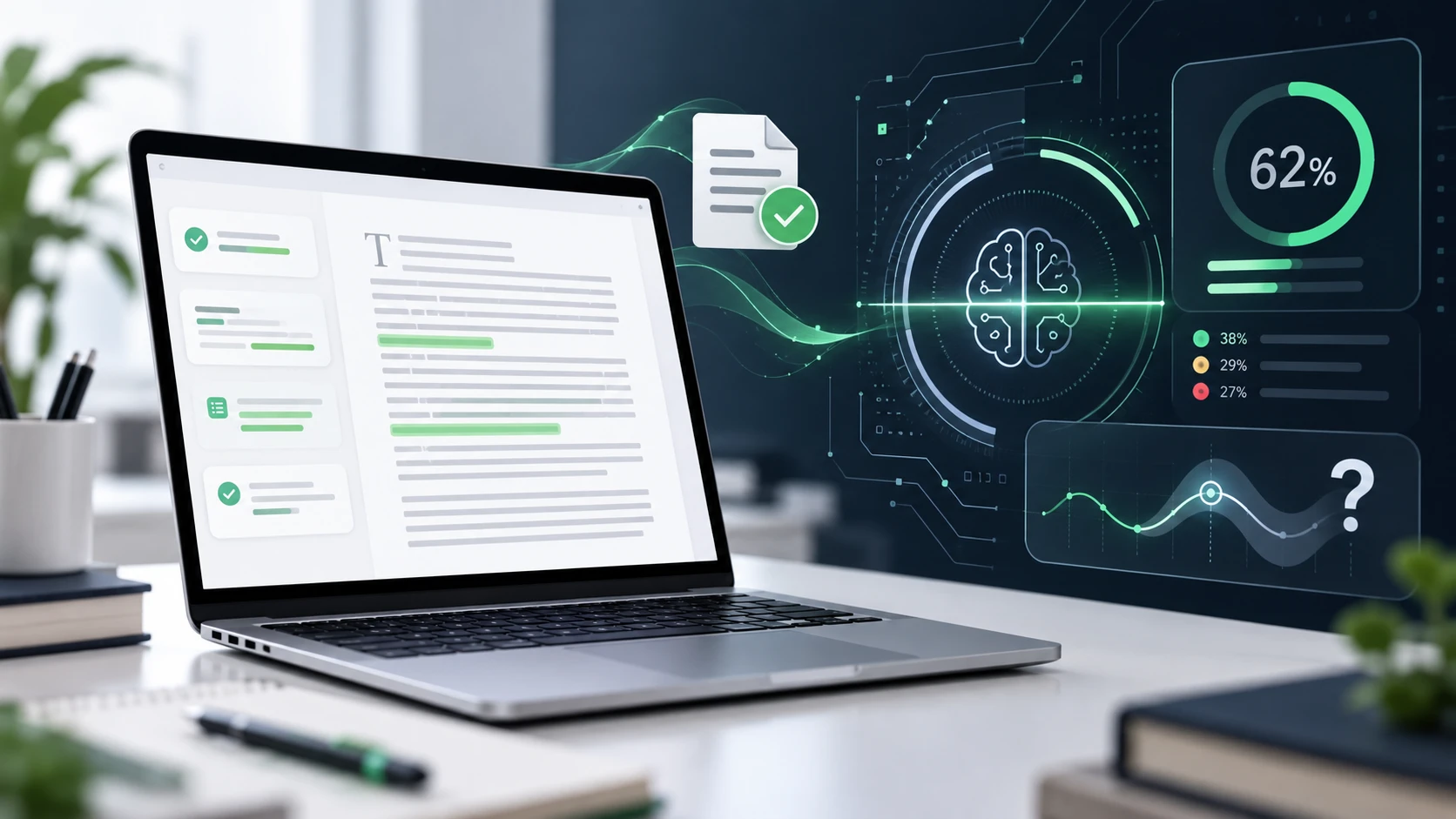

Grammarly can affect AI detection, but the important question is which Grammarly features you use. Fixing spelling, punctuation, or ordinary grammar is very different from asking Grammarly to rewrite a paragraph, paraphrase a passage, summarize material, or generate a draft.
This distinction matters especially for students worried about Turnitin. Unlike a normal similarity report, Turnitin's AI-writing report is generally visible only to instructors and administrators, so students often submit work without knowing what the detector will say. According to Turnitin's current AI-detection FAQ, instructors can download that report and share it with students, but students do not normally see the AI indicator themselves.
The reassuring part is that Turnitin has answered the Grammarly question directly: basic Grammarly corrections usually should not cause a paper to be flagged. The less reassuring part is that Grammarly now contains generative-AI features, and Turnitin says text produced by those features is likely to be detected as AI-generated.
Basic Grammarly Corrections Are Not the Same as Generative AI
It is misleading to divide Grammarly into an old "non-AI" version and a new "AI" version. Grammarly has used machine learning for years. What has changed is that modern Grammarly also offers features capable of generating or substantially rewriting your words.
Grammarly itself makes this distinction. Its Authorship documentation separates text edited using traditional features, such as grammatical corrections and some clarity or word-choice suggestions, from text changed through on-demand AI rephrasing or generated by AI. Its current paraphrasing tool, for example, explicitly uses AI to rewrite text.
So simply having Grammarly installed does not make your essay AI-written. Correcting "their" to "there," fixing a comma, or accepting a conventional grammar correction is not comparable to clicking a button that replaces several sentences with newly generated wording.
Also Read: [HOT] Is Grammarly an AI Tool?
What Turnitin Says About Grammarly
Turnitin's September 2026 guidance is unusually specific. It says its detector is not designed to target spelling, grammar, and punctuation changes produced by Grammarly. Turnitin reports that, in its testing of human-written documents, changes from Grammarly Free, Grammarly Premium, and other grammar-checking tools were not flagged in most cases.
Turnitin immediately adds an important exception: this does not apply to Grammarly's generative-AI features. It specifically names draft generation, paraphrasing, and summarizing and says content created with such features will likely be identified as AI-generated.
That means accepting every Grammarly recommendation is not necessarily harmless. If those recommendations are traditional corrections, there is relatively little reason for concern. But when suggestions become complete sentence or paragraph rewrites, you may be allowing a generative model to contribute substantial wording to your paper.
Also remember that a Turnitin AI percentage is not the same as a plagiarism or Similarity score. Turnitin says the two systems are independent. It also explicitly says its AI score should not be used by an instructor as the sole basis for determining misconduct.
Also Read: Can Grammarly Humanize AI Text?
What Independent Research Tells Us
There is an important limitation in the evidence: I could not find a strong independent peer-reviewed experiment that takes the same set of human essays, applies current Grammarly features, and then tests the before-and-after versions specifically with Turnitin's current 2026 model. So claims such as "Grammarly always increases Turnitin by 20%" are not supported.
However, independent research provides good evidence that editing style can influence AI detectors.
A large 2026 study titled “Style as a Confound” analyzed 135,389 pairs of academic documents written by non-native English authors before and after professional English editing. The ideas and authorship remained human, but editing changed AI-detector scores. Across 13 detectors, some scores increased after editing while others decreased, and larger edits were associated with larger changes. This was professional editing rather than Grammarly, so it does not prove a Grammarly-Turnitin effect. It does, however, demonstrate why polished writing can sometimes change detector behavior even when a human created the underlying work.
An additional 2026 academic-integrity study tested light LLM editing of genuinely human academic abstracts. Some commercial detectors frequently classified the lightly AI-refined versions as AI writing, illustrating how detectors can struggle to distinguish "AI helped edit my sentences" from "AI wrote this for me."
There is also a known concern for English-language learners. A Stanford-led study of AI detectors found that popular detectors could disproportionately misclassify writing from non-native English writers. These findings do not establish the error rate of today's Turnitin system, but they are a good reason not to treat any detector score as proof.
Turnitin says its own false-positive rate is below 1% for documents exceeding its 20% AI threshold and says it tests updates against hundreds of thousands of pre-ChatGPT academic papers. That is a vendor-reported performance claim, however, rather than an independent guarantee for your individual paper. Turnitin also acknowledges that repetitive writing, limited structural variation, and some paraphrased writing can contribute to false positives.
Also Read: ProWritingAid vs. Grammarly: Which Tool Truly Elevates Your Writing?
What Students and Writers Are Reporting
Anecdotes online fit this more complicated picture rather than supporting a simple "Grammarly equals AI" rule.
In one Reddit discussion, a writer reported that content edited with Grammarly or QuillBot later received very high AI scores from several detectors, despite the writer claiming to have used the tools primarily for proofreading and readability. Because multiple tools were involved and there was no controlled experiment, this is not evidence that Grammarly caused the scores—but it shows why users are worried.
A more recent student discussion on r/WGU describes the modern gray area well: the student wrote an entire paragraph independently, only to have Grammarly offer complete sentence rewrites that sounded AI-generated. That is precisely why the feature you accept matters more than the Grammarly name.
These reports should be treated as anecdotes, not scientific measurements. Different detectors use different models and thresholds, and a result from GPTZero, Copyleaks, or another checker does not tell you what Turnitin will report.
How to Reduce the Risk of a False AI Flag
The safest approach is not to deliberately make your writing "less detectable." Instead, protect the evidence showing that it is genuinely yours.
- Write the original draft yourself. Draft in Word, Google Docs, or another editor that preserves revision history. Keep your outline, notes, sources, earlier drafts, and tracked changes.
- Use Grammarly selectively. Ordinary spelling, punctuation, and grammar fixes are lower-risk. Be much more cautious with buttons that paraphrase, generate, summarize, rewrite, or replace whole passages.
- Do not blindly click “accept all.” Read every substantial suggestion and keep your own wording when it already communicates the idea clearly.
- Do not intentionally add mistakes. Awkward grammar and random sentence changes are not a sensible defense against AI detection and only weaken your work.
- Avoid “AI humanizers” and detector-evasion tools. Besides potentially violating academic rules, they replace even more of your wording and can destroy the clean authorship trail that could otherwise defend you. Turnitin says its current system also looks for AI-generated writing modified by paraphrasers or bypass tools.
- Check your school's AI policy. Some institutions permit proofreading but restrict generative rewriting. The academic-integrity question is ultimately about what your course permits, not merely whether software detects it.
For professionals, the same principle applies. Preserve revision history and follow your employer's, client's, journal's, or publisher's rules concerning substantive AI-assisted rewriting.
What to Do If Your Human-Written Paper Gets Flagged
Do not panic over a percentage. Ask your instructor which passages were highlighted and explain exactly how you wrote and edited the document. Then show evidence: document history, earlier drafts, outlines, notes, research sources, timestamps, or tracked revisions.
This is particularly valuable because students normally cannot inspect Turnitin's AI report before submitting. Turnitin itself recognizes uncertainty at low scores: according to its current documentation, results from 1% through 19% are displayed to instructors as “*%” rather than an exact percentage specifically because of the greater possibility of false positives in that range.
If Grammarly Authorship is available to you, its writing-history features can also distinguish text you typed from some AI-generated or AI-modified material. It can be useful supporting evidence, although it should complement—not replace—your normal drafts and revision history.
The Bottom Line
Using Grammarly does not automatically raise your Turnitin AI score. Turnitin specifically says ordinary Grammarly spelling, grammar, and punctuation corrections are generally not what its detector targets.
But modern Grammarly is no longer only a grammar checker. It also includes generative features capable of producing new sentences, paraphrases, summaries, and drafts. Heavy use of those features can result in genuinely AI-modified wording, and Turnitin says such content is likely to be detected. Independent research also shows that substantial editing can alter AI-detector scores even when the underlying ideas and authorship are human.
So the practical rule is simple: use Grammarly as an editor, not a ghostwriter. Write your ideas and sentences yourself, use conventional corrections where helpful, be cautious about wholesale rewrites, and preserve your writing history. That gives you something far more valuable than trying to achieve a particular detector score: evidence that the work really is yours.