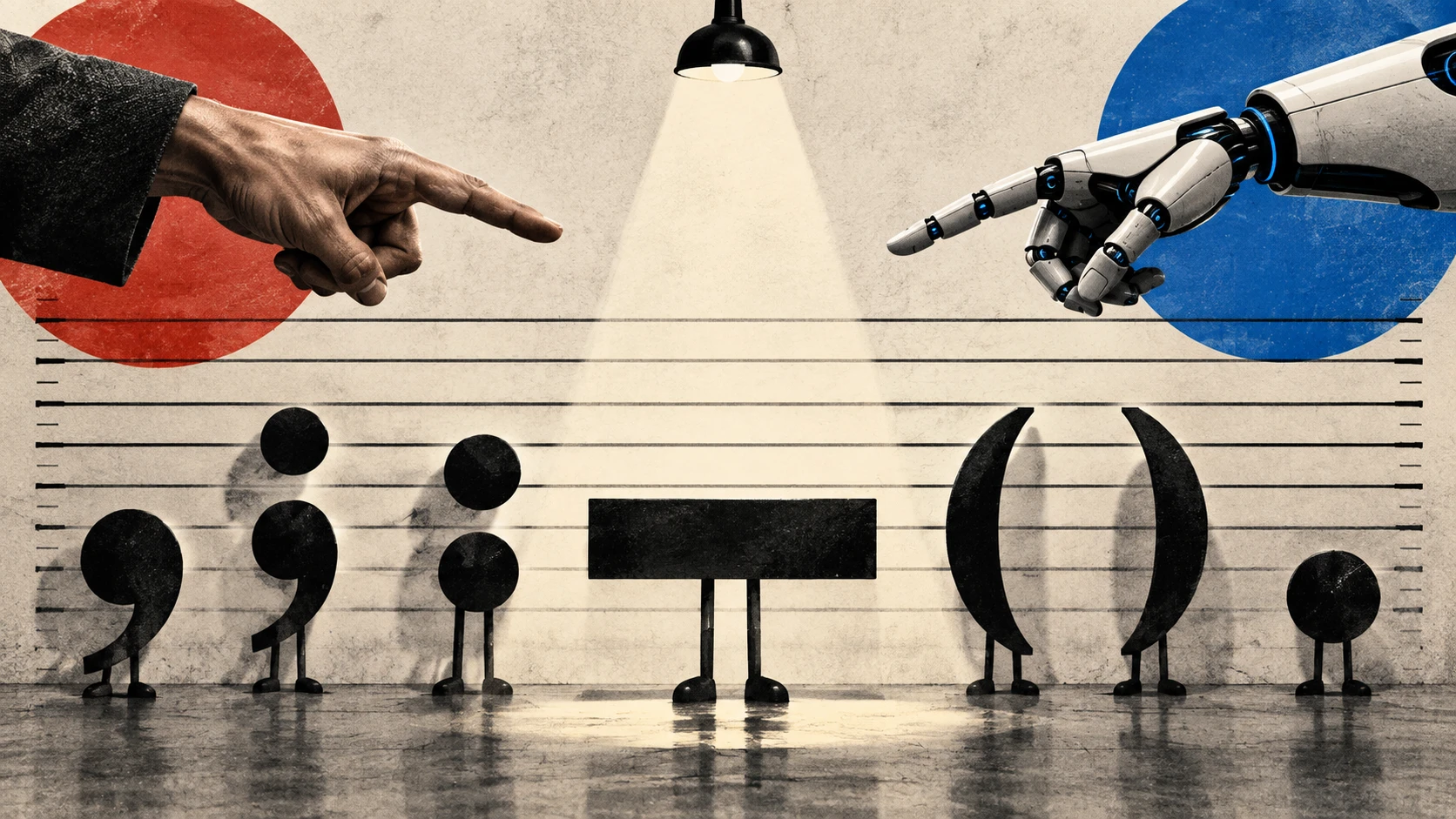

A few years ago, an em dash was just punctuation. Today, typing one can feel strangely like leaving fingerprints at a crime scene. Writers who have used the mark for years now worry that readers, teachers, clients, or coworkers will see “—” and assume ChatGPT did the work.
That fear is not imaginary. On Reddit, one writer asked whether using em dashes would make people suspect AI use. Another said they had started avoiding a punctuation mark they already used because they did not want to sound like an LLM. In another thread, a user complained that people were accusing writers of AI use simply because of em dashes.
So, does an em dash mean AI wrote something? No. It can be a clue about style, but by itself it is extremely weak evidence of authorship.
What the research actually says
The association did not appear from nowhere. A 2026 preprint, “The Last Fingerprint: How Markdown Training Shapes LLM Prose”, tested 12 models from OpenAI, Anthropic, Google, Meta, and DeepSeek. In unconstrained essay writing, GPT-4.1 produced 10.62 em dashes per 1,000 words and Claude Opus 4.6 produced 9.09. DeepSeek V3 produced 6.95. But Gemini 2.5 Flash produced only 1.28, GPT-5.4 produced 1.43, and two tested Llama models produced none.
The same study measured eight published human essays. Their mean was 3.23 em dashes per 1,000 words, but the range was enormous: 0.33 to 17.12. That small human sample should not be treated as a universal baseline, yet it makes the central problem obvious. A human can use more em dashes than an AI model, while an AI model can use fewer than a human. There is no magic punctuation threshold.
A separate preregistered study of 69,632 medRxiv preprints found something more interesting at the population level. The share of Discussion sections containing at least one em dash rose from 4.23% before ChatGPT to 11.58% afterward, reaching 20.3% in 2025. The authors explicitly warn that this is a population-level signal, not a detector for individual papers, and the design cannot prove that LLMs caused the increase.
Also Read: Does Using Grammarly Affect AI Detection?
Why people are so quick to judge
Em dashes are tempting as an AI detector because they are visible. You do not need software or linguistic expertise to notice one. But serious detection is more complicated.
In a 2025 study of human detection of AI-generated nonfiction, five people who frequently used LLMs for writing collectively misclassified only one of 300 articles. Crucially, their judgments relied on combinations of clues: vocabulary, formality, originality, clarity, and broader patterns. They were not simply hunting for one character.
That distinction matters because false accusations have real costs. A peer-reviewed Patterns study found that automated GPT detectors could systematically misclassify writing by non-native English speakers. If sophisticated detectors can make unfair mistakes, “I saw an em dash” is an even shakier basis for judging a person.
Also Read: What Is AI Residue? Definition, Examples, and Why It's Spreading
The models are already changing
The funniest part of the em-dash panic is that the supposed tell is already becoming obsolete. OpenAI’s ChatGPT release notes say newer models became better at following custom instructions and style preferences. In November 2025, Sam Altman specifically celebrated the fact that telling ChatGPT not to use em dashes in custom instructions finally worked reliably. OpenAI has not publicly disclosed the exact training recipe behind that change, so it is safer to say the behavior was tuned than to invent details about how.
Anthropic has moved in the same direction. The company says Claude Opus 5.5 “communicates more naturally” and follows writing rules better than Opus 5. An independent Arena analysis, reported by BleepingComputer, measured a drop from 15.2 em dashes per 1,000 words in Opus 5 to 0.8 in Opus 5.5, roughly 95% fewer.
In other words, a “tell” can disappear as soon as model makers decide users dislike it. That makes punctuation-based AI detection a moving target.
Also Read: Ways to Spot AI Writing in Classrooms
We have been suspicious of writing tools before
There is a familiar historical pattern here. People sometimes say Plato was “against pens.” That is not literally accurate. In Plato’s Phaedrus, Socrates tells the story of Theuth and King Thamus, in which writing is criticized for encouraging people to rely on external marks instead of exercising memory, and for creating the appearance of wisdom without understanding. The concern sounds surprisingly modern: what happens when a tool performs part of the mental work for us?
Calculators produced a similar battle in mathematics education. Some math educators went as far as proposing that hand-held calculators should be banned from parts of elementary mathematics, while later guidance from the National Council of Teachers of Mathematics argued against simply banning the technology and favored appropriate use instead.
AI is not identical to writing or calculators. It can generate ideas, arguments, and whole passages, which raises deeper questions about authorship. Still, the recurring mistake is useful to notice: we often turn a debate about responsible tool use into a debate about whether touching the tool makes the work illegitimate.
Also Read: Are Ebooks on Amazon and Other Ebook Stores AI-Written?
Is undisclosed AI use morally wrong?
This is where the answer becomes genuinely gray.
If a school, journal, contest, employer, client, or platform requires disclosure, then disclose it. Ignoring an explicit rule is not an interesting philosophical loophole; it is breaking the terms under which your work is being judged. Some publishing policies make those boundaries very clear. Springer Nature guidance, for example, distinguishes substantive LLM use, which should be documented, from AI-assisted copy editing of human-written text, which does not need to be declared. ACM’s authorship policy similarly puts responsibility on human authors while defining rules for AI assistance.
Outside such rules, though, using AI without announcing it is not automatically immoral. Writers already use spellcheckers, editors, search engines, templates, style guides, reference books, autocomplete, and advice from coworkers. The morally important questions are what the tool contributed, what the audience was promised, and whether you stand behind the result.
If you submit an AI-written exam answer as proof that you personally mastered the material, that is deception. If you sell expert analysis you do not understand and hide behind an LLM, that is irresponsible. But if there is no disclosure requirement, no promise that every word was composed without assistance, and you verify, edit, and take responsibility for the final work, nondisclosure can be perfectly reasonable.
Keep the em dash if it sounds like you
Do not let an internet stereotype confiscate a useful piece of punctuation. The research supports the idea that some LLMs have overused em dashes, and the anecdotes show that people really do judge writers for them. But the same research also shows huge differences among models and humans, while current models are already changing their habits.
An em dash can make someone suspect AI. It cannot tell them who wrote the sentence. Good writing has always been about choices, context, and voice. Use the mark when it earns its place, disclose AI when the rules require it, and take responsibility for whatever you put your name on.