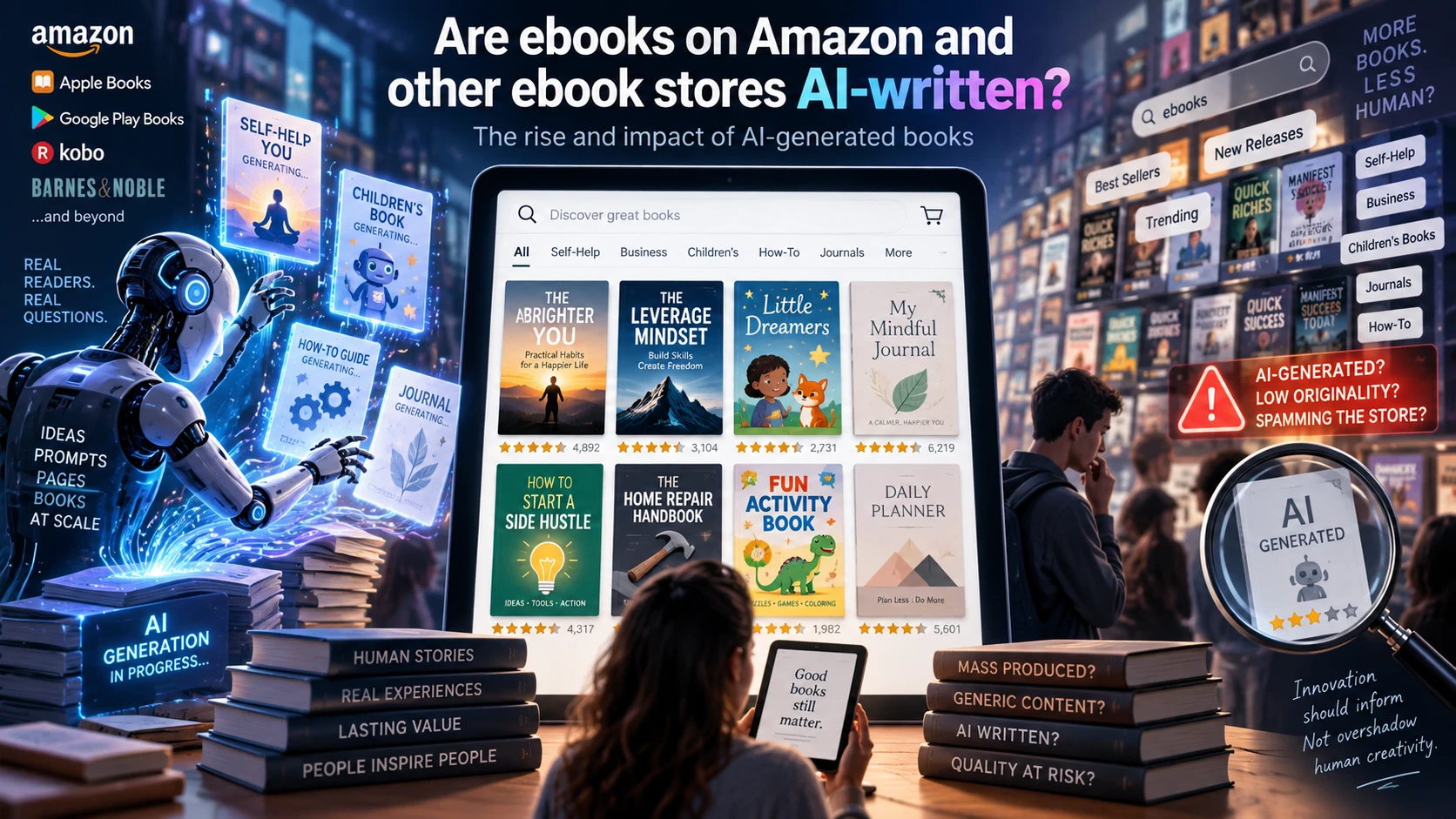

Yes—some ebooks sold through major stores are demonstrably or very probably AI-written, and the number has risen sharply since 2023. But there is no credible evidence that “most ebooks” across Amazon, Apple Books, Kobo, Google Play Books, or indie stores are AI-written. The strongest systematic evidence concerns Amazon's self-published catalog. A 2026 study of 14,419 Amazon genre-fiction ebooks found substantial detected AI text in 20.0% of its 2023–2026 sample; those books generated 12.1% of unit sales and 11.3% of revenue. A separate NBER study using AI detection on more than 50,000 randomly selected Amazon titles estimated that books containing detected AI text rose from roughly zero before 2023 to more than 60% of new releases during 2025. Crucially, that study detected AI in approximately 1,000-word previews, not entire books, so “60% fully AI-written” would be an incorrect interpretation.
For Apple Books, Kobo, Google Play Books, and major indie-oriented publishing channels, representative published prevalence estimates remain unspecified. There is nevertheless direct evidence of AI-generated books reaching Apple Books, while Kobo says AI-driven low-quality submissions have become a major moderation problem. Platform responses vary from mandatory disclosure at Amazon and Barnes & Noble Press, to aggressive quality filtering at Kobo and Draft2Digital.
What ebook stores actually permit and police
Amazon does not ban AI-generated books. Kindle Direct Publishing requires publishers to tell Amazon when text, images, or translations are AI-generated—even after substantial human editing—but not when AI merely assists editing or brainstorming. Amazon says machine learning, automation, and human reviewers enforce its rules and that noncompliant books can be rejected or removed.
Apple's public documentation is less explicit, but an Apple spokesperson told technology journalist Joanna Stern in June 2026 that Apple Books requires disclosure of AI-generated, though not merely AI-assisted, books and prohibits misleading or copyright-infringing material. Stern's investigation documented multiple AI copycats that Apple subsequently removed.
Kobo says it uses internally developed machine-learning systems alongside human review and is developing similarity detection aimed at pirated, reprocessed, summarized, and AI-produced material that crowds search results. CEO Michael Tamblyn reported that Kobo rejected 45% of Kobo Writing Life submissions in 2025 and attributed more than 80% of those rejections to manifestly AI-generated, very poor-quality books. That does not mean 80% of Kobo books—or even 80% of submissions—were AI-generated. Kobo has not published the total files examined or detector methodology.
Also Read: Can Turnitin Detect NotebookLM? Unmasking AI Detection Secrets
| Platform | AI policy | Detection/enforcement | Published catalog prevalence |
|---|---|---|---|
| Amazon KDP | AI-generated content must be disclosed to Amazon; AI-assisted need not be. | Automation, machine learning and human review; reject/remove/appeal. | Independent Amazon studies exist; no official Amazon percentage. |
| Apple Books | Company spokesperson says AI-generated books require disclosure. | Investigates misleading/IP-infringing uploads and removes violations. | Unspecified. |
| Kobo | Low-quality/AI mass-production is actively filtered. | ML plus human review; similarity tools. | Unspecified. |
| Google Play Books | No ebook-text-specific AI disclosure rule was found in the public policy reviewed. | Automated models plus human reviewers; removal, visibility limits and account sanctions. | Unspecified. |
| Draft2Digital | AI-assisted accepted; fully AI-generated work without extensive human editing rejected. | Quality, mass-production, infringement and misleading-content screening. | Unspecified. |
Google does explicitly require AI-generated audiobooks to be identified as having a synthesized voice, but that rule should not be confused with an ebook-prose labeling requirement.
What the prevalence studies actually show
The strongest full-text study is Chakrabarty and colleagues' August 2026 preprint. Researchers randomly sampled 14,419 self-published Amazon genre-fiction ebooks released from January 2023 through March 2026, obtained their full text, and matched them to daily sales data through June. Books with more than 25% of text windows detected as AI represented 20.0% of the sample; another 17.1% contained lighter detected AI use. Changing the threshold did not erase the pattern. Importantly, the sample covers commercially active self-published genre fiction—not Amazon's entire book catalog—and detector classification is probabilistic rather than proof of authorship.
Reimers and Waldfogel's May 2026 NBER work provides a broader but shallower measurement. Using AI detection on more than 50,000 randomly selected Amazon titles, it estimated detected AI incidence at about 30% in 2023, 45% in 2024 and above 60% during 2025. The method examined short previews rather than full books; therefore it measures whether sampled text contains detectable AI characteristics, not whether an entire title was machine-written. The researchers also found lower ratings and less usage per detected-AI title. Public summaries do not provide a conventional confidence interval for those headline percentages.
Commercial detector company Originality.ai has reported much higher rates in narrow Amazon niches. These studies are useful warning signals but should receive less weight: the company sells the detector being used, samples only selected categories and often analyzes previews rather than complete books.
Also Read: How often does Turnitin update its database?
Where AI-written books appear most concentrated
The following ranking combines Originality.ai's recent category audits. Because sampling periods and category definitions differ, the percentages are not directly comparable estimates of the whole Amazon marketplace.
| Rank | Category | Likely AI metric | Sample and method |
|---|---|---|---|
| 1 | Herbal Remedies | 82% | 558 qualifying 2025 titles; summaries, bios and available book samples scanned. |
| 2 | Witchcraft | 78% | Subset of a 2,034-title Religion & Spirituality study, mostly Jan–Jun 2026. |
| 3 | Self-Help: Success | 77% | 844 qualifying books, Aug–Nov 2025; 651 samples flagged. |
| 4 | Hinduism | 76% | Religion & Spirituality study subset. |
| 5 | Taoism | 74% | 61 books in religion study; category sample relatively small. |
Within the more rigorous full-text genre-fiction study, AI-text penetration increased across all eight genres, with top-ranked AI titles expanding fastest in crime/suspense romance, science-fiction/adventure/dystopian fiction, and mystery/thriller/crime.
Economic, legal and trust consequences
For authors, the central problem is not simply that AI books exist, but that near-zero marginal production costs allow enormous output. In the 14,419-book study, the number of selling titles grew 19.2-fold from the early-2023 baseline while quarterly revenue grew only 8.9-fold. Revenue per selling book declined in seven of eight genres even among books with no detected AI text. The result is greater competition for recommendation slots, rankings and Kindle Unlimited reading time, although the observational study cannot prove AI alone caused every decline.
Readers face search pollution, impersonation and quality risks. The problem becomes more serious in medical, financial or instructional nonfiction, where fluent but invented information can look authoritative. Originality.ai's herbal-remedy audit, for example, found AI-suspected books with inconsistent recipe instructions and apparently fabricated author or expert identities.
Publishers and marketplaces meanwhile absorb screening, complaint and legal costs. Copyright adds another complication: the U.S. Copyright Office concluded in 2025 that copyright continues to require human authorship; AI-generated material can be incorporated into a copyrightable work when sufficiently human-authored expression, selection, arrangement or modification exists, but purely machine-generated expression is not protected merely because a person prompted the system.
Also Read: Does Microsoft Word Have An AI Detector?
Case studies show the problem is no longer theoretical
In 2026, Joanna Stern found ten AI-generated ebooks on Apple Books imitating her book I Am Not a Robot, including similar covers, titles and an AI-generated summary-style version. Apple removed reported copies, yet additional imitations appeared afterward; Stern also found lookalikes targeting books by Lena Dunham and Haley Sacks.
The phenomenon has reached traditional publishing too. Hachette canceled publication of the horror novel Shy Girl in 2026 following allegations and analysis indicating extensive AI-generated text; the episode illustrated how detector findings can create major editorial, contractual and reputational consequences even outside self-publishing.
Detection, enforcement and practical recommendations
Today's detectors are useful for screening, not reliable enough to serve as sole proof. The Amazon full-text study used Pangram and classified many windows across entire books, which is stronger than testing one paragraph. But independent research shows that paraphrasing can sharply reduce detector performance and that increasingly human-like models make perfect text-only attribution fundamentally difficult. A separate study found widely used detectors disproportionately misclassified writing by non-native English speakers, underscoring the danger of automatic punishment from one score.
A better system combines disclosure, provenance, upload-rate anomalies, text similarity/plagiarism checks, metadata analysis, multiple text samples, customer reports and human review—the broad approach already visible in Amazon, Kobo and Google's moderation systems.
Readers should check the author identity, publisher, publication history, sample pages, suspiciously rapid output and independent reviews—especially for health or financial advice—and treat an AI-detector score only as supporting evidence. Authors should retain drafts and revision history, disclose AI use exactly as each retailer requires, verify facts and rights, and monitor stores for impersonation. Platforms should make meaningful AI-generation disclosures visible to buyers, impose stronger friction on mass uploads, combine similarity and provenance analysis with human review, provide appeals for false positives, and publish regular transparency statistics on AI submissions, removals and error rates.
The evidence therefore supports a nuanced conclusion: AI-written ebooks are already a substantial part of some fast-moving self-publishing niches, particularly on Amazon, but there is no sound basis for claiming that ebooks in general—or the catalogs of Apple, Kobo, Google or indie stores as a whole—are mostly AI-written. The largest information gap in 2026 is not proof that AI books exist; it is the absence of standardized, independently audited marketplace-wide disclosure and prevalence data.