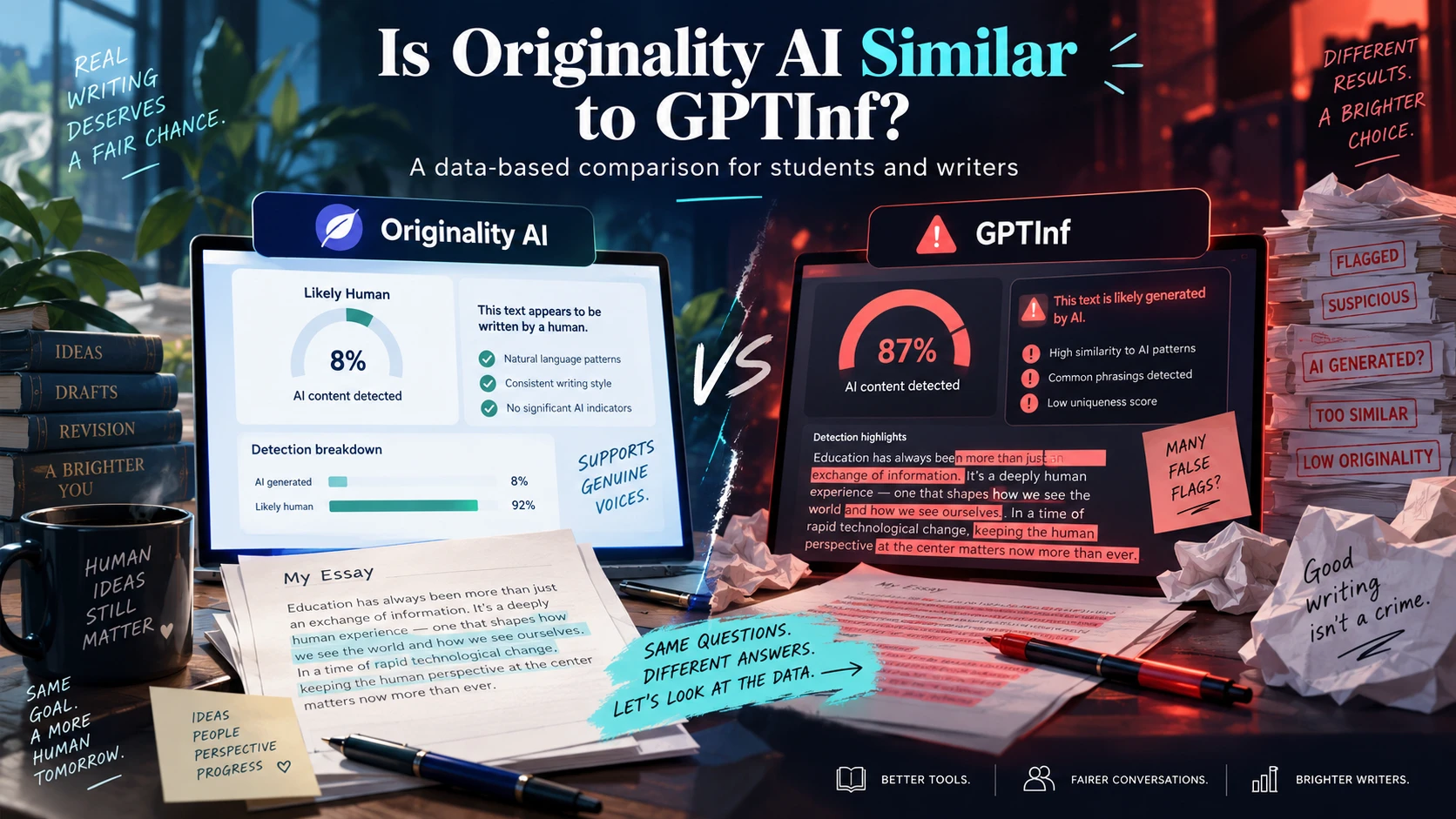

If you are choosing between Originality AI and GPTInf, it is easy to assume that the two tools should give roughly similar results. After all, both are designed to decide whether a piece of writing looks human-written or AI-generated.
Our test data shows something very different. The two detectors do overlap on many AI-generated texts, but their behavior on human writing is dramatically different. In this dataset, GPTInf was much more aggressive about calling text AI, while Originality AI was much more willing to classify text as human.
Short answer: no, Originality AI and GPTInf are not particularly similar in the way they classify text. Originality AI was substantially more accurate overall in this test, while GPTInf caught a larger share of the AI samples at the cost of a very high false-positive rate on human writing.
How we tested Originality AI and GPTInf
Each CSV contained 160 texts: 82 labeled as AI-written and 78 labeled as human-written. The files also recorded the detector's final classification and its score.
There is one important detail about the score columns. GPTInf's AI Score increases as the text looks more AI-generated. Originality AI's score works in the opposite direction in this dataset: 100% means human-written. For the accuracy calculations below, we used the explicit detector verdict columns rather than trying to reinterpret the scores.
The two files were also not perfectly identical. All 82 AI texts were shared between them, but only 56 of the 78 human texts were the same. That means the full-dataset accuracy numbers are useful for evaluating each detector, but direct detector-to-detector agreement should only be calculated on the 138 texts that appear in both files.
Also Read: Is Originality.ai Similar to Pangram? I Compared Their Results on 160 Texts
Originality AI was much more accurate overall
Across all 160 rows in each test, Originality AI classified 134 texts correctly, giving it an overall accuracy of 83.75%. GPTInf classified 92 correctly, for an accuracy of 57.5%.
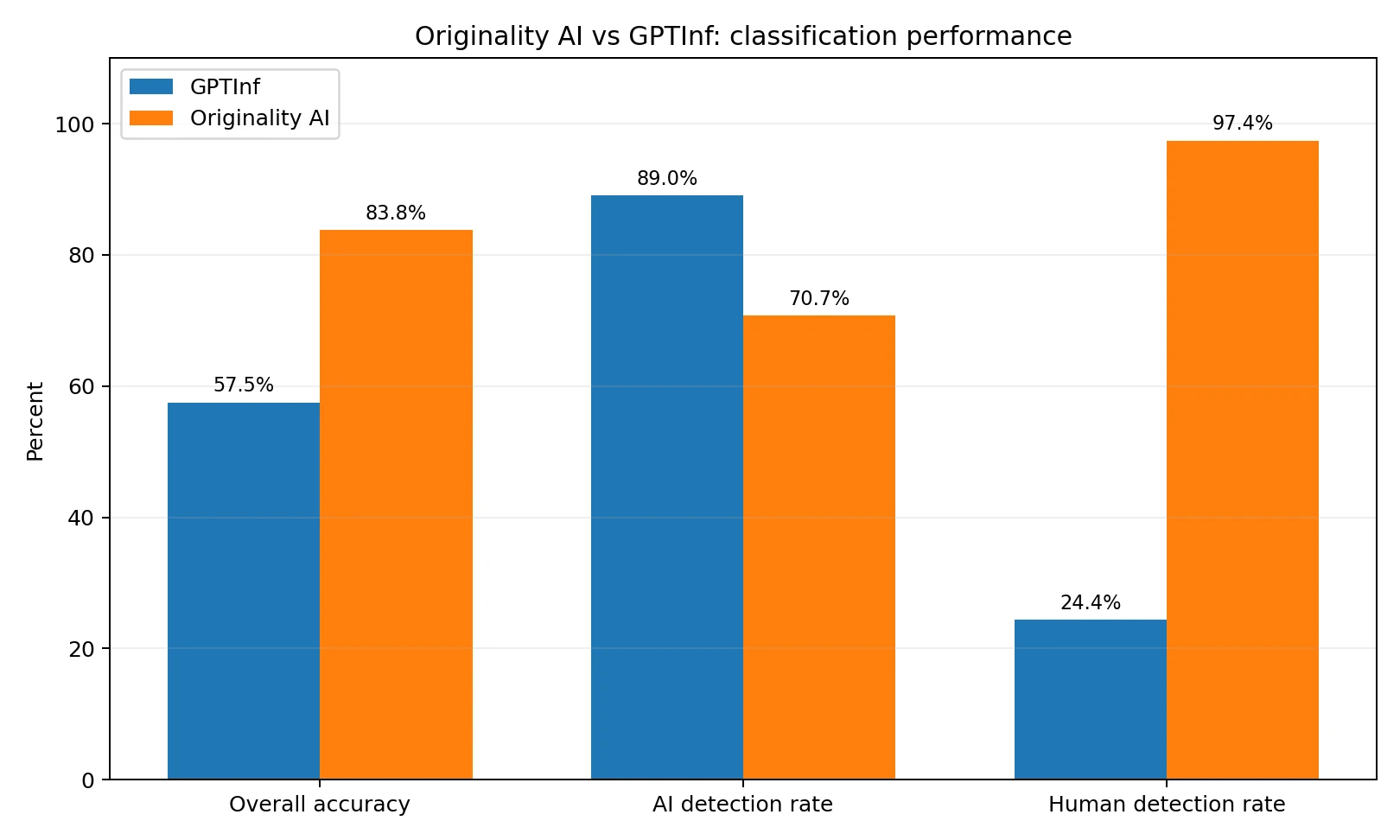
The reason for that large gap becomes obvious when the results are separated into AI and human writing.
| Metric | GPTInf | Originality AI |
|---|---|---|
| Overall accuracy | 57.5% | 83.75% |
| AI detection rate | 89.02% | 70.73% |
| Human detection rate | 24.36% | 97.44% |
| False-positive rate | 75.64% | 2.56% |
| False-negative rate | 10.98% | 29.27% |
GPTInf caught more AI text, but at a major cost
GPTInf correctly flagged 73 of the 82 AI-written texts, which works out to an AI detection rate of about 89.0%. Originality AI correctly flagged 58 of 82, or about 70.7%.
If you looked only at AI recall, GPTInf would appear to be the stronger detector. But AI detection is only half of the problem. A useful detector also needs to avoid accusing human-written work of being AI-generated.
That is where the results changed completely.
GPTInf produced far more false positives on human writing
Out of 78 human-written samples, GPTInf labeled 59 as AI. Only 19 were correctly recognized as human. That gives GPTInf a false-positive rate of 75.64% on this dataset.
Originality AI made just 2 false-positive errors out of 78 human texts. It correctly recognized 76 human samples, producing a false-positive rate of only 2.56%.
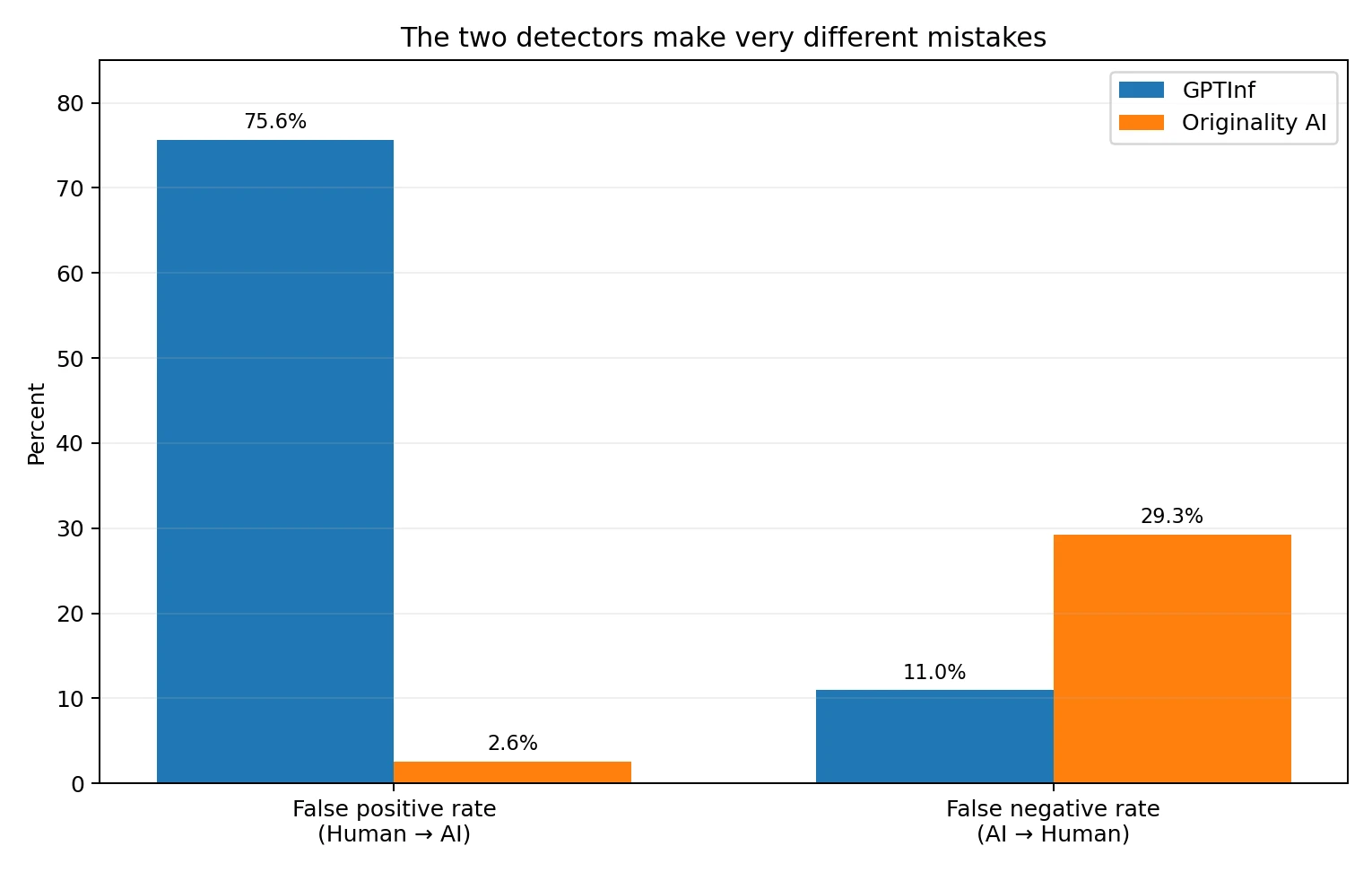
This distinction matters a lot for students, writers, editors, and freelancers. A detector that catches almost every AI text can still be difficult to trust if ordinary human writing is frequently flagged as AI.
GPTInf's errors in this test leaned heavily in that direction. Originality AI showed the opposite trade-off: it was much more conservative about accusing human text, but that also meant it allowed more AI-written samples to pass as human.
Also Read: Is Originality AI Similar to Turnitin? A Data-Based Comparison
The raw classification counts make the difference clearer
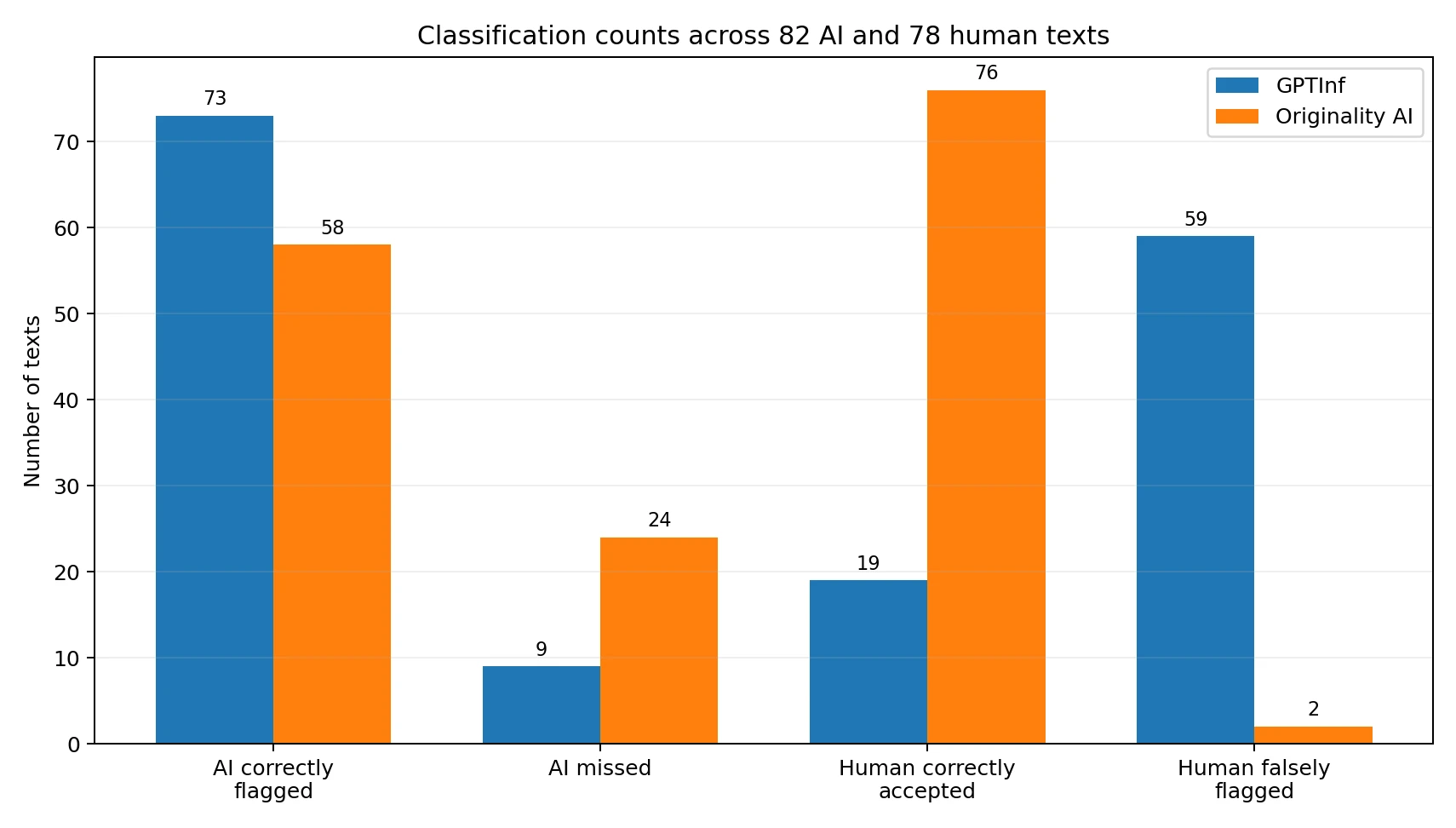
GPTInf missed only 9 AI samples, compared with 24 for Originality AI. But Originality AI correctly accepted 76 human samples, compared with only 19 for GPTInf.
There is no single metric that tells the entire story here. GPTInf behaved like a detector optimized toward catching suspicious text even if that creates many false alarms. Originality AI behaved much more conservatively toward human writing.
Also Read: [STUDY] Can Stealthwriter really slip past Originality.ai? I tested 100 rewrites to find out.
Do Originality AI and GPTInf usually agree?
To answer that fairly, we compared only the 138 exact texts that appeared in both datasets.
The detectors gave the same verdict on just 57.97% of those shared texts. Their agreement was much higher on AI writing, at 79.27%, but extremely low on the shared human writing: only 26.79%.
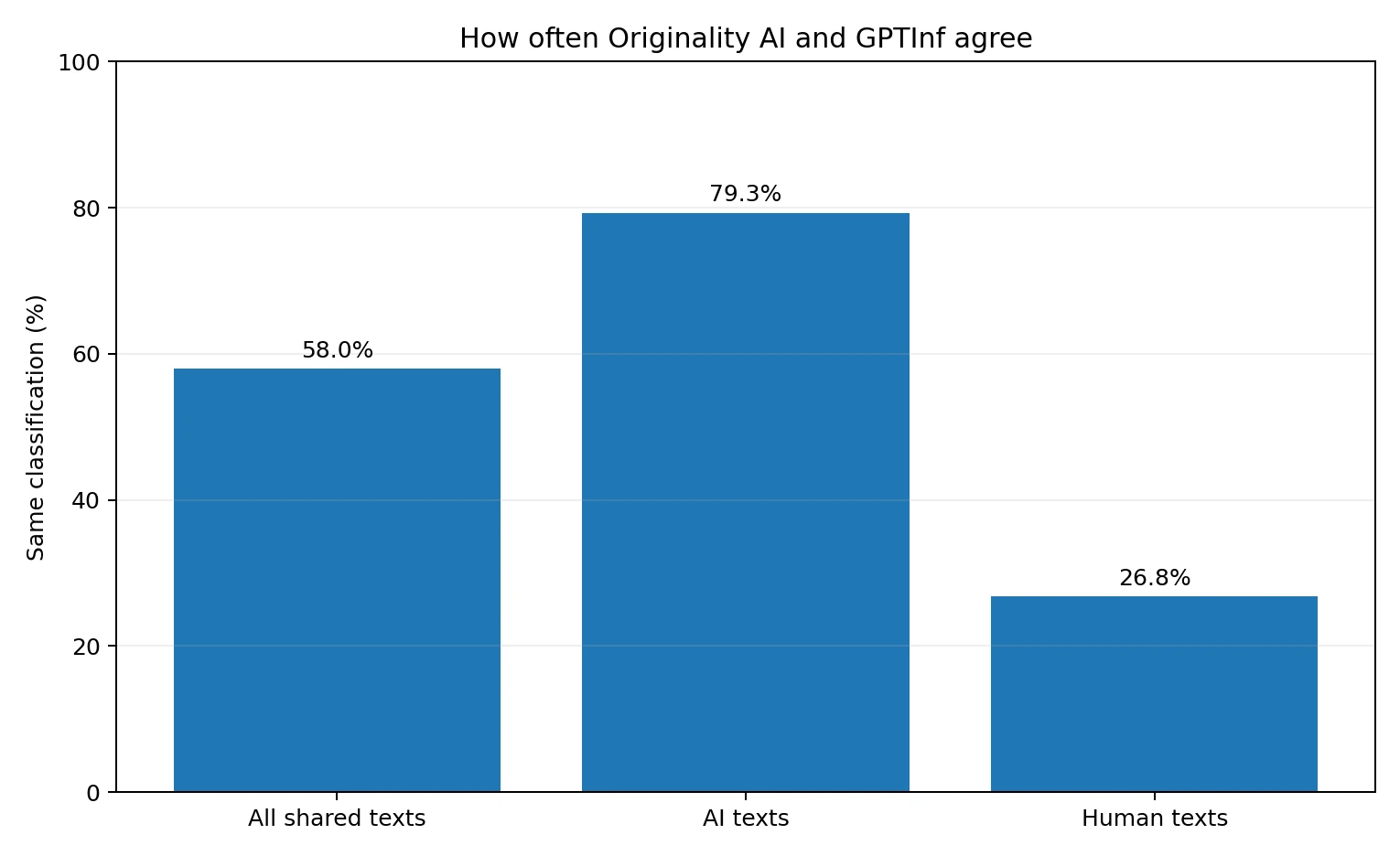
That is probably the clearest answer to the original question. Two detectors that classify the same human texts the same way only about one-quarter of the time are not behaving like close substitutes.
Also Read: I Tested 100 Phrasly Rewrites Against Originality.ai. The Results Were Hard to Ignore.
What do the scores tell us?
The score distributions support the same conclusion. GPTInf gave the AI-written samples an average AI score of about 88.5%, but its human-written samples still received an average AI score of roughly 73.0%. That lack of separation helps explain why so many human texts were classified as AI.
Originality AI's score column points in the opposite direction, with 100% representing human-written text. Human samples averaged about 96.0% human, while AI samples averaged about 29.8% human. In this test, its scoring separated the two groups much more cleanly.
These are detector scores, not proven probabilities that a text was actually written by AI. They are best treated as confidence-style signals produced by each system rather than as mathematical certainty.
Which detector looks better for students and writers?
For students and writers, false positives are especially important. If you wrote an essay, article, or report yourself, a detector incorrectly calling it AI can be more concerning than a detector occasionally failing to identify an AI-generated passage.
Under that criterion, Originality AI performed much better in this particular test. It falsely accused only 2 of 78 human samples, while GPTInf falsely flagged 59.
GPTInf does have one clear advantage in these results: it detected more of the known AI texts. If your only goal were to maximize the percentage of AI samples caught, its 89.0% AI detection rate beat Originality AI's 70.7%.
But that advantage comes with such a large increase in false positives that the two products should not be considered equivalent.
So, is Originality AI similar to GPTInf?
Not based on this dataset. Both tools are trying to solve the same problem, and they often agree when a text is strongly AI-like, but their overall decision patterns are very different.
Originality AI achieved higher overall accuracy and was dramatically better at recognizing human writing. GPTInf caught more AI samples, but it also treated a large percentage of genuine human text as AI-generated. On the exact texts shared by both tests, the two detectors agreed only 58% of the time overall and just 27% of the time on human writing.
That also means you should not assume that a text passing one detector will receive the same result from the other. AI detectors can apply very different thresholds and learn very different signals, so a result from one tool does not reliably predict a result from another.
A final caution about AI detector results
This comparison is based on a limited test set of 160 rows per detector, not every possible writing style, model, language, or type of edited text. The human subsets were also not completely identical between the two CSV files. These results therefore describe how the detectors behaved on this test, not a guarantee of how either service will perform on every document.
For important academic or professional decisions, an AI-detector score should be treated as one signal rather than proof of authorship. The strongest conclusion from this experiment is not that one detector can establish who wrote a document. It is that Originality AI and GPTInf can produce substantially different judgments on the same kind of writing, particularly human-written text.