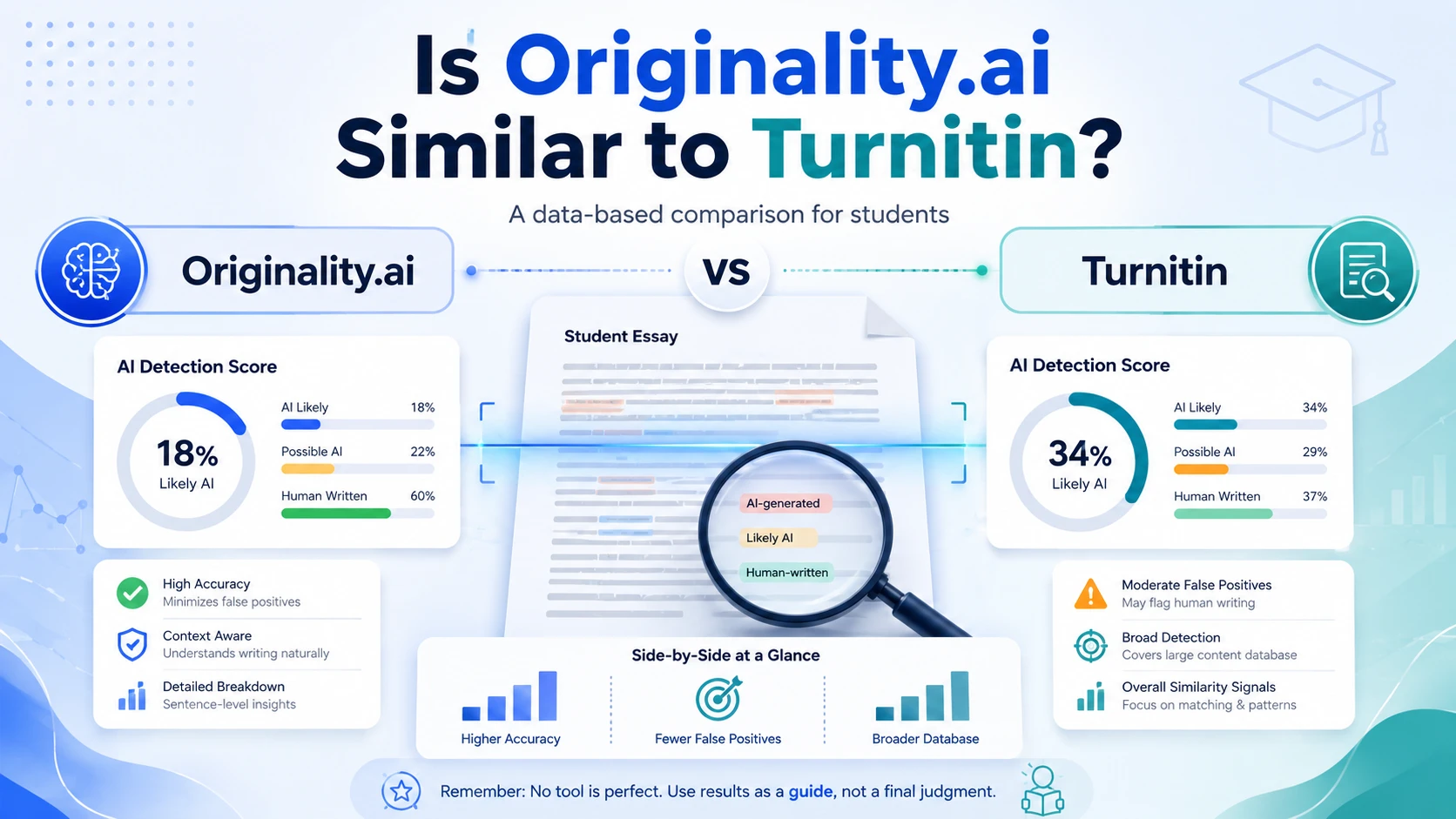

Turnitin's AI detector creates an awkward problem for students. Your school may use it, but you usually cannot run your own paper through the same system before submitting it. That leaves many students searching for a publicly accessible detector that can give them some idea of what Turnitin might say.
Originality.ai is one of the names that comes up often. But the useful question is not simply whether both products detect AI writing. The real question is: does Originality.ai behave similarly enough to Turnitin that its result can tell you what Turnitin is likely to do?
To investigate that, we compared two datasets containing 160 tests each. Every row includes the actual author type, either Human or AI, the detector's final classification, and its confidence score. There were 82 AI-written and 78 human-written samples in each dataset.
TL;DR
- Yes, Originality.ai is fairly similar to Turnitin at a broad level, but it is not a Turnitin clone.
- Originality.ai was 83.8% accurate across its 160 samples, while Turnitin was 82.5% accurate.
- On the 138 exact same texts present in both datasets, the two detectors gave the same Human/AI label 91.3% of the time.
- Their converted AI scores had a strong overall correlation of about 0.84.
- For students worried about false accusations, Turnitin falsely flagged 1 of 78 human texts (1.3%), while Originality.ai falsely flagged 2 of 78 (2.6%).
- Those false-positive counts are very small, so the difference between 1 and 2 false positives should not be treated as proof that one detector is inherently safer.
- If Originality.ai says your work is human-written, that is useful evidence, but it cannot guarantee that Turnitin will agree.
First, the scores do not mean the same thing
The most important detail is hidden in the column names. Turnitin's score is an AI score: a higher percentage means the detector thinks more of the writing is AI-generated.
The Originality.ai dataset uses the opposite direction. Its score is explicitly described as a score where 100% means human-written. To make the two systems comparable, we converted every Originality.ai score into an AI-oriented score using:
Originality.ai AI score = 100 - Originality.ai human score
Without doing that conversion, a score comparison would be backwards and could produce a very misleading conclusion.
Also Read: [STUDY] Can Undetectable AI Bypass Originality AI? A 100-Sample Reality Check
Overall accuracy is remarkably close
Across all 160 rows in each dataset, Originality.ai classified 134 correctly, giving it an accuracy of 83.75%. Turnitin classified 132 correctly, for an accuracy of 82.50%.
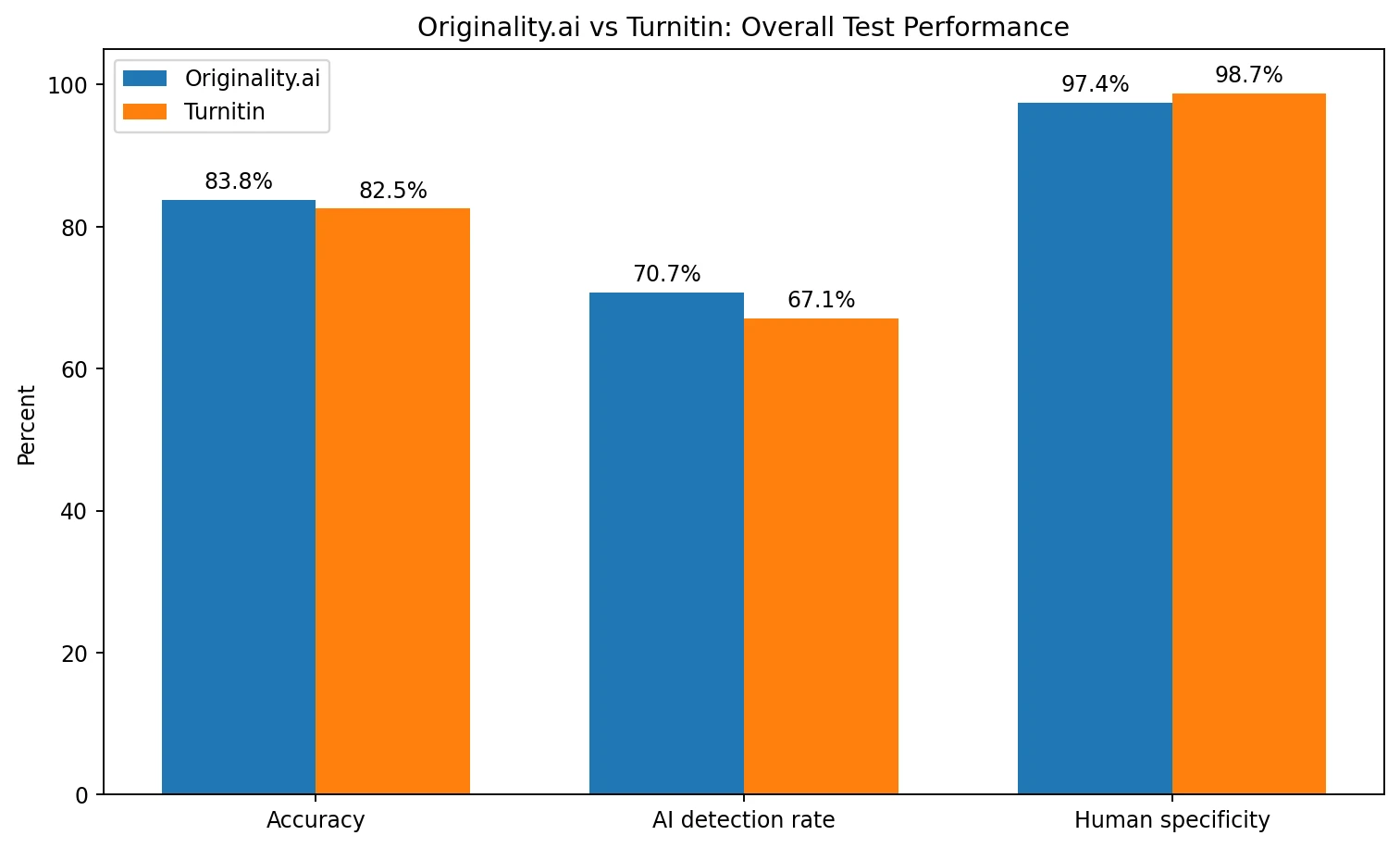
The two-point accuracy gap is small. More importantly, the detectors show almost the same general behavior: both are much better at recognizing genuine human writing than they are at catching every AI-written text.
Originality.ai correctly detected 58 of 82 AI-written samples, an AI detection rate of 70.7%. Turnitin detected 55 of 82, or 67.1%.
On human writing, Originality.ai correctly left 76 of 78 samples as human, while Turnitin correctly left 77 of 78 as human.
Also Read: [STUDY] Can Stealthwriter really slip past Originality.ai? I tested 100 rewrites to find out.
What students care about most: false positives
For a student, a missed piece of AI writing and a false accusation are not equally concerning. The more worrying error is a false positive: writing that really was produced by a human but gets labeled AI.
In this test, Originality.ai produced 2 false positives out of 78 human samples, a false-positive rate of 2.56%. Turnitin produced 1 false positive out of 78, a rate of 1.28%.
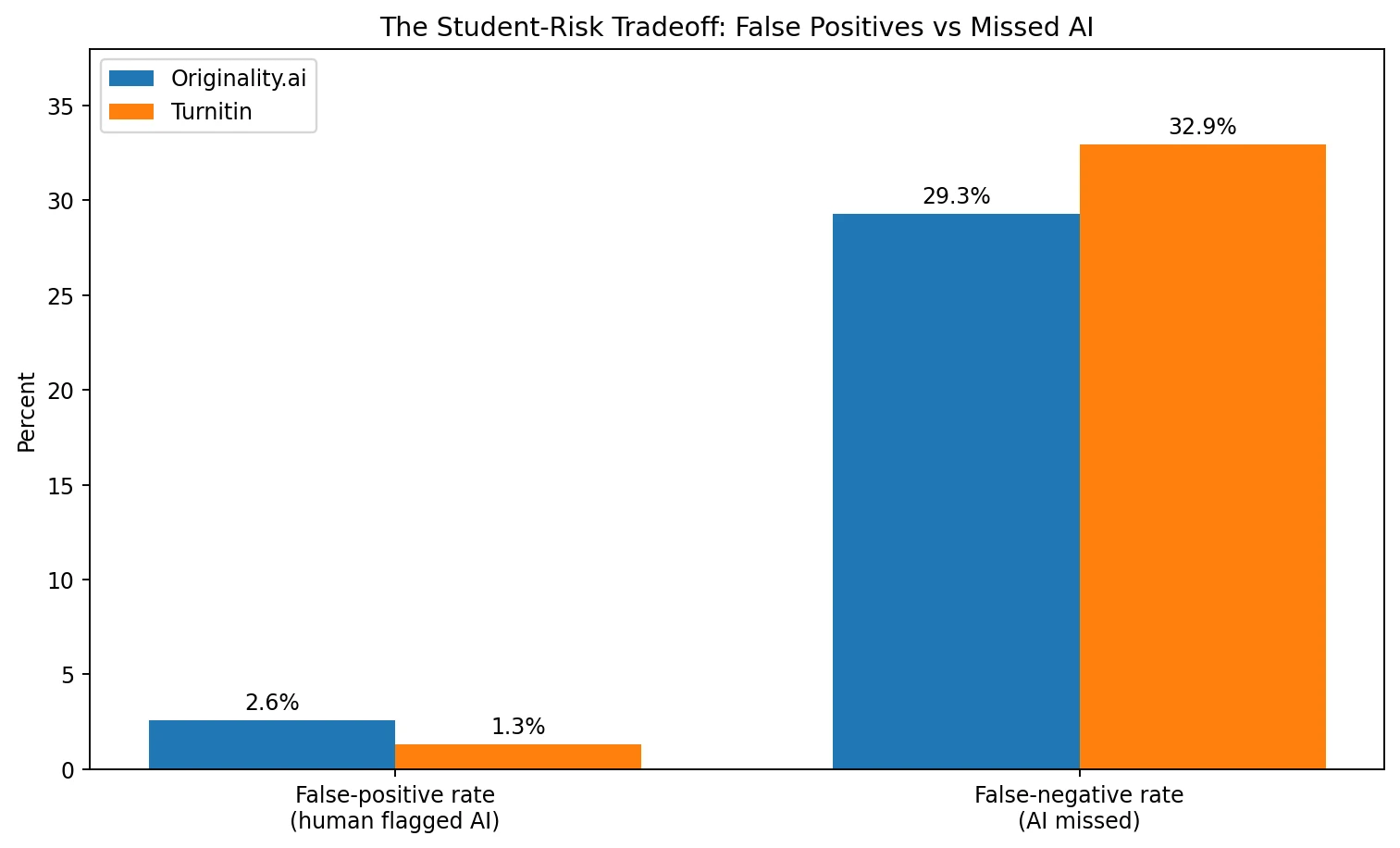
That looks encouraging, but it needs context. With only 78 human samples per detector, one extra false positive changes the percentage noticeably. A difference between one and two errors is not enough evidence to declare Turnitin twice as safe or Originality.ai meaningfully more likely to falsely accuse students.
The larger pattern is that both detectors were conservative in this dataset. They rarely labeled human writing as AI, but that caution came with a cost: Originality.ai missed 24 of 82 AI samples (29.3%), while Turnitin missed 27 of 82 (32.9%).
Also Read: How often does Turnitin update its database?
How often do Originality.ai and Turnitin actually agree?
Accuracy by itself does not answer whether one detector can stand in for another. For that, we need to run the comparison on the same writing.
The two CSV files contain 138 texts that are exact matches. The remaining 22 samples differ between the files, so they should not be used for direct detector-to-detector agreement.
On those 138 shared texts, Originality.ai and Turnitin gave the same final Human/AI classification on 126 samples and different classifications on 12. That is an agreement rate of 91.3%.
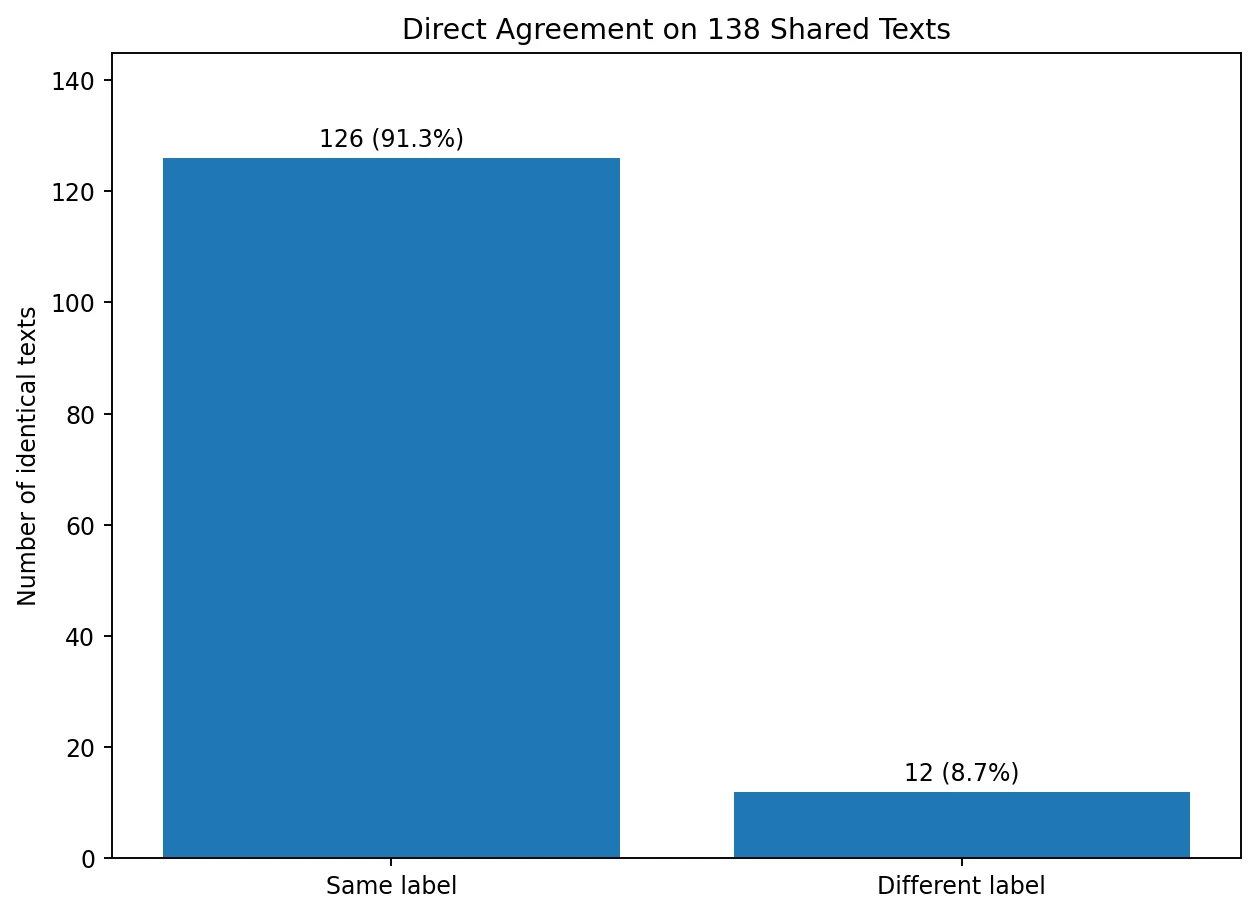
The agreement is not just caused by both detectors favoring the Human label. Cohen's kappa, which adjusts for agreement that could happen from the detectors' overall label tendencies, is approximately 0.82. That indicates strong similarity in their binary decisions within this dataset.
Still, 12 disagreements out of 138 means roughly one in every 11.5 shared samples received a different verdict. For a student trying to predict one specific Turnitin result, that difference matters.
Also Read: [HOT] Does Turnitin compare your paper against paywalled journals?
The detectors are also similar at the score level
After reversing Originality.ai's human-oriented score into an AI-oriented score, the two detectors' scores show a strong overall relationship. The Pearson correlation across the shared texts is about 0.84.
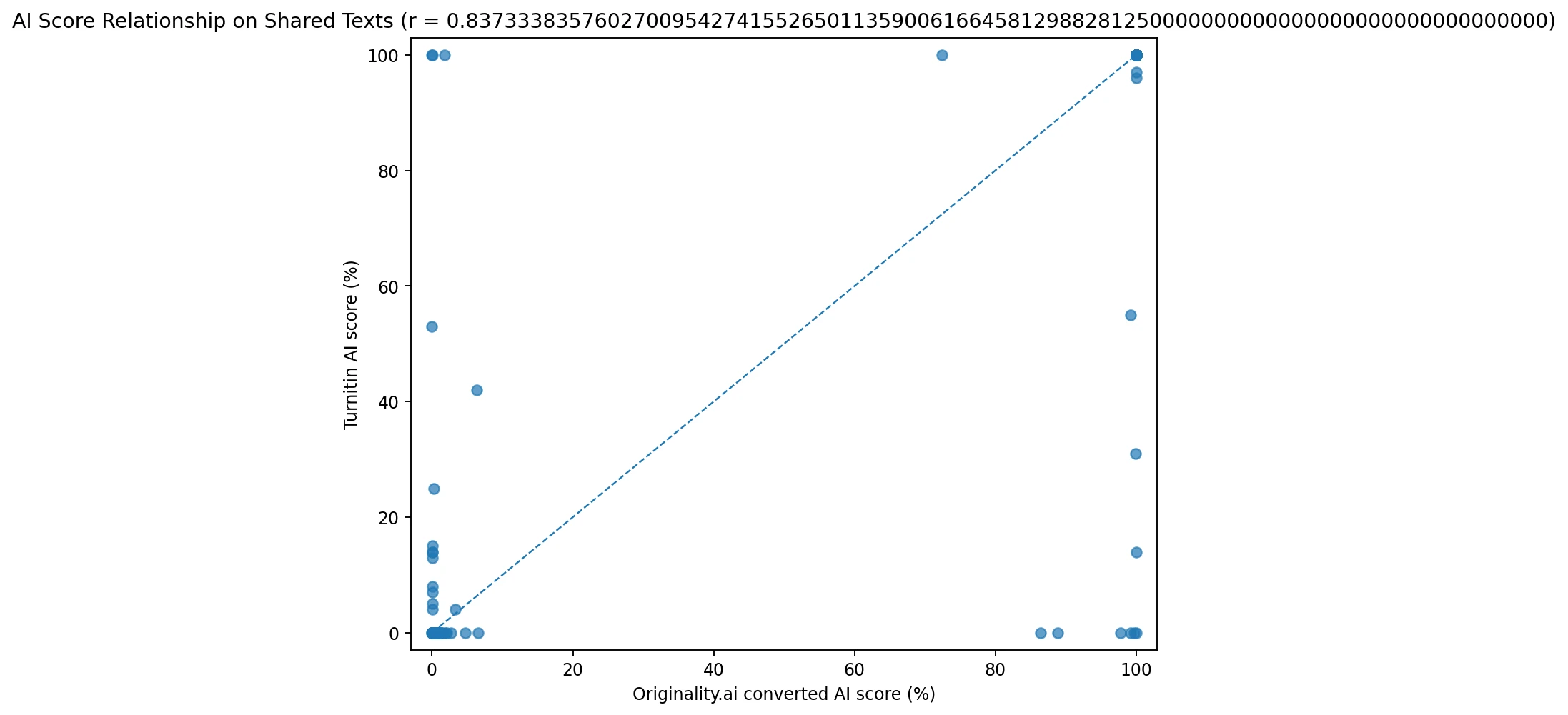
The dashed diagonal represents perfect score agreement. Many samples cluster near the same broad regions: texts one detector considers strongly AI-like are often considered strongly AI-like by the other, while human writing tends to sit near the bottom of both AI scales.
However, the points do not all sit on the diagonal. A strong correlation does not mean the percentages are interchangeable. A 20% Originality.ai AI score should not be read as a prediction that Turnitin will show exactly 20%.
What happens specifically to human writing?
The shared human-written subset is especially relevant for students who wrote their work themselves and want to understand false-flag risk.
Among the 56 human texts that appeared in both datasets, Turnitin classified all 56 as Human. Originality.ai classified 55 as Human and one as AI. Most human samples received very low AI scores from both systems.
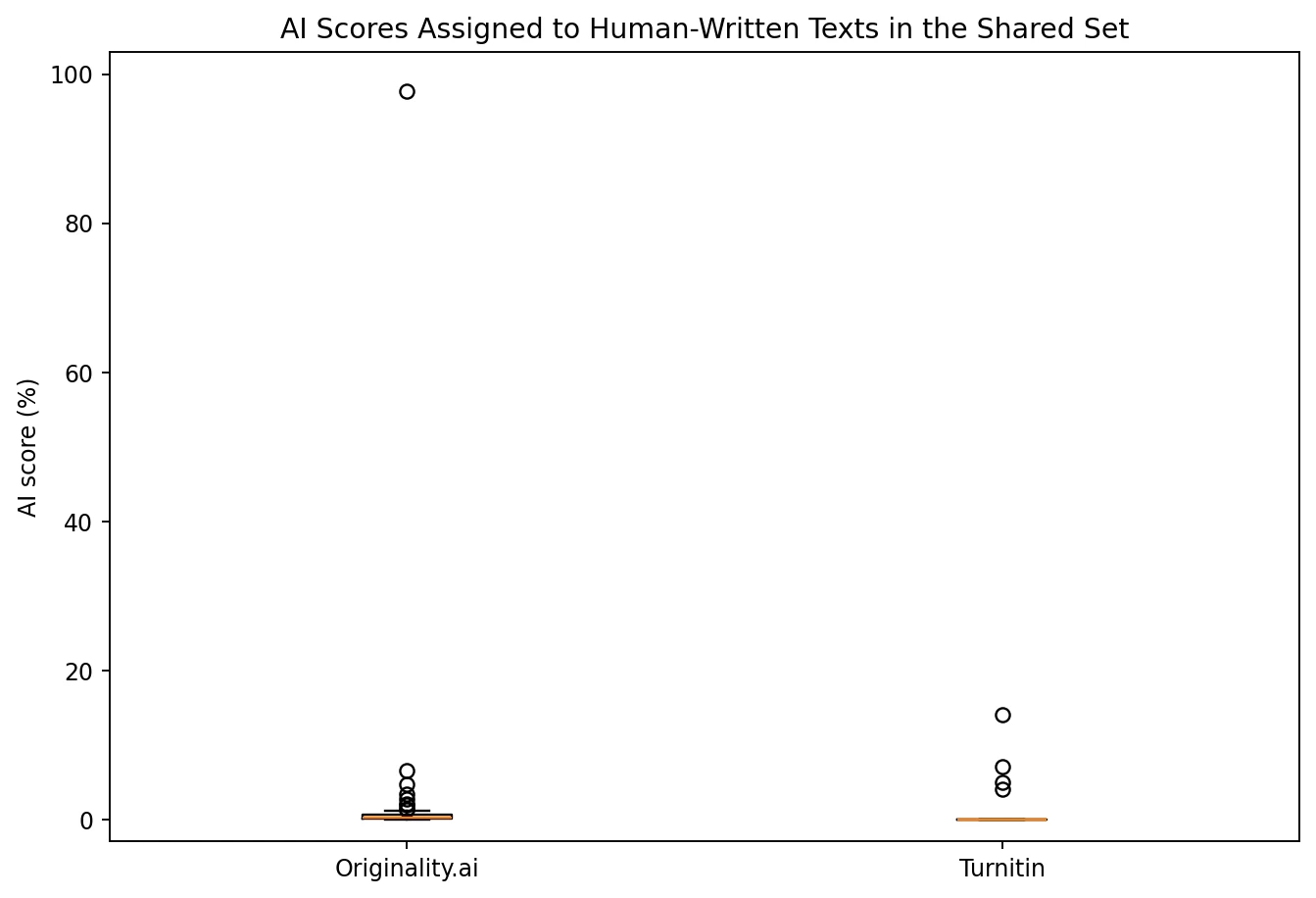
This is a positive sign for using Originality.ai as a rough pre-check, but the sample is still too small to treat a clean result as a guarantee. Real student work varies enormously by subject, editing style, English proficiency, use of templates, quotations, technical vocabulary, and sentence structure.
Where the similarity breaks down
The shared dataset reveals something important: the two detectors can fail on the same text, but they can also disagree about which text is suspicious.
Of the 138 shared samples, both detectors were correct on 106. Both were wrong on 20. Originality.ai was correct while Turnitin was wrong on 7, and Turnitin was correct while Originality.ai was wrong on 5.
That is exactly why Originality.ai should be treated as an approximation of Turnitin's behavior rather than a private copy of Turnitin. They appear to respond to many of the same broad signals, but they do not make identical decisions.
Can you use Originality.ai to predict a Turnitin AI score?
You can use it as a rough warning signal, not as a score converter.
If Originality.ai gives a text a very strong human result, this dataset suggests Turnitin will often agree. If Originality.ai gives a very strong AI result, Turnitin also frequently sees the same text as AI. But the exact percentages and borderline decisions should not be treated as equivalent.
For students, the most reasonable interpretation is:
- Low AI signal on Originality.ai: reassuring, but not a guarantee of a clean Turnitin result.
- High AI signal on Originality.ai: worth reviewing, especially if the writing is genuinely yours and you can identify repetitive, generic, or overly formulaic sections.
- Borderline result: the least useful zone for prediction because the detectors can cross their decision thresholds differently.
- Exact score matching: do not assume Originality.ai's percentage will equal Turnitin's percentage.
Is Originality AI similar to Turnitin?
Yes, based on this dataset, Originality.ai is meaningfully similar to Turnitin in overall detection behavior. Their overall accuracy is close, their false-positive rates are both low in this test, their scores move in similar directions, and they agree on more than nine out of ten identical texts.
But "similar" is not the same as "equivalent." A student should not run an essay through Originality.ai and assume the number on screen is what a teacher will see in Turnitin. The direct comparison still produced 12 different classifications among 138 shared texts, and the two products do not use an identical scoring system.
So, if you cannot access Turnitin yourself, Originality.ai can be a useful rough proxy for checking whether your writing contains patterns that another major AI detector may also notice. It is much less defensible to use it as a precise Turnitin predictor.
A final caution about AI detector scores
No detector result can prove who wrote a paper. This test measures how two classifiers behaved on a particular collection of labeled texts. It does not establish a universal false-positive rate for every student, every writing style, or every future version of either detector.
If your work is genuinely your own, keeping drafts, notes, sources, revision history, and earlier versions of the document provides much stronger evidence of authorship than trying to optimize for a detector score. Detector output is best treated as one imperfect signal, not a verdict.