
We checked 160 passages. The results reveal a detector that usually trusts the writing in front of it—even when that writing came from AI.
TL;DR
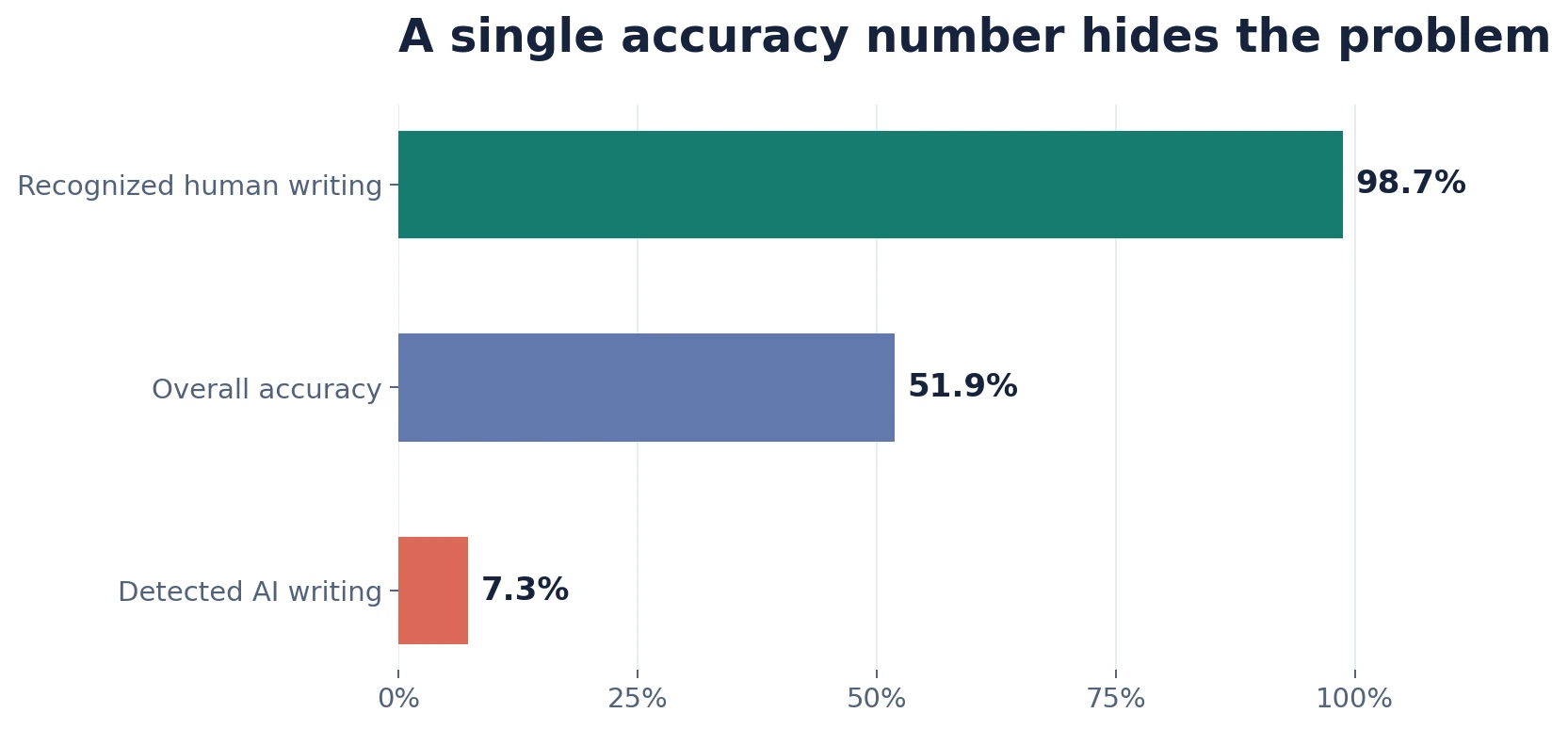
StealthWriter was not reliable at detecting AI writing in this test. It caught just 6 of 82 AI-written passages (7.3%), but correctly accepted 77 of 78 human-written passages (98.7%). Its overall accuracy was 51.9%. A “Looks Human” result is not proof that someone wrote the text themselves; an AI flag should not be treated as proof of misconduct either.
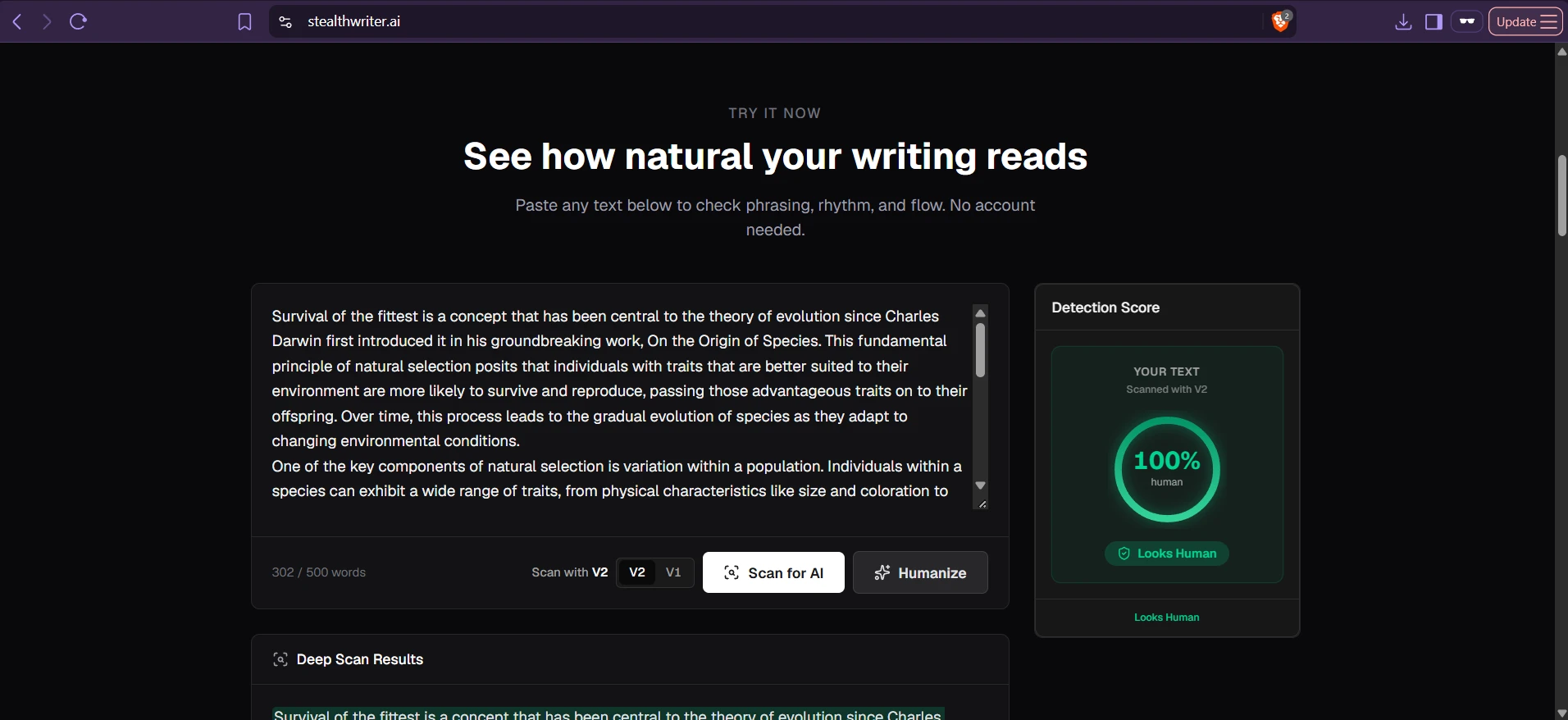
An AI writes 302 words about evolution. StealthWriter scans the passage and returns a glowing green badge: 100% human. No hesitation, no warning. Just a confident-looking answer to the wrong question: the passage was actually AI-written.
Now imagine that same detector examining an assignment you spent hours writing yourself. Would you trust the number on its screen? In a test containing both human and AI writing, StealthWriter let most AI passages through while incorrectly flagging one human-written piece. For students, that difference matters more than any impressive-looking percentage.
Also Read: StealthWriter AI vs BypassGPT: Which One Actually Beats AI Detectors?
How Accurate Is the StealthWriter AI Detector?
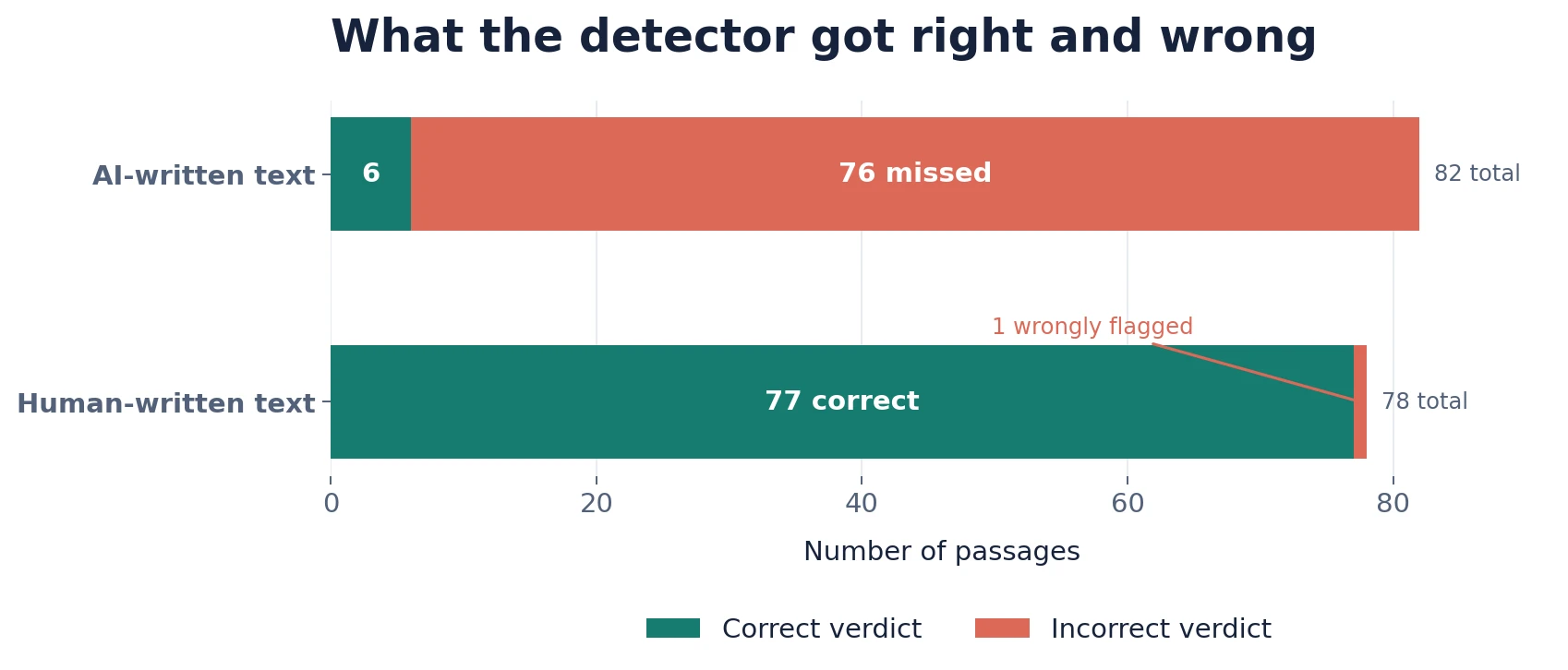
Across 160 passages, the detector made the correct call 83 times. That works out to 51.9% overall accuracy. But the total hides two very different outcomes:
| What was submitted | What StealthWriter said | Number |
|---|---|---|
| AI-written | AI (correct) | 6 |
| AI-written | Human (incorrect) | 76 |
| Human-written | Human (correct) | 77 |
| Human-written | AI (incorrect) | 1 |
Why Did So Much AI Writing Pass as Human?
The detector labeled 76 out of 82 AI passages as human. That's a 92.7% miss rate: for every 100 AI texts resembling those in this test, it would have missed roughly 93.
Even more striking, 65 AI-written passages received a score of zero in the supplied results, the same score associated with a fully human-looking result. These were not merely borderline calls.
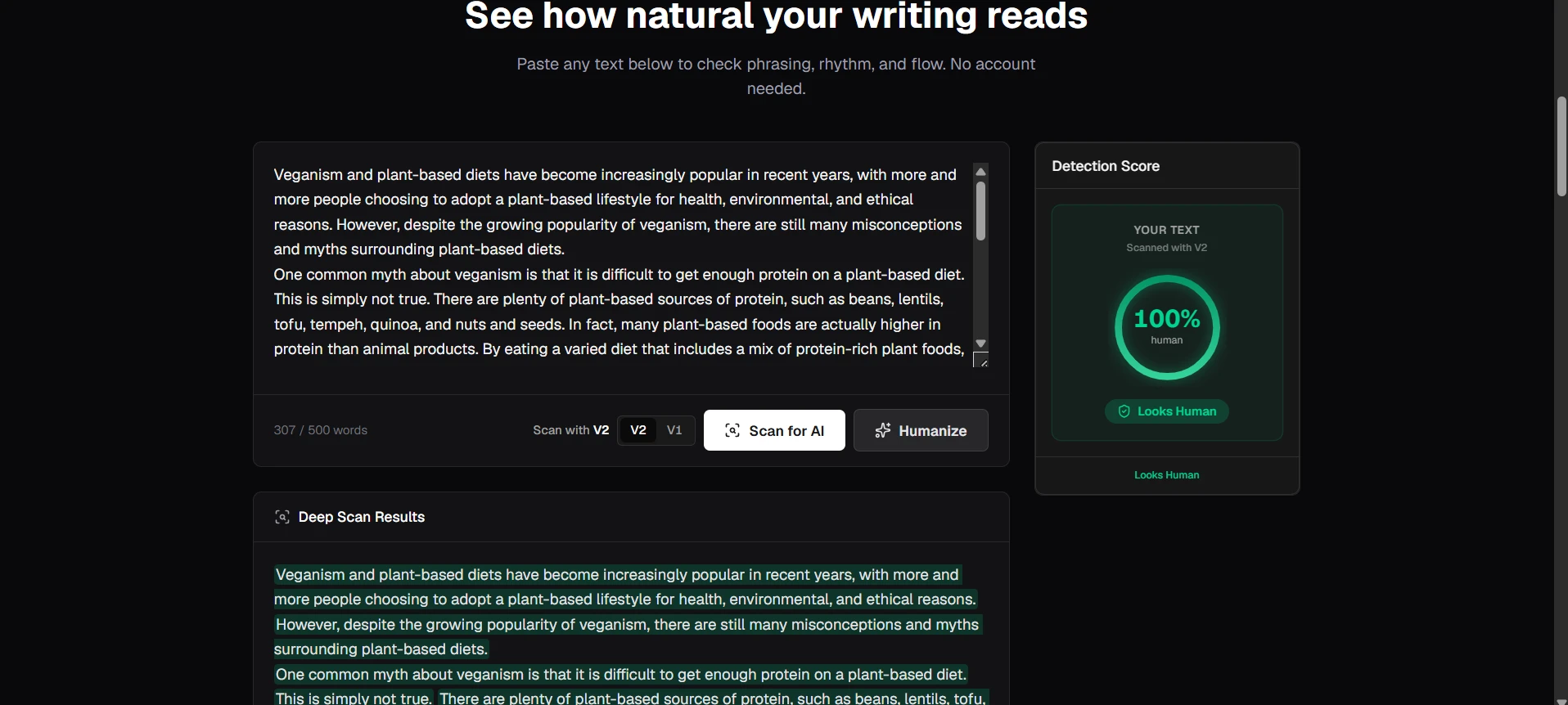
The screenshots show examples about evolution and veganism receiving a 100% human display despite being labeled AI-written in the test data. A confident-looking interface does not make a verdict correct.
Also Read: Is StealthWriter Safe for Students?
Does StealthWriter Falsely Accuse Human Writers?
It did in one case. Among 78 human-written passages, StealthWriter incorrectly called one AI-generated. The false-positive rate—meaning genuine human writing wrongly marked as AI—was 1.3% in this sample.
That wrongly flagged passage, titled Kids’ Favorite Board Games, even received a recorded score of 100. An extreme score, therefore, can still be wrong about authorship.
The low false-positive rate sounds reassuring, but it is not a guarantee. Seventy-eight human examples cannot establish what will happen to every student's writing style, subject, or language background. A single false accusation can also carry serious consequences when a teacher treats a detection score as evidence rather than a clue.
Also Read: Is Stealthwriter Good?
What Do Its Detection Scores Actually Tell Us?
Most scores were clustered at the lowest possible value. Out of all 160 passages, 137 scored zero. That includes 65 AI texts and 72 human texts.
In other words, a zero score did little to distinguish who wrote the passage. The chart below groups the recorded scores from zero to 100. The numbers inside the largest sections show how many passages fell there.
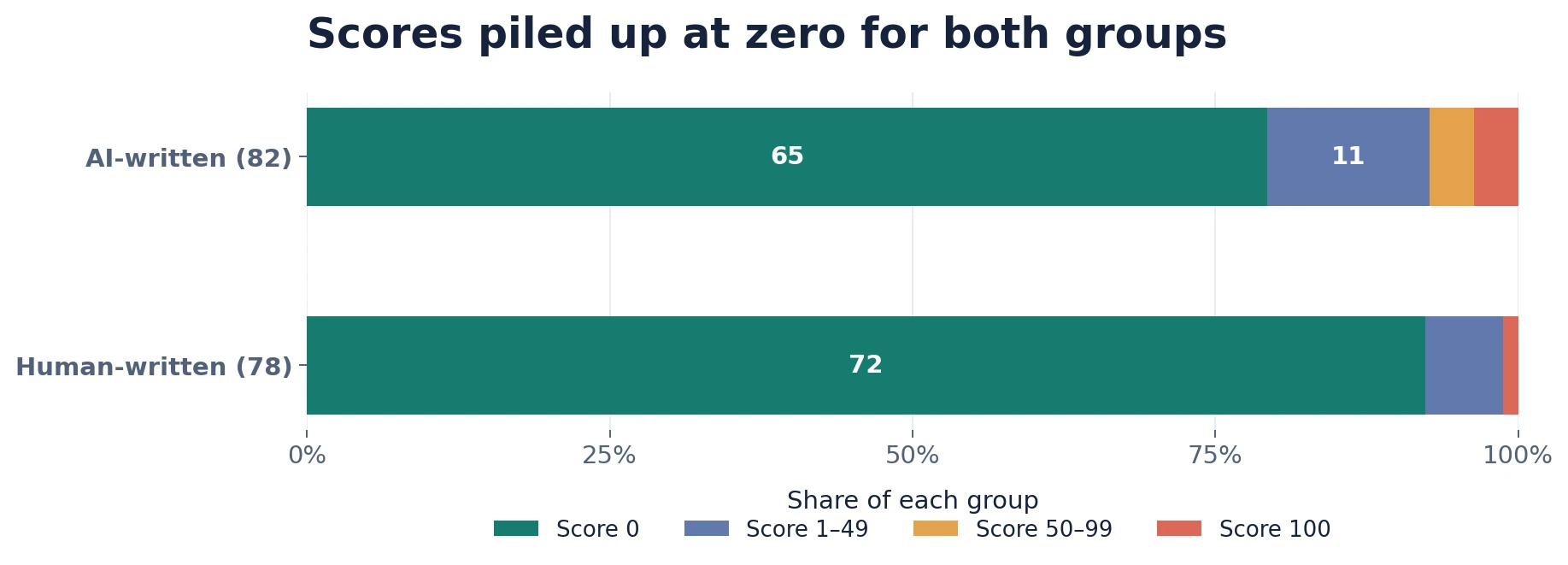
There is one important distinction: of the seven passages flagged as AI, six really were AI-written. So a flag was often right among the very few flags issued. It does not follow that an unflagged passage is human-written—or that a particular student's flagged essay must be AI-generated.
Also Read: Can Stealthwriter AI Beat QuillBot's AI Detector? We Tested 100 Rewrites
How Was This Accuracy Test Conducted?
The dataset contains the original text, a label identifying its writer as AI or human, StealthWriter's verdict, and its recorded score. We compared each verdict with the supplied writer label and counted correct and incorrect results. The sample was nearly balanced: 82 AI passages and 78 human passages.
These findings describe this dataset, not every possible use of StealthWriter. The file does not establish which AI models produced the passages, whether any were edited, or whether all scans used the same detector version. Also, nine human entries exceed the 500-word limit visible in the screenshots; the file does not show whether they were shortened before scanning.
Excluding those nine longer human texts changes the overall accuracy to 49.0%; the AI detection rate stays at 7.3%. Those gaps prevent sweeping claims about all subjects, future versions, or real classroom conditions. They do not erase the central finding: this set of AI writing was overwhelmingly labeled human.
Also Read: [STUDY] Can Stealthwriter Really Bypass Copyleaks? What 100 Samples Show
Should Students Trust StealthWriter's AI Detector?
Use a detector as a rough signal, not as a verdict on authorship. If you're worried about your own essay, a sensible approach is to:
- Keep drafts and revision history. They show how your argument developed.
- Save notes and sources. Research material helps establish your writing process.
- Ask for specific concerns. A colored score is not an explanation of what is supposedly wrong.
- Follow your institution's AI policy. Disclosure rules matter more than trying to achieve a particular detector score.
Before uploading coursework to any third-party detector, consider whether it contains private information or unpublished research.
Final Verdict: Is StealthWriter AI Detector Accurate?
Not reliably for detecting AI-written text, based on these 160 tests. StealthWriter recognized most human writing, but missed nearly all the AI passages. Its 51.9% overall accuracy should not be mistaken for useful detection performance.
For students, the lesson is simple: neither a green badge nor an alarming red one can tell the complete story of how an essay was written. Writing has a process. A detector only makes a guess.