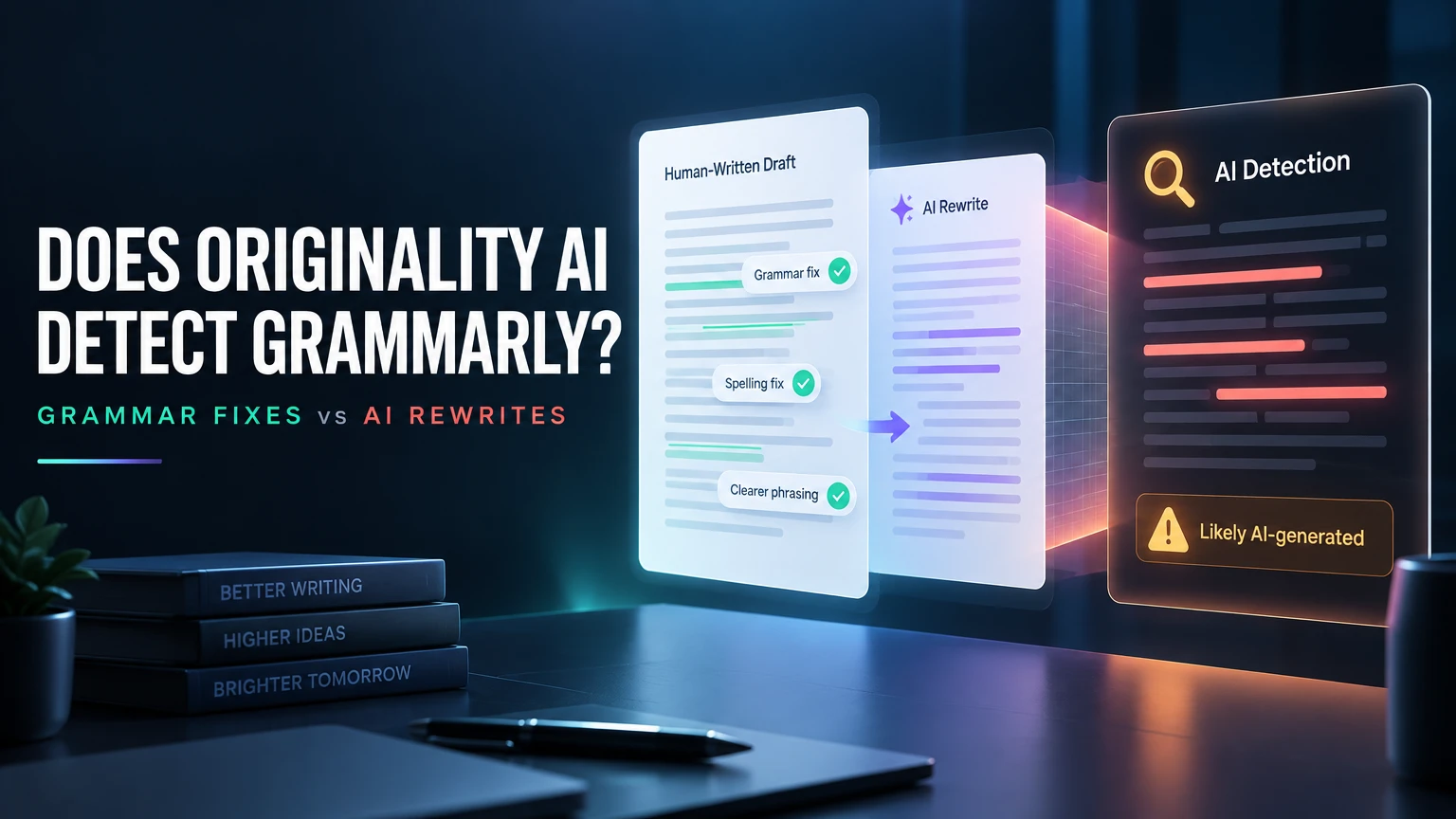

Yes, Originality AI can flag text after you use Grammarly, but it depends heavily on what you actually let Grammarly change.
If you are only fixing obvious spelling mistakes, missing commas, punctuation errors, or basic grammar problems, you are usually fine. The risk starts going up when you accept suggestions that change your wording, sentence structure, tone, clarity, or delivery.
I have tested this myself, and the difference is quite noticeable. A piece of writing can look completely human before Grammarly touches it, then start getting flagged after enough of Grammarly's more aggressive suggestions are accepted.
So the important question is not really, "Does Originality AI detect Grammarly?"
The better question is:
How much of your writing did Grammarly actually rewrite?
Also Read: Does Using Grammarly Affect AI Detection?
Basic Grammar Corrections Usually Are Not the Problem
There is a big difference between correcting an error and rewriting a sentence.
Suppose you write:
He don't know what happened yesterday.
And Grammarly changes it to:
He doesn't know what happened yesterday.
That is a straightforward grammatical correction. Your sentence is still essentially your sentence. Grammarly has fixed a clear error without changing your style or reorganizing your thought.
The same applies to things such as missing commas, incorrect apostrophes, obvious spelling errors, subject-verb agreement, and similar mechanical corrections.
Even Grammarly says that its traditional, non-generative corrections should typically have little effect on AI detection scores.
Originality AI has published similar findings. In one of its own Grammarly tests, lightly edited human-written essays generally continued to be recognized as human when only grammar corrections were accepted.
That matches what I have seen in my own testing.
Also Read: [STUDY] Can Undetectable AI Bypass Grammarly's AI Detector?
The Problem Starts With Rewriting Suggestions
Grammarly is no longer just a grammar checker.
It can now suggest clearer versions of sentences, shorten sentences, change tone, improve conciseness, rewrite paragraphs, paraphrase text, make writing sound more professional, and generate entirely new wording.
Once you start accepting those suggestions, you are no longer simply correcting grammar. You are allowing an AI system to change how your ideas are expressed.
This distinction matters because AI detectors are not looking for a hidden Grammarly tag inside your document. There is no invisible label saying, "This sentence came from Grammarly."
They are looking at linguistic patterns.
When Grammarly rewrites a sentence, the resulting wording may contain patterns that are more statistically similar to machine-generated writing than the sentence you originally wrote.
The more rewritten text you accept, the more noticeable that effect can become.
Also Read: [HOT] Grammarly vs Sapling AI Detector: Which One Is Fairer to Student Writing?
Grammarly Uses AI Models for Much More Than Grammar
It is worth understanding what Grammarly is doing behind the scenes.
For traditional correctness features, Grammarly uses a mixture of rule-based systems and machine-learning models. Its engineering team has also described transformer-based sequence-to-sequence models that can take an incorrect sentence and produce a corrected version.
For more subjective tasks such as style, tone, clarity, and rewriting, machine-learning models play a much larger role.
Grammarly also has explicit generative AI features. These can rewrite sentences, rewrite paragraphs, adjust tone, paraphrase text, compose new text, and transform existing writing.
Grammarly has previously stated that its generative writing features use large language models.
This is why I would not treat every Grammarly suggestion equally.
A suggestion telling you to add a comma is very different from a button offering to "rewrite for clarity."
The second option may replace most of your original wording with wording produced by a model.
Also Read: Can Grammarly Humanize AI Text?
Why Tone and Clarity Suggestions Can Trigger Originality AI
This is where many people get caught.
They write the entire article themselves, run it through Grammarly, accept a large number of suggestions, and then wonder why an AI detector suddenly gives them a much higher AI score.
The problem is often not the grammar corrections.
It is everything else.
For example, Grammarly may suggest that you:
- make a sentence more confident;
- make the wording more professional;
- remove repetition;
- rewrite a sentence for clarity;
- shorten a paragraph;
- make the tone more positive;
- replace a sentence with a "better" version;
- paraphrase a section;
- rewrite an entire paragraph.
Those changes can substantially alter the language statistics of your writing.
Originality AI has tested this exact issue. In its published experiment, it took ten human-written IELTS essays and created two Grammarly-edited versions. One version accepted only grammar suggestions. The other accepted Grammarly's broader rewriting and rephrasing suggestions.
The lightly edited versions generally remained classified as human, while the heavily edited versions were much more likely to be flagged as AI-generated.
That is almost exactly what I have found from my own testing.
Also Read: [DIRECT] Does Grammarly Humanizer Work?
Full Sentence Rewrites Carry the Highest Risk
The biggest jump usually happens when Grammarly starts replacing complete sentences or paragraphs.
Grammarly now offers several features capable of doing this, including paragraph-level rewrites, paraphrasing tools, generative AI assistance, tone rewrites, and dedicated rewriting agents.
At that point, large portions of the final text may no longer contain the wording you naturally chose.
Your ideas may still be yours. Your research may still be yours. You may even have written the entire first draft yourself.
But the final language can increasingly become machine-produced language.
Grammarly itself acknowledges this distinction in its documentation. It says traditional corrections normally should not have much effect on its own AI detector, while meaningful sentence and paragraph rewrites can increase the percentage of text classified as AI-generated.
It also explicitly notes that paraphrasing edits are performed by large language models and can therefore trigger AI detection.
That is an important detail.
You do not need to generate an article from scratch with ChatGPT for AI detection to become an issue. AI-assisted rewriting can be enough.
Originality AI Has Become Much More Sensitive to AI-Edited Writing
This matters even more with Originality AI's newer detection models.
Originality AI released Originality 5.0 and Originality 5.0 Max in October 2026. One of the major areas the company has focused on is mixed writing: documents that contain a combination of human-written and AI-influenced text.
That is directly relevant to Grammarly.
A document that you wrote yourself and then heavily revised with AI-powered rewriting tools is exactly the type of mixed-authorship problem modern detectors are increasingly trying to identify.
Originality says its 5.0 Max model classified 90.1% of mixed documents correctly in one of its published tests. The company is also actively testing text produced by paraphrasers, humanizers, rewriting tools, and other systems designed to modify AI-generated language.
This follows a wider trend in AI detection.
Pangram, for example, has publicly described training systems specifically to recognize humanized and AI-edited text. Its newer detector includes separate categories for human writing, AI-assisted writing, and AI-generated writing.
Originality AI is clearly moving in the same general direction: instead of asking only whether an entire document came from an LLM, its newer models are increasingly trying to identify smaller amounts of AI involvement.
That makes heavy Grammarly use more relevant than it was a few years ago.
Are Originality 5.0 and 5.0 Max More Likely to Flag Grammarly?
In practical use, I would be more careful with them.
Originality's own benchmark numbers say that its newer models maintain very low false-positive rates on the datasets it tested. So I would not claim that every human writer is suddenly going to get falsely flagged.
However, these models are also specifically designed to detect much smaller amounts of AI involvement and perform better on mixed human-AI writing.
Those two goals create an important distinction.
If Grammarly only corrects a typo, there may be almost nothing meaningful for the detector to notice.
If Grammarly rewrites twenty sentences, improves your tone, restructures paragraphs, simplifies your wording, and replaces phrases throughout the article, there is now a substantial amount of machine-influenced language for a detector to evaluate.
That does not necessarily make the detector wrong.
The uncomfortable part is that there is no clean boundary between "AI generated" and "human written" anymore.
A document can genuinely be written by a human while still containing many sentences whose final wording came from an AI system.
That is exactly why detector scores should never be treated as definitive proof of authorship.
A large 2026 study of professionally edited human writing also found that editing itself can significantly change AI detector scores. The direction and size of the change differed between detectors, but heavier editing was associated with larger score changes.
In other words, writing style matters to these systems, not just who originally had the idea.
What I Recommend If You Need to Pass Originality AI
My rule is very simple:
Use Grammarly to correct mistakes, not to rewrite your writing.
If Grammarly points out that you used the wrong tense, fix it.
If Grammarly catches a spelling error, fix it.
If you forgot a comma, add it.
If your subject and verb do not agree, correct them.
But if Grammarly says your sentence could sound more confident, more engaging, more professional, more concise, or more polished, I would usually leave it alone if AI detection matters to you.
The same applies to rewrite buttons.
Do not automatically accept a replacement sentence simply because Grammarly says it is clearer.
Read the suggestion, understand what Grammarly thinks is wrong, and then make the improvement yourself in your own words.
That lets you keep your natural sentence structure, vocabulary, rhythm, and imperfections.
Those characteristics are part of what makes your writing yours.
The Safest Way to Use Grammarly With Originality AI
If you know your work will be checked with Originality AI, this is the approach I would use.
Write the entire first draft yourself.
Then use Grammarly only for obvious correctness issues: spelling, punctuation, clear grammatical errors, and similar mistakes.
Ignore most tone, style, clarity, conciseness, paraphrasing, and rewriting suggestions.
If Grammarly identifies a sentence that genuinely needs improvement, rewrite that sentence yourself instead of accepting Grammarly's replacement.
And avoid paragraph rewrites or generative AI features entirely if maintaining a clearly human writing trail is important.
You can also keep your original draft. If a detector ever produces an unexpected result, having the pre-Grammarly version makes it much easier to see exactly which edits changed the score.
So, Does Originality AI Detect Grammarly?
It can.
But Grammarly itself is not automatically the problem.
The amount and type of editing are what matter.
Basic grammar and punctuation corrections usually have very little effect. Heavy rewriting, tone adjustments, paraphrasing, sentence replacements, and paragraph-level rewrites are much more likely to affect the result.
The odds increase further as you accept more AI-generated wording.
This is especially important now that detectors such as Originality 5.0, Originality 5.0 Max, and Pangram are being built to recognize AI-assisted and mixed-authorship writing rather than just completely AI-generated articles.
So if you wrote something yourself and want it to remain recognizably yours, keep Grammarly in its original role: fixing mistakes.
Do not let it become your ghostwriter.