
TL;DR
- StealthWriter won the head-to-head test overall, averaging a 58.8% human score across the five detectors tested on both tools, compared with 49.8% for BypassGPT.
- StealthWriter led on Copyleaks, Originality.ai, and QuillBot. BypassGPT won clearly on GPTZero. Sapling produced an exact tie in the uploaded results.
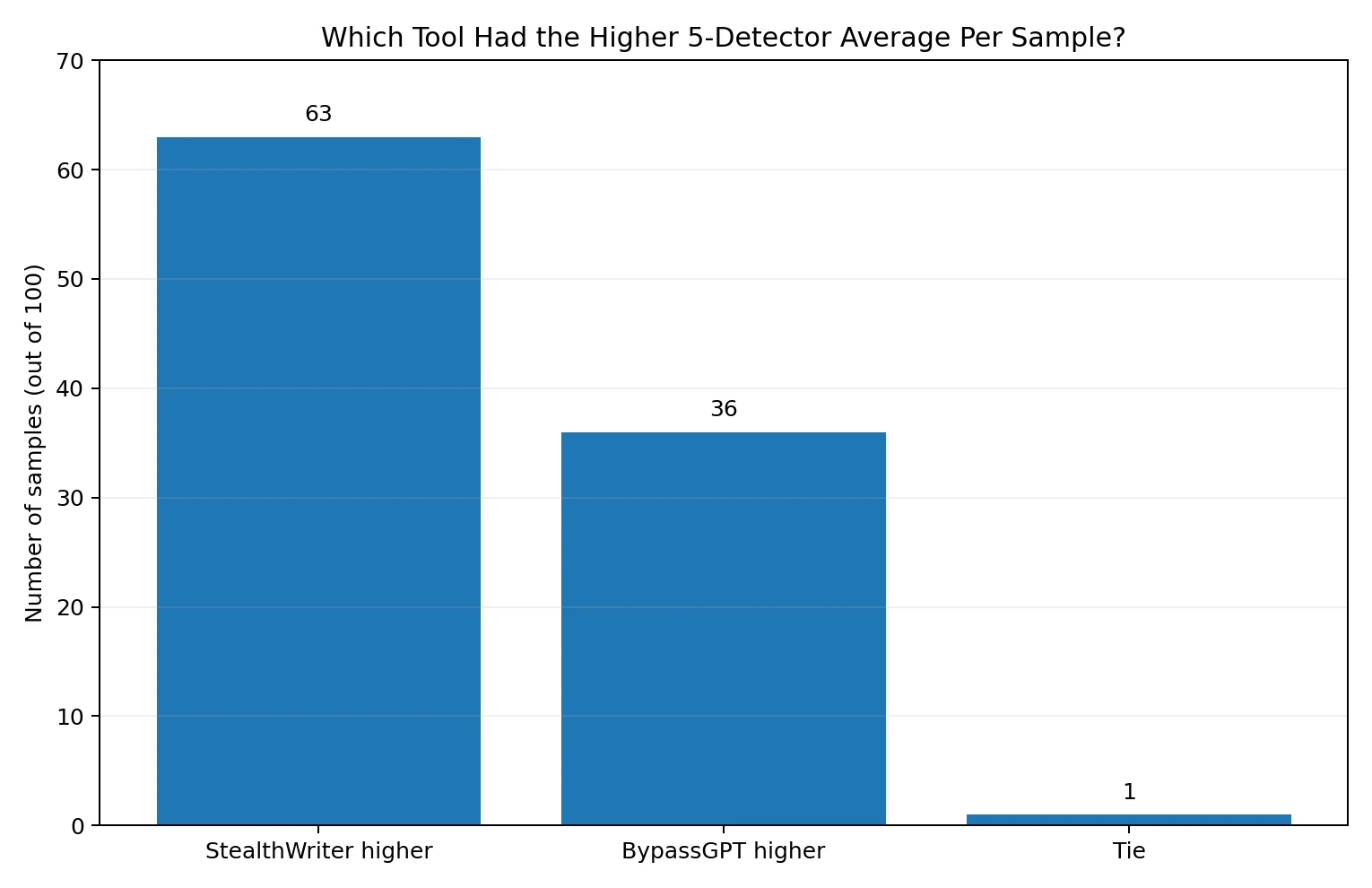
- Across the 100 paired samples, StealthWriter had the higher five-detector average on 63 samples; BypassGPT won 36, with one tie.
- StealthWriter also preserved numbered-list formatting much more reliably. BypassGPT produced more obvious hallucinations, broken phrases, irrelevant additions, and meaning drift.
- Neither tool was consistently “undetectable.” Results changed dramatically depending on the detector.
What does it really mean when an AI humanizer promises to make generated text look human? If one detector calls a rewrite human and another flags the same passage as AI, the word “undetectable” starts to lose its meaning.
To see how two popular options compare, I tested StealthWriter AI and BypassGPT on the same 100 source samples. The detector scores were converted into human scores, so a higher percentage means the detector considered the text more human-like. I also read through the rewrites themselves because a high detector score is not useful if the output becomes inaccurate, awkward, or nonsensical.
Also Read: Is StealthWriter Safe for Students?
How did StealthWriter and BypassGPT perform across the same detectors?
Five detectors were available for a fair direct comparison: Copyleaks, GPTZero, Originality.ai, QuillBot, and Sapling. Across those five, StealthWriter averaged 58.8%, while BypassGPT averaged 49.8%. That gives StealthWriter an advantage of about 9 percentage points.
| AI detector | BypassGPT | StealthWriter | Winner |
|---|---|---|---|
| Copyleaks | 50.0% | 67.7% | StealthWriter |
| GPTZero | 66.0% | 47.2% | BypassGPT |
| Originality.ai | 49.0% | 74.3% | StealthWriter |
| QuillBot | 60.5% | 81.4% | StealthWriter |
| Sapling | 23.7% | 23.7% | Tie |
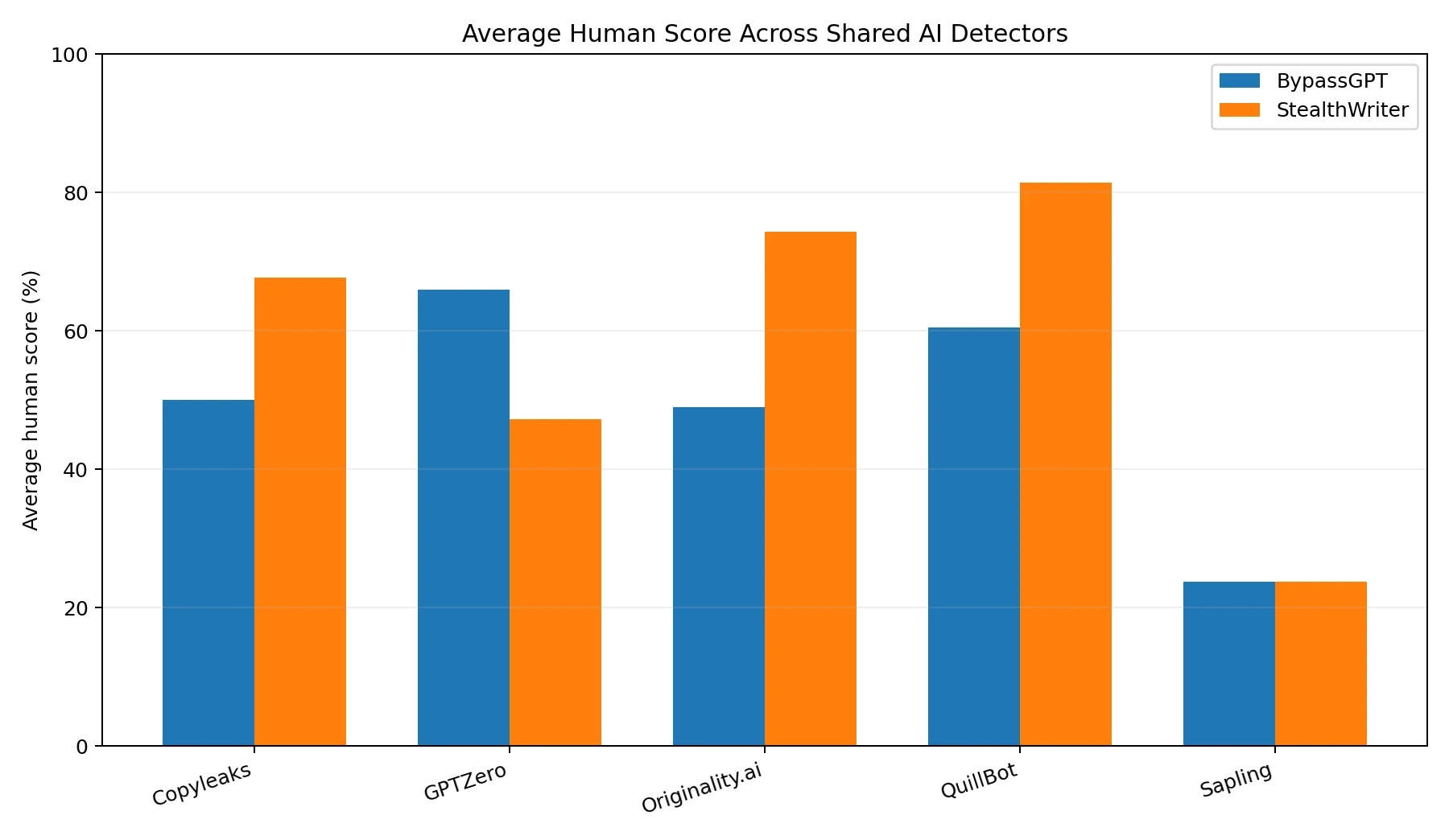
The most striking part is how inconsistent the detectors are. StealthWriter reached 81.4% on QuillBot but only 23.7% on Sapling. BypassGPT reached 66.0% on GPTZero yet only 23.7% on Sapling. A rewrite that performs well against one detector cannot automatically be assumed to perform well against another.
Also Read: StealthWriter vs Pangram: Can a "Humanized" Rewrite Really Escape Detection?
How often did the rewrites receive a reasonably high human score?
For an easy cross-detector comparison, I also counted how many samples scored at least 50% human. This is a simple reporting threshold, not an official universal cutoff used by every detector.
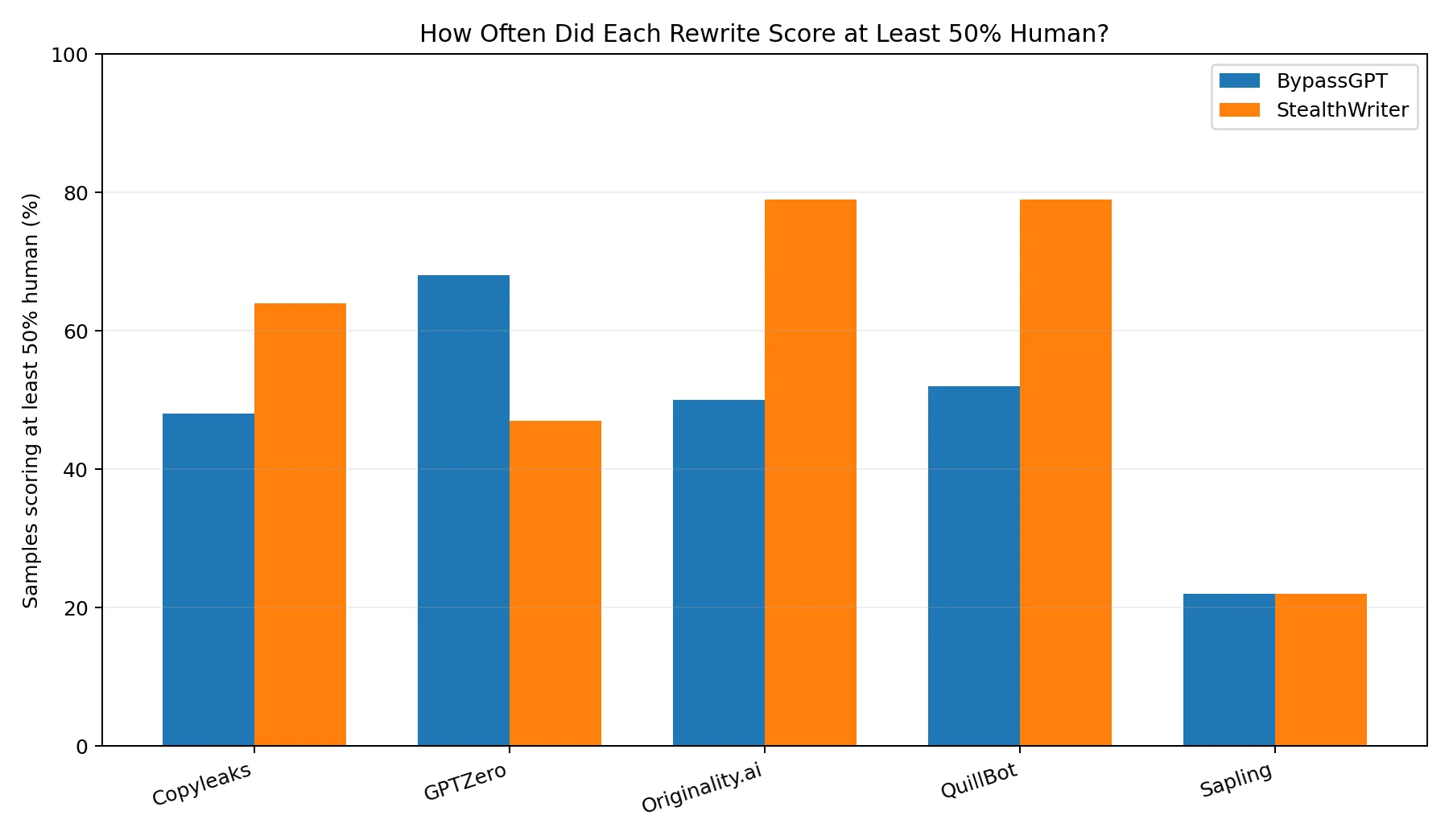
Across all 500 shared detector results, StealthWriter scored at least 50% human 58.2% of the time, compared with 48.0% for BypassGPT. For the stronger 80%-plus range, the gap was 53.2% versus 44.4%.
The paired comparison tells the same story. I averaged the five detector scores for each of the 100 source samples and compared the two rewrites directly. StealthWriter finished higher on 63 samples, while BypassGPT finished higher on 36.
Also Read: [STUDY] Can Stealthwriter Outsmart GPTZero? A 100-Sample Test
Did the rewrites still preserve the original meaning?
This is where the difference became more important than the detector scores. StealthWriter was often clunky, but its rewrites generally stayed closer to the original structure. BypassGPT produced several much more serious failures.
Examples found in BypassGPT's rewrites included:
- A virtual-reality passage suddenly referred to an invented-sounding “Final Battle 2” and contained the gibberish phrase “frucking umbelievables matical experiences.”
- A soundproofing article unexpectedly inserted “9. Easy and high impact solution: Stagger your carpets or rugs” and even included the unrelated German word “Räume.”
- A pet-disaster article inserted the model-like text “Train on data up to October 2023.”
- An Ethereum rewrite added a stray [READ: ...] cross-reference that did not exist in the source.
- A remote-islands passage suddenly switched from St. Helena to Thailand and Koh Phi Phi, creating obvious meaning drift.
- A kitchen-organization passage changed the idea of an efficient, attractive kitchen into a space that “helps create content that looks great,” which does not fit the topic.
StealthWriter had problems too, but they were usually less destructive. I found awkward phrases such as “explored by the off road,” “deciding to lose fossil fuels,” and “breathtaking and immerging worlds.” It also introduced spelling or formatting problems such as “British Colombia,” “Tutancamun,” and spaced ordinals like “17 th.” In one breakfast list, item 1 became item 2, creating duplicate numbering.
Also Read: Does BypassGPT AI Work? We Tested 100 Samples Across Eight AI Detectors
Which tool preserved formatting better?
Both tools generally kept the same number of main text blocks, but numbered lists revealed a large gap. When I compared the list-number sequences in the 100 samples, StealthWriter preserved them in 99 of 100 cases. BypassGPT preserved them in only 64 of 100.
BypassGPT frequently removed the numbers and turned list items into unnumbered headings. That may not destroy the meaning, but it matters for essays, guides, notes, and content that has to retain its original structure. StealthWriter was much safer on this specific formatting test.
Also Read: [STUDY] Can BypassGPT Really Slip Past ZeroGPT? I Tested 100 Rewrites to Find Out.
What happened on the detectors that were not shared?
Some uploaded tests existed for only one tool, so including them in the overall head-to-head average would be unfair. BypassGPT averaged 94.4% on Grammarly, 56.3% on Turnitin, and 47.6% on ZeroGPT. StealthWriter's separate Pangram test was dramatically weaker, with a 3.69% average human score and a 1% median; only two of 100 samples reached 50%.
These results are still useful, but they should be treated as additional tests rather than evidence that one tool beats the other on those detectors.
So, is StealthWriter better than BypassGPT?
In this 100-sample dataset, StealthWriter is the stronger overall choice. It scored higher across the shared detectors, won 63 of the 100 paired comparisons, and preserved numbered formatting much more consistently. Its rewrites were not flawless, but the errors were generally awkward wording rather than the more severe hallucinations and irrelevant insertions seen in BypassGPT.
BypassGPT still has one important advantage: it performed much better on GPTZero, and its separate Grammarly result was excellent. That makes the broader lesson more interesting than a simple winner-and-loser verdict. AI detector performance is highly detector-dependent. No humanizer in this test produced consistently human-looking scores everywhere, and detector scores alone did not tell us whether a rewrite was actually good.
For students, that last point matters most. A passage can receive a high “human” score and still contain broken grammar, invented facts, or altered meaning. Whatever tool is used, the final text still needs to be read carefully and checked against the original.
Method note: 100 paired source samples were used. Higher detector scores mean more human-like according to the converted scoring system. The overall comparison uses only the five detectors available for both tools.