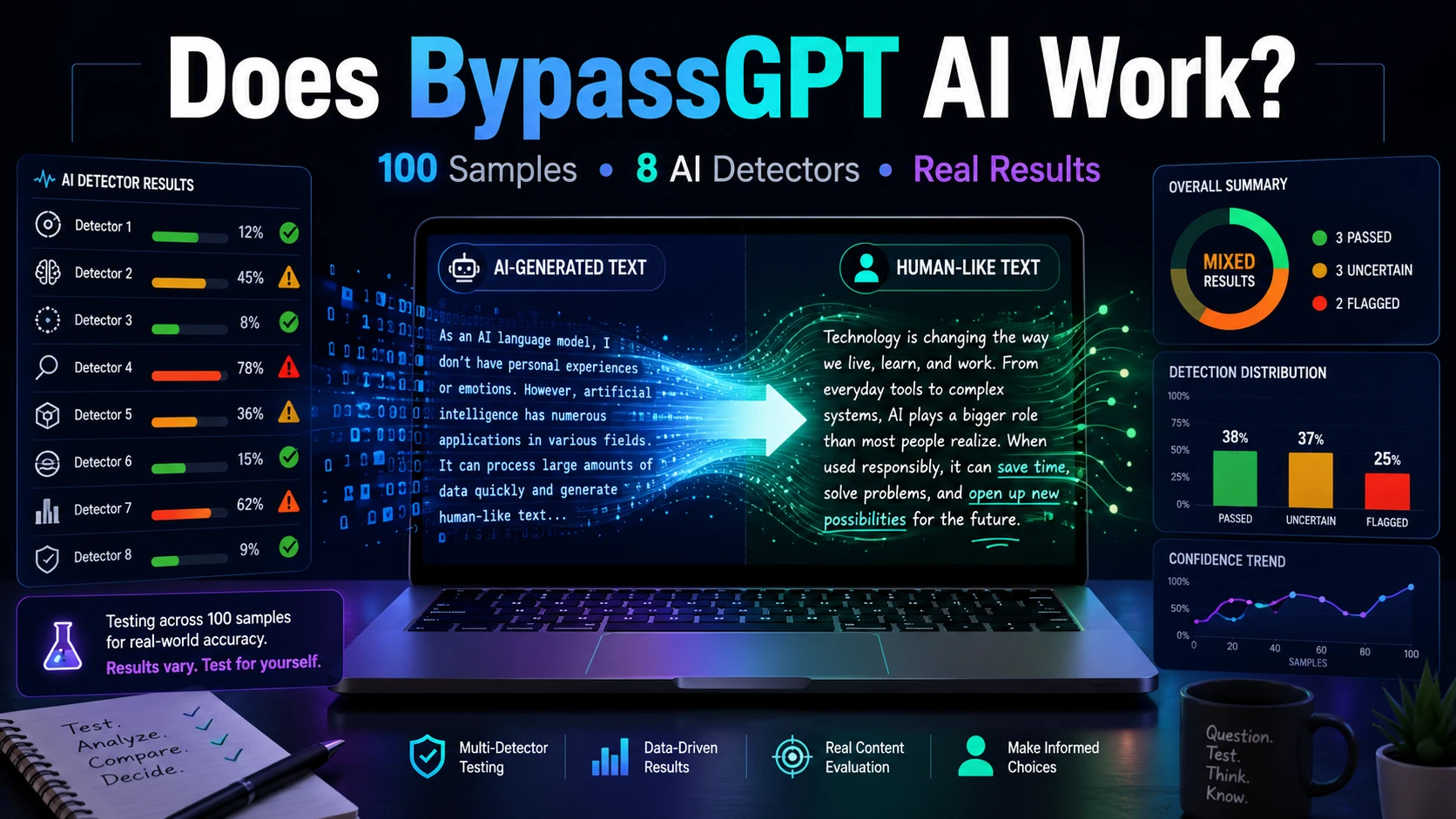

TL;DR
A rewrite can look completely human to one detector and strongly AI-generated to another. That is exactly what happened in this 100-sample test.
- BypassGPT achieved an overall average human score of 55.9% across 800 detector checks.
- Its best result came from Grammarly at 94.4%, while its worst came from Sapling at only 23.7%.
- 62 of 100 rewrites averaged at least 50% human across the eight detectors, but only 14 averaged at least 80%.
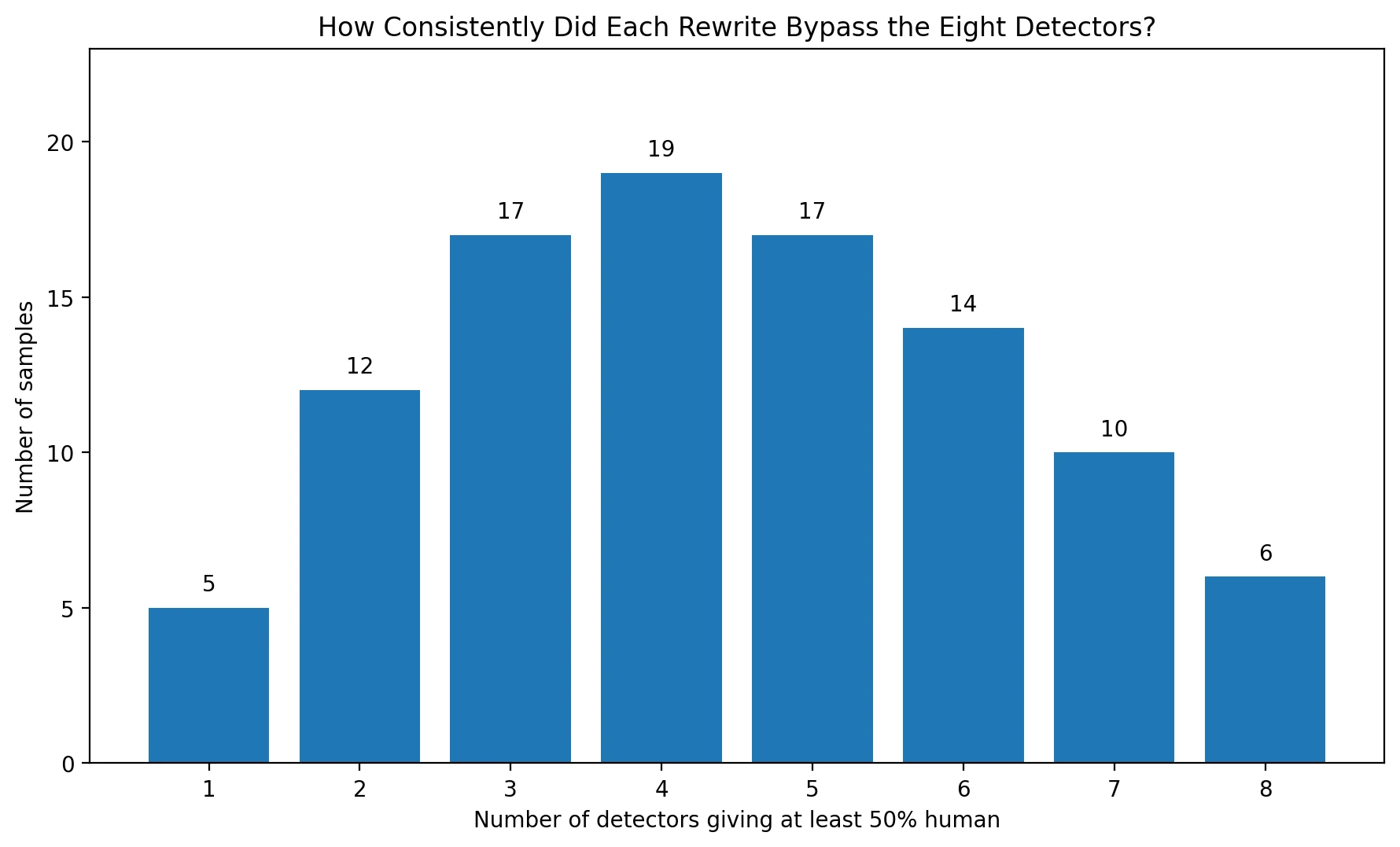
- Only 6 rewrites reached at least 50% human on every detector.
- The rewrites also contained contradictions, unsupported additions, broken formatting, awkward sentences, foreign-language leakage, and occasional gibberish.
Verdict: BypassGPT sometimes works, but it is not a reliable one-click solution. Its success depends heavily on the detector, and every rewrite still needs careful editing.
How was BypassGPT tested?
The test used 100 original passages and their corresponding BypassGPT rewrites. Each rewritten passage was checked with Copyleaks, QuillBot, GPTZero, Grammarly, Originality.ai, Sapling, Turnitin, and ZeroGPT. The detectors normally report an AI score, but those results were converted into human scores. A higher score therefore means the detector considered the text more likely to be written by a person.
For easier comparison, a score of 50% or higher is treated here as a basic pass, while 80% or higher is treated as a strong pass. These are analysis thresholds, not a claim that every detector officially uses the same cutoff.
Also Read: [STUDY] Can BypassGPT Really Slip Past ZeroGPT? I Tested 100 Rewrites to Find Out.
Which AI detector was easiest for BypassGPT?
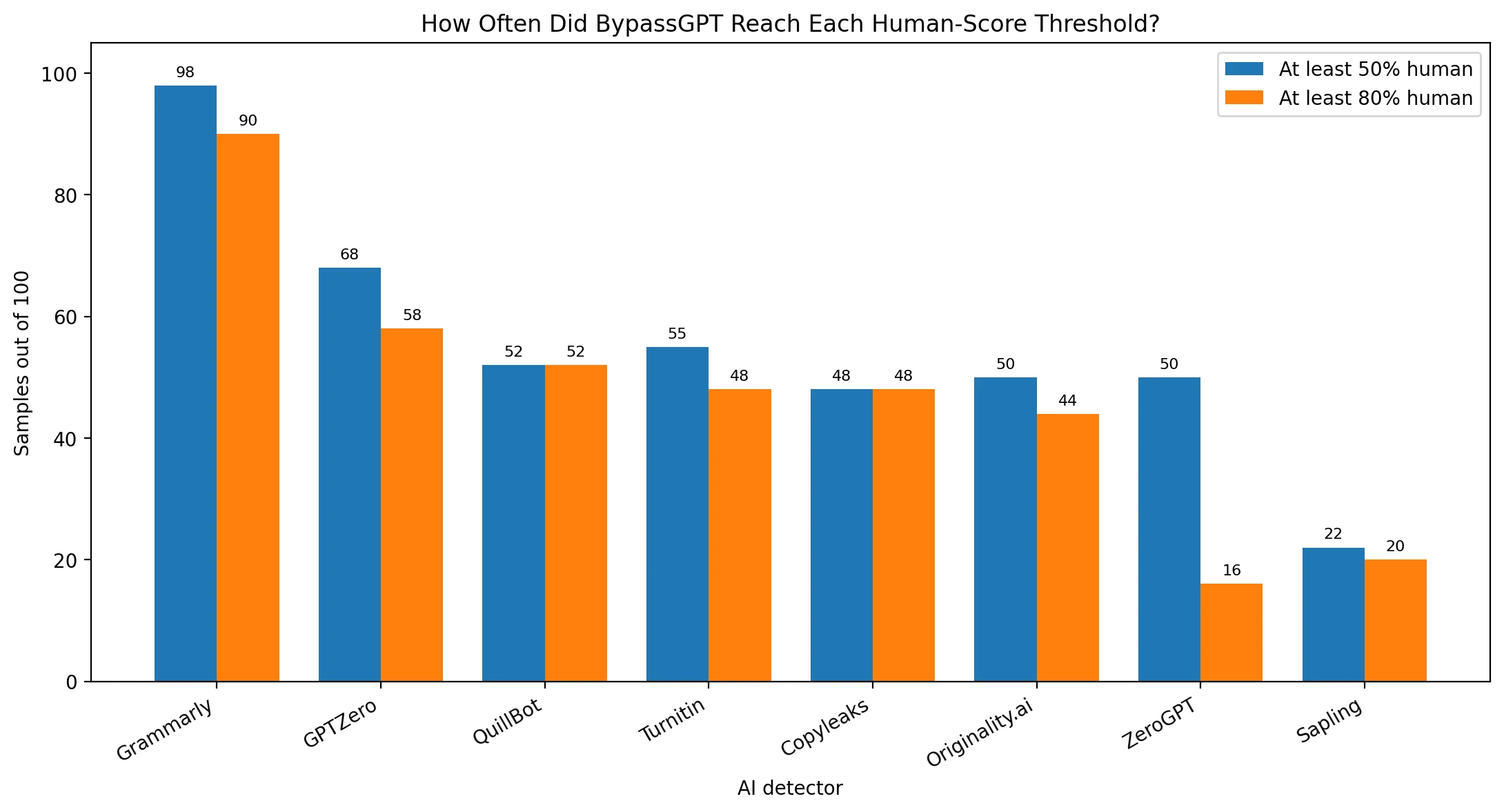
Grammarly was clearly the easiest detector in this dataset. BypassGPT averaged 94.4% human and reached at least 50% on 98 of the 100 samples. GPTZero ranked second with a 66.0% average, followed by QuillBot at 60.5%.
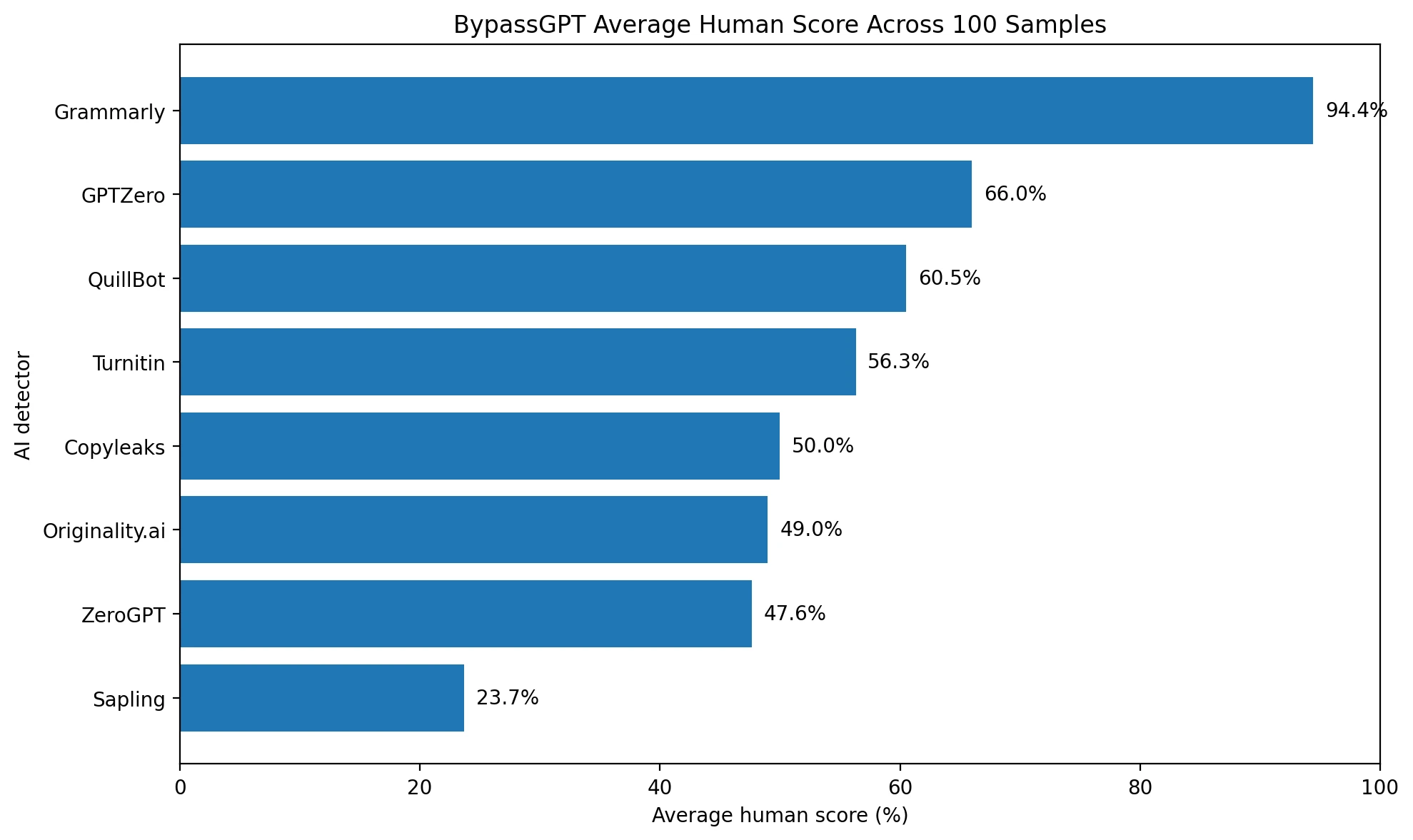
The difficult detectors told a very different story. Sapling gave an average human score of just 23.7%, and 48 samples received a score of zero. Originality.ai, ZeroGPT, and Copyleaks all produced averages around 48% to 50%.
| Detector | Average human score | Median human score | Samples at 50%+ | Samples at 80%+ |
|---|---|---|---|---|
| Grammarly | 94.4% | 100.0% | 98 | 90 |
| GPTZero | 66.0% | 92.5% | 68 | 58 |
| QuillBot | 60.5% | 100.0% | 52 | 52 |
| Turnitin | 56.3% | 73.5% | 55 | 48 |
| Copyleaks | 50.0% | 36.0% | 48 | 48 |
| Originality.ai | 49.0% | 49.5% | 50 | 44 |
| ZeroGPT | 47.6% | 50.0% | 50 | 16 |
| Sapling | 23.7% | 1.0% | 22 | 20 |
Also Read: BypassGPT.ai vs Turnitin: My 100-Sample Test Shows Why “Humanized” Text Is Still a Gamble
How often did BypassGPT produce a strong pass?
The average score alone can hide how unstable the results were. Grammarly gave 90 samples a score of at least 80%, while ZeroGPT did so for only 16. Sapling strongly passed only 20 samples. QuillBot behaved almost like a switch: 52 samples received a perfect 100% human score, while most of the remaining samples stayed low.
Across all detectors, 47 rewrites passed at least five of the eight tools. However, only 6 passed all eight. This matters because a student cannot assume that a rewrite that passes one checker will receive the same result elsewhere.
Also Read: [STUDY] Can BypassGPT.ai Really Bypass Copyleaks?
Why did different detectors disagree so much?
AI detectors do not all look for the same signals or calculate probability in the same way. The score-distribution chart shows that several detectors frequently jumped between very low and very high results. Copyleaks, Originality.ai, Sapling, and Turnitin all produced many scores near zero as well as many near 100.
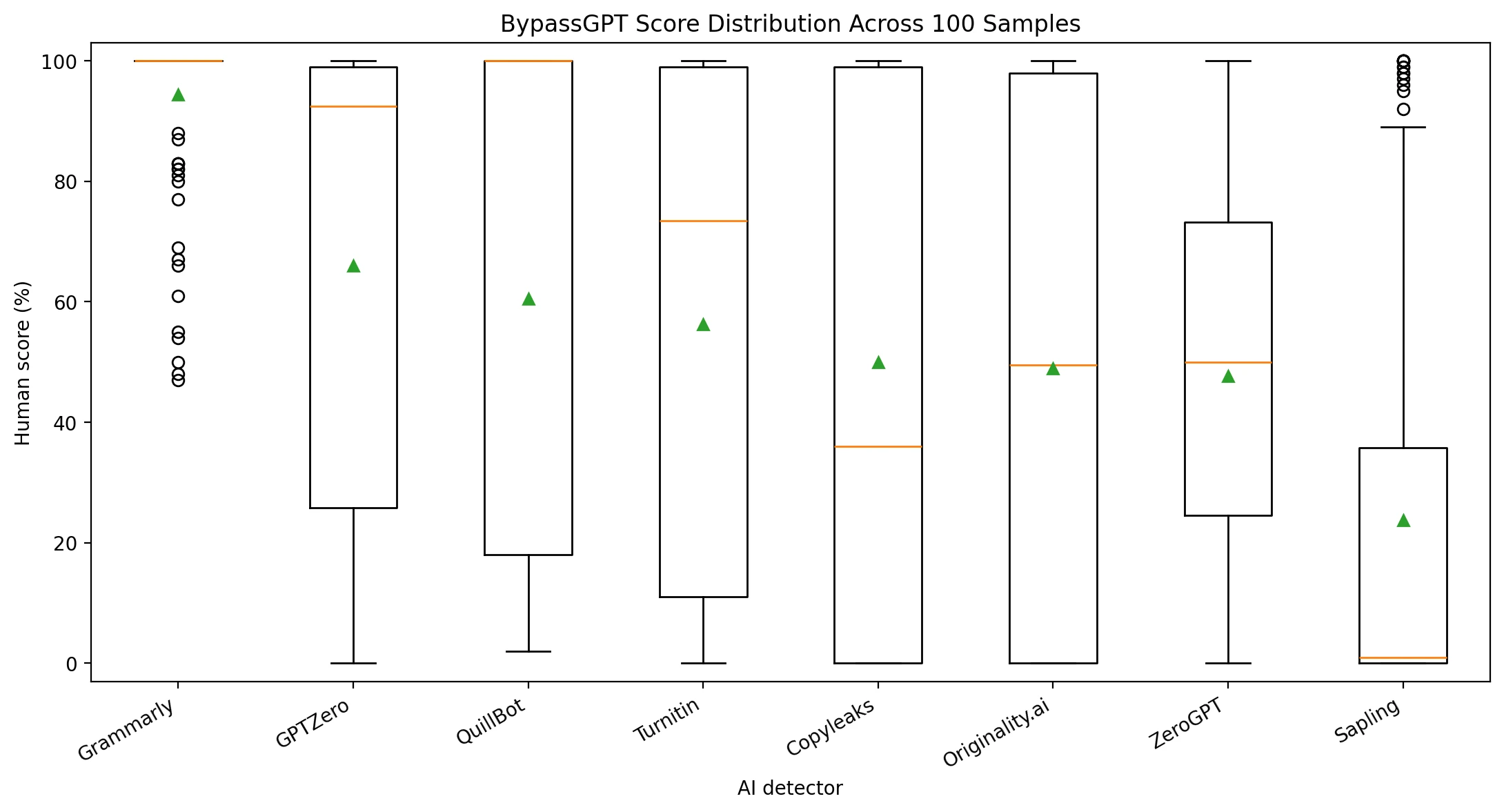
This is why “Does BypassGPT work?” cannot be answered with one percentage. It worked extremely well against Grammarly in this test, moderately against GPTZero and QuillBot, and poorly against Sapling. The detector being used changes the answer.
Also Read: [STUDY] Can BypassGPT Outsmart Grammarly’s AI Detector?
Did BypassGPT preserve the quality of the original writing?
Not consistently. A separate review compared every original passage with its rewrite. The automated checks found that the line-break pattern changed in 100 of 100 samples, paragraph grouping changed in 99, and numbered-list structure changed in 38. Numeric content also changed in 11 samples after list numbers were ignored. Some formatting changes were harmless, but they show that headings, lists, dates, measurements, and other details need to be checked before submission.
The manual review found more serious problems:
- Contradictions: One eye-safety rewrite changed a heading from advice about wearing a wide-brimmed hat to “Avoid sunglasses,” even though the surrounding text still recommended sunglasses.
- Meaning reversal: A smart-home passage originally said voice assistants integrate with a wide range of devices. The rewrite said they are “restricted to a customized ecosystem.”
- Unsupported additions: The eye-safety rewrite added a claim about hearing problems. Another sample invented a “part one of this two-part series” introduction that did not exist in the source.
- Gibberish and invented content: A virtual-reality rewrite included “frucking umbelievables matical experiences” and introduced a game called “Final Battle 2,” neither of which belonged in the original.
- Foreign words and spelling errors: Samples included “Räume,” “convencional,” and a misspelling of the scientific name Vibrio fischeri.
- Broken or awkward sentences: Examples included “increase your hosting answer as per making progresses,” “operationOne,” and phrases that sounded unnatural even when the main idea survived.
Also Read: I Tested 100 BypassGPT Rewrites Against Sapling.ai. The Result Wasn’t What the Hype Suggests.
Should students rely on BypassGPT?
BypassGPT can raise human scores, especially on certain detectors, but passing a detector is not the same as producing accurate, clear, or academically acceptable writing. A polished-looking rewrite can still reverse an idea, insert a false detail, damage a list, or produce nonsense.
Students should treat the output as a rough draft rather than a finished submission. Compare it with the original, verify every factual claim and number, restore headings and lists, remove strange wording, and rewrite unclear sentences in your own voice. School rules also matter. A detector score does not override an institution’s academic-integrity policy.
The Bottom Line
BypassGPT works in a limited and uneven way. It produced convincing scores for Grammarly and reasonable results for GPTZero, QuillBot, and Turnitin, but it struggled badly with Sapling and remained inconsistent elsewhere. The overall 55.9% human score is better described as mixed performance than dependable bypassing.
The bigger problem is quality control. The most successful detector bypass is still a poor result when the rewrite contains contradictions, invented details, formatting damage, or gibberish. BypassGPT may help change the surface style of text, but it cannot replace careful human review.