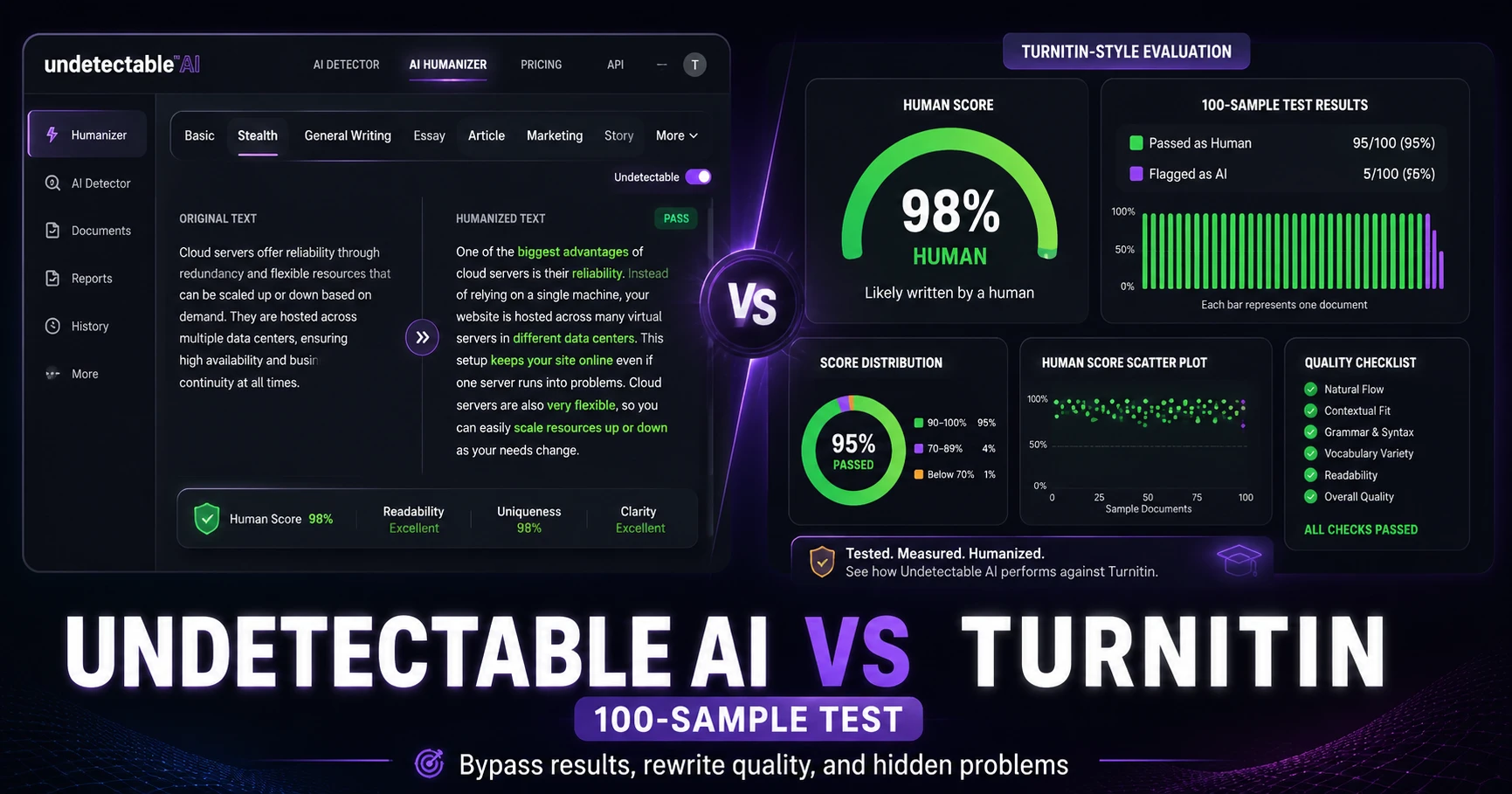

A high “human” score can look like a clean escape route. But the better question is not only whether a tool can fool a detector. It is whether the rewritten text still makes sense, keeps the original meaning, and reads like something a student would confidently stand behind. To test that, 100 AI-written samples were rewritten with Undetectable AI and checked against Turnitin.
What Was Tested
This test used 100 samples. Each sample had an original text, an Undetectable AI rewrite, and a recorded detector score. Because AI detectors often report the chance that something is AI-written, the scores in this dataset were converted into human scores. In simple terms: higher is better for bypassing detection.
A score of 1.0 means the text was treated as 100% human. A score of 0.0 means it was treated as 0% human. For students, that distinction matters. A detector score is not the same thing as quality, originality, or safety. It is only a signal from a system, and signals can be wrong, inconsistent, or incomplete.
Also Read: Can Undetectable.ai Really Slip Past Sapling AI? We Tested 100 Rewrites to Find Out.
Snapshot of the Results
- Average human score: 58.9% across all 100 Undetectable AI rewrites.
- Median human score: 91.5%. The median is the middle result, so half the rewrites scored above it and half below it.
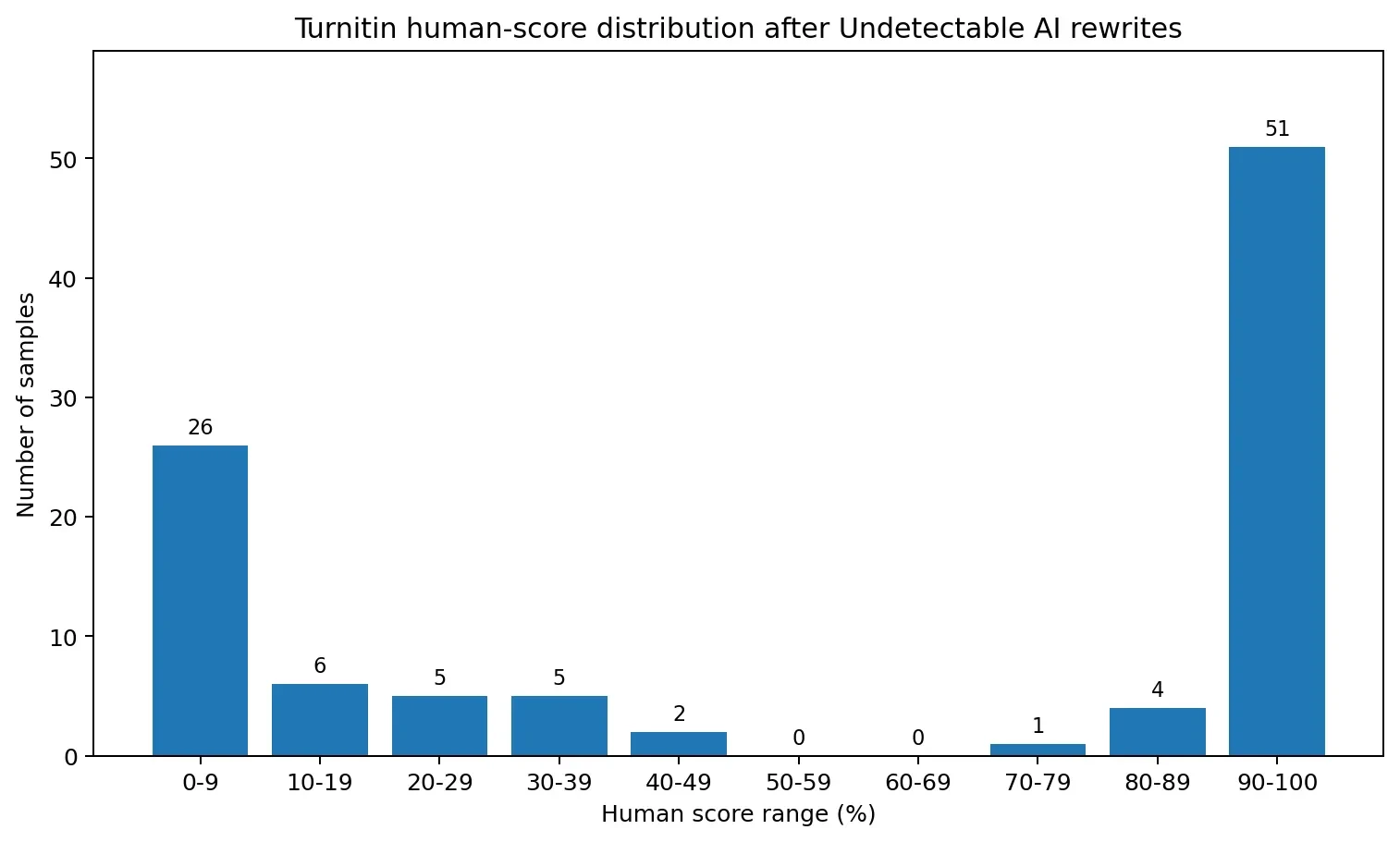
- 56 out of 100 rewrites scored at least 50% human.
- 51 out of 100 rewrites scored at least 90% human.
- 31 out of 100 rewrites received a perfect 100% human score.
- 25 out of 100 rewrites received a 0% human score.
The Big Pattern: Not a Smooth Win, but a Split Result
Undetectable AI did bypass the detector in many cases. More than half of the rewrites crossed the 50% human line, and 51 samples reached 90% or higher. That is not a small result.
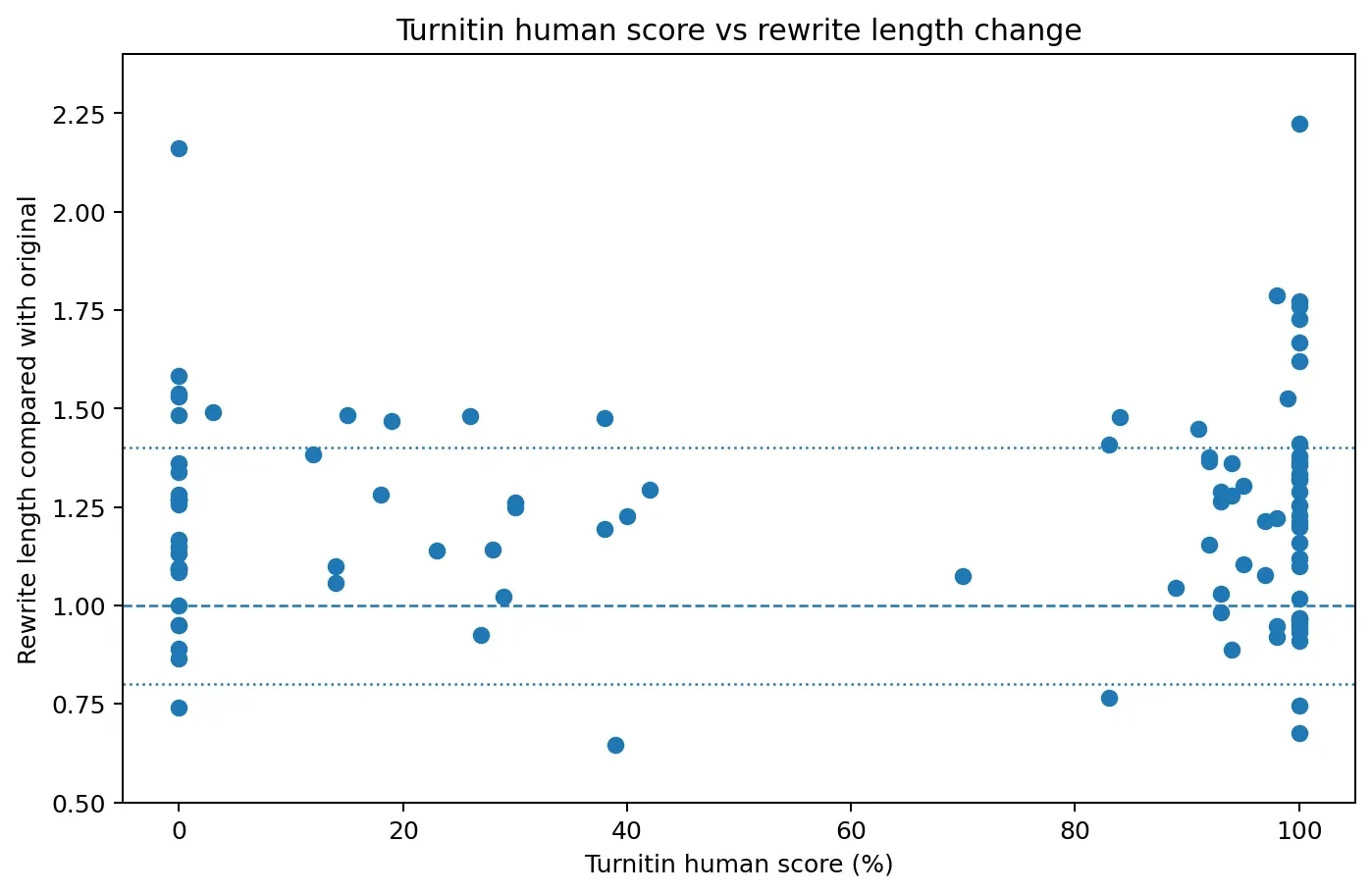
But the full picture is less comfortable. The scores were not evenly spread. Most samples landed near the top or near the bottom. In fact, 77 out of 100 samples were either 10% human or lower, or 90% human or higher. That means the tool did not gently improve every rewrite. It produced a sharp split: some outputs looked highly human to the detector, while others failed completely.
How Often Did It Cross the Main Score Lines?
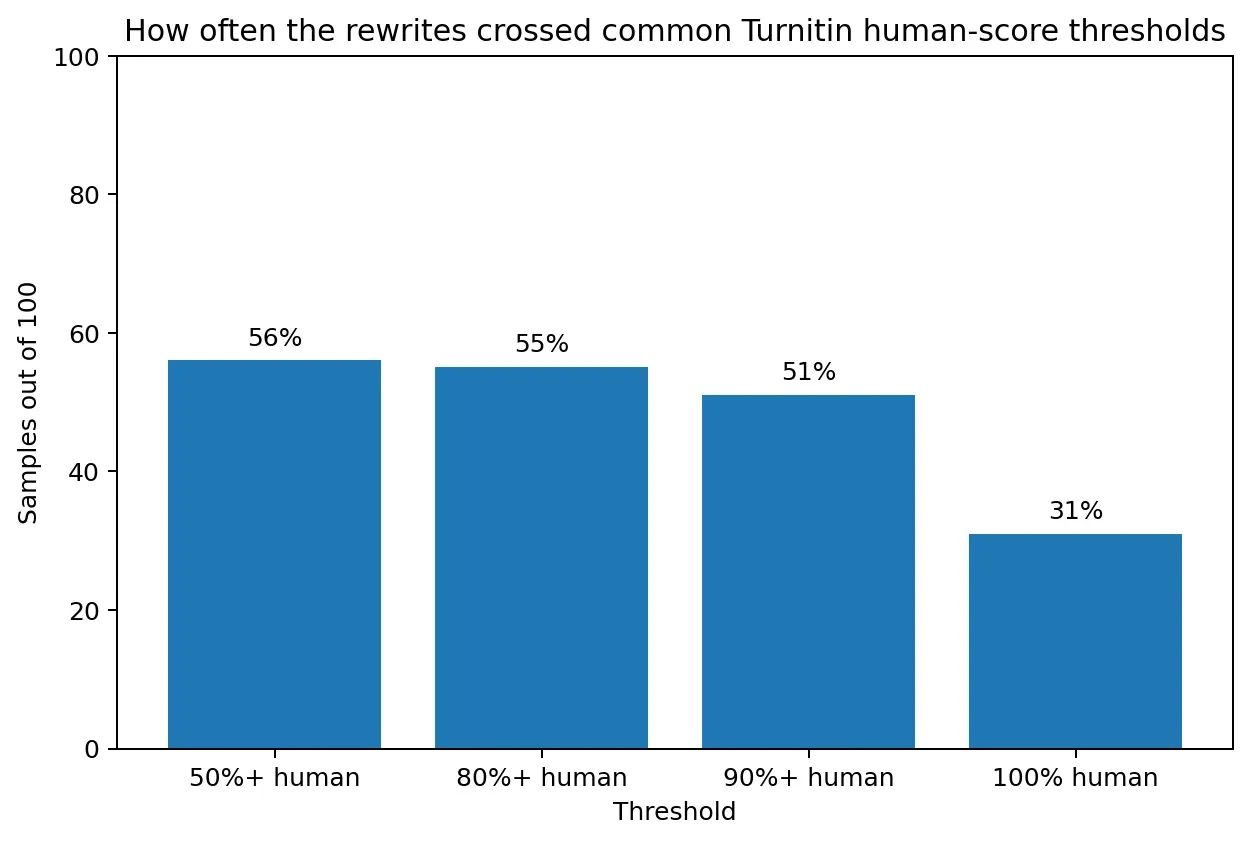
Students often think in simple terms: “Did it pass or not?” The problem is that different people may use different score lines. A 50% human score sounds like a basic pass. An 80% or 90% score sounds much safer.
In this dataset, Undetectable AI crossed the 50% human line in 56 cases. It crossed 80% in 55 cases, and 90% in 51 cases. The surprising part is how close those numbers are. Once a rewrite worked, it often worked strongly. But when it failed, it often failed hard.
Also Read: [STUDY] Can Undetectable AI Bypass GPTZero? A 100-Sample Reality Check
The Part Students Should Not Ignore: Human Score Is Not Writing Quality
The CSV revealed a second issue: some rewrites that scored well still had writing problems. This is where students can get misled. A detector may give a strong human score, but a teacher can still notice messy wording, broken logic, or a paragraph that no longer says the same thing as the original.
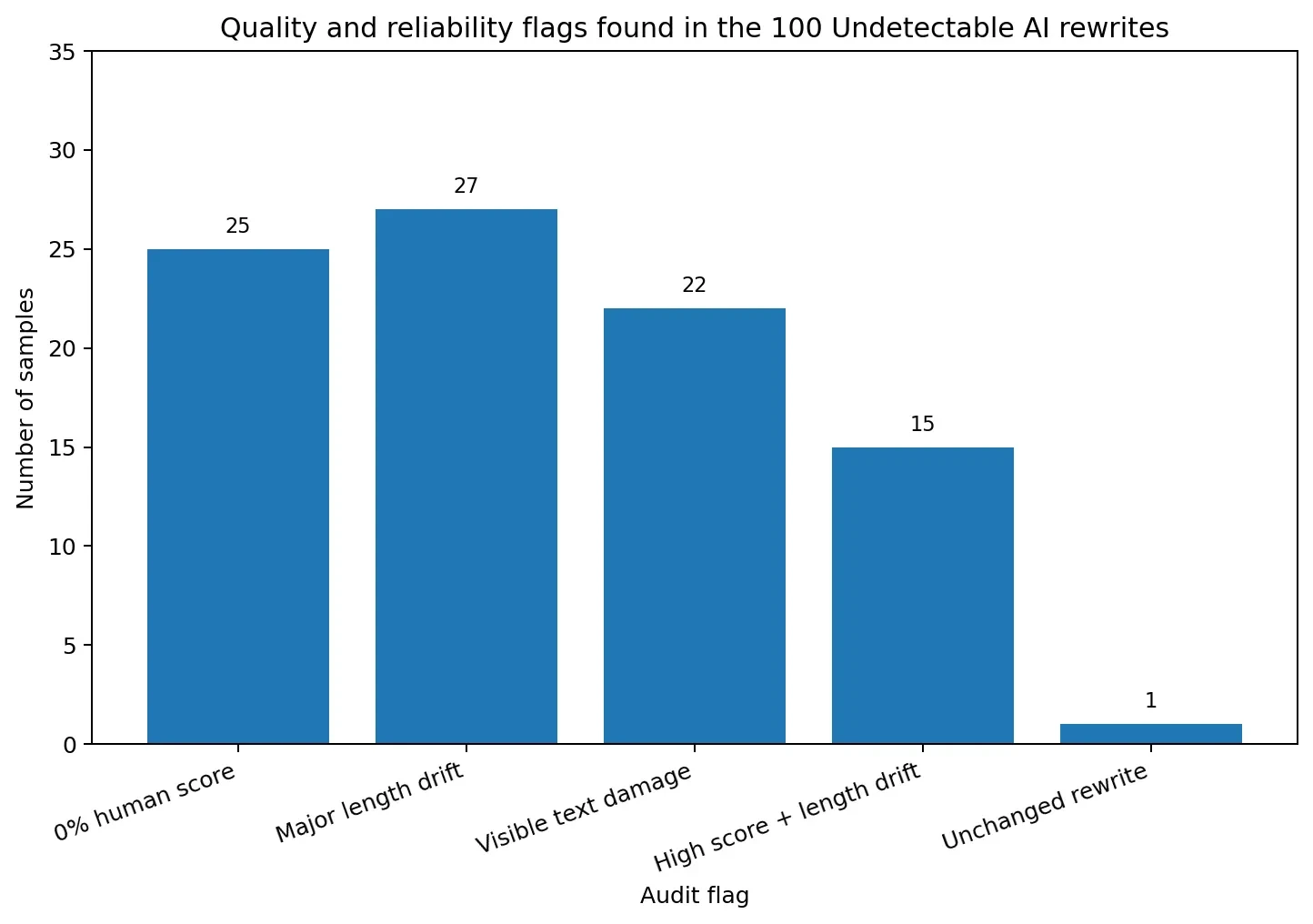
- 1 rewrite was unchanged. The original and paraphrased text were identical, and it received a 0% human score.
- 27 rewrites had major length drift. Length drift means the rewrite became much longer or much shorter than the original, changing the shape of the answer.
- 22 rewrites showed visible text damage. This included broken sentence openings, scrambled word order, repeated phrases, and odd fragments.
- 15 high-scoring rewrites still had major length drift. This shows that a strong detector score does not always mean a faithful rewrite.
Also Read: [STUDY] Can Undetectable AI Bypass Originality AI? A 100-Sample Reality Check
Rewrite Problems Found
The biggest problems were not advanced grammar issues. They were the kinds of mistakes any careful reader could spot.
Some sentences opened in broken ways. One battery-safety rewrite began with “The them to over heat or even leak,” which immediately sounds damaged. A Nobel Prize rewrite started with “N of millions of people,” then joined words together in a way that made the paragraph feel scrambled.
Some list formatting became messy. In one online advertising sample, the rewrite changed a clear list item into “1. your target audience,” followed by a sentence with words in the wrong order. In another garage-organization sample, “Useboards” appeared where the text clearly meant “Use boards” or “Use pegboards.”
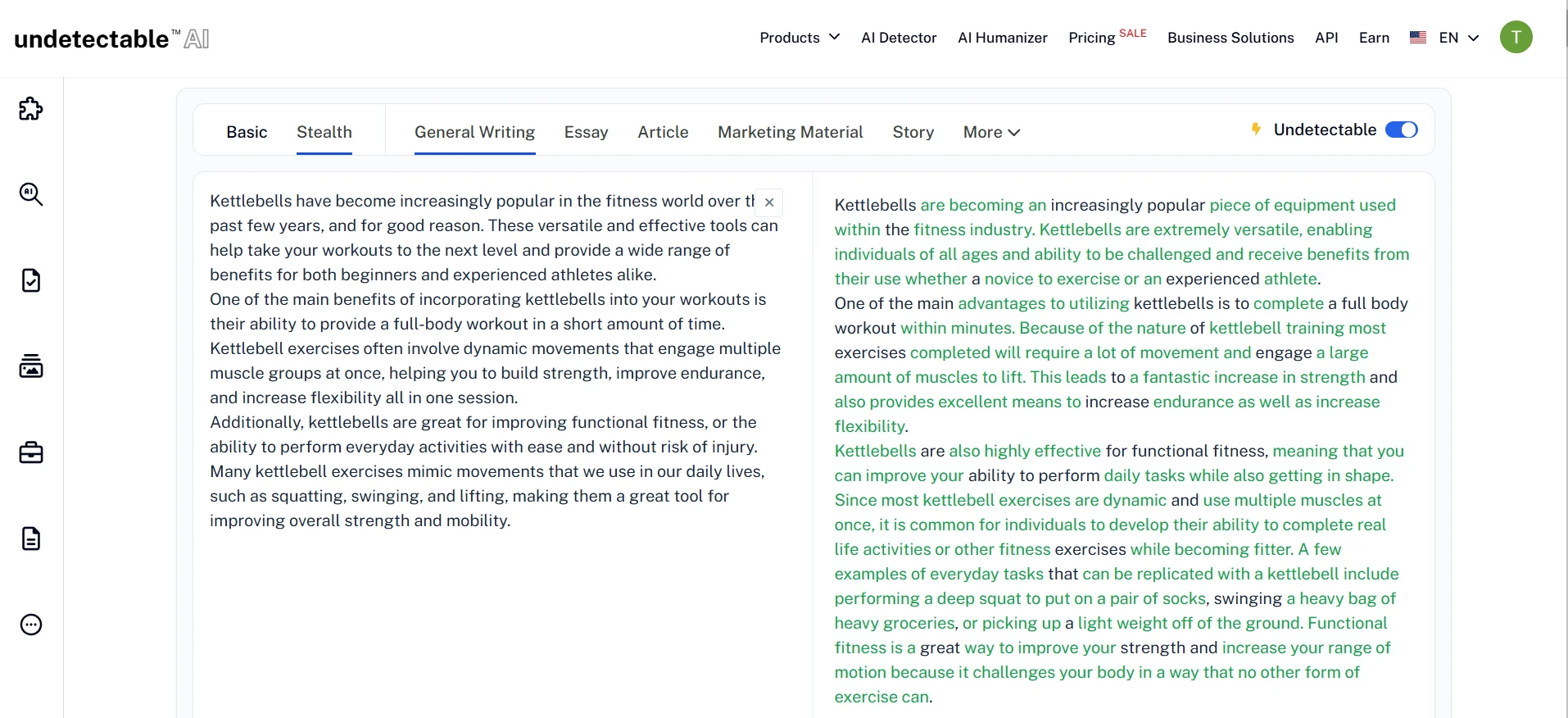
Meaning drift appeared too. Meaning drift means the rewrite no longer carries the same message. A soundproofing rewrite became more confident than the original by implying a stronger “noiseless environment.” A kettlebell rewrite added extra everyday-life examples that were not in the original. Additions like that can make the text look fuller, but they can also change what the writer is actually claiming.
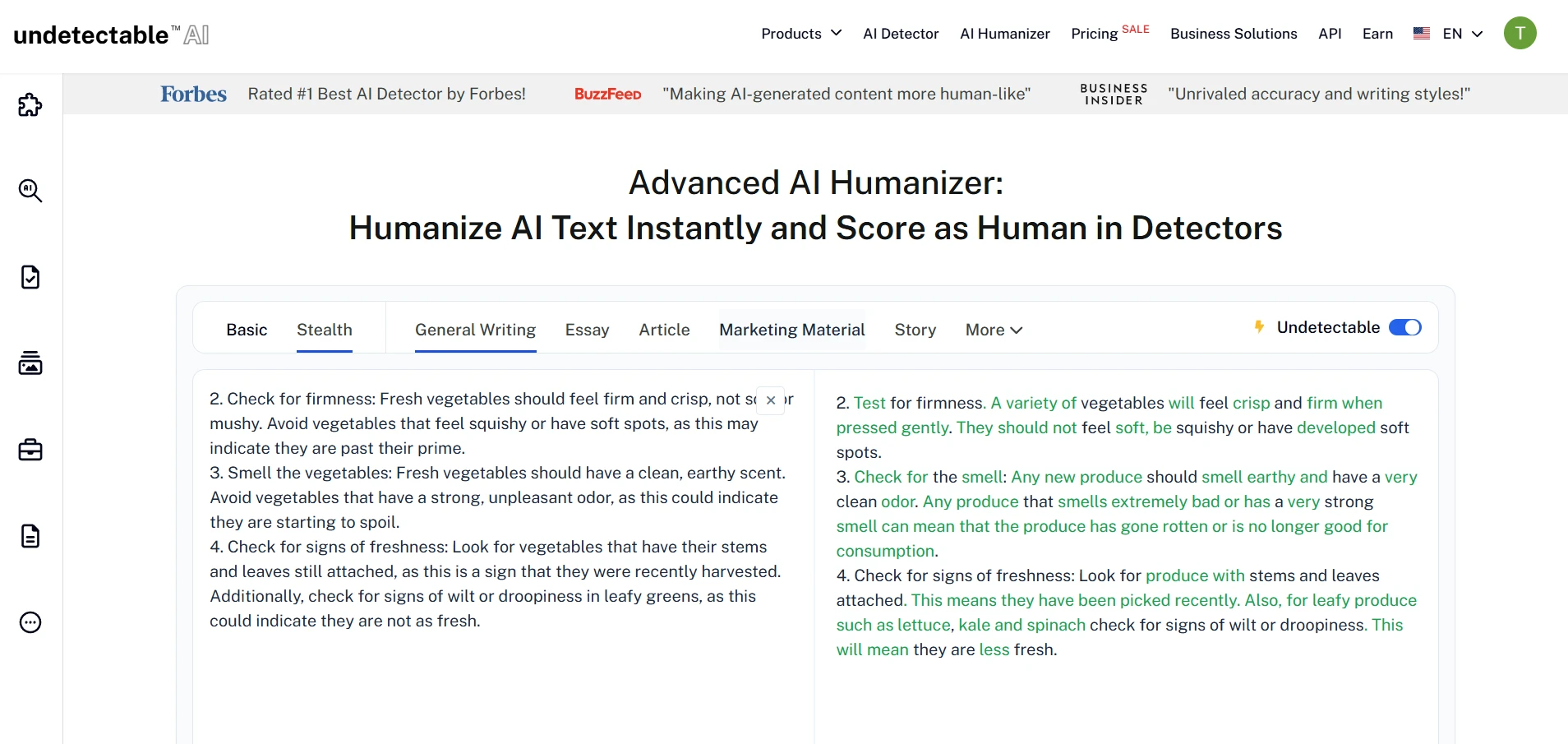
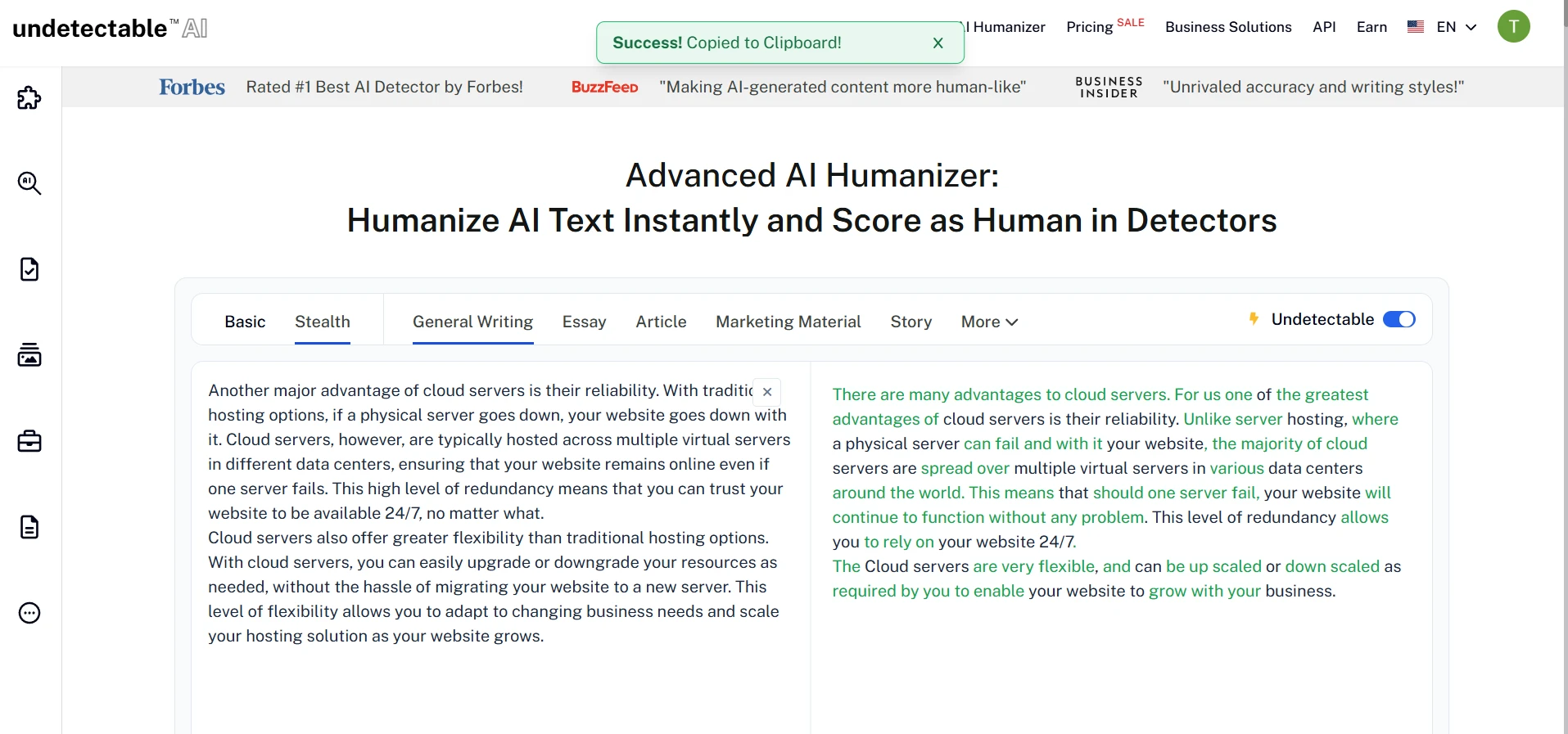
What the Undetectable AI Screenshots Show
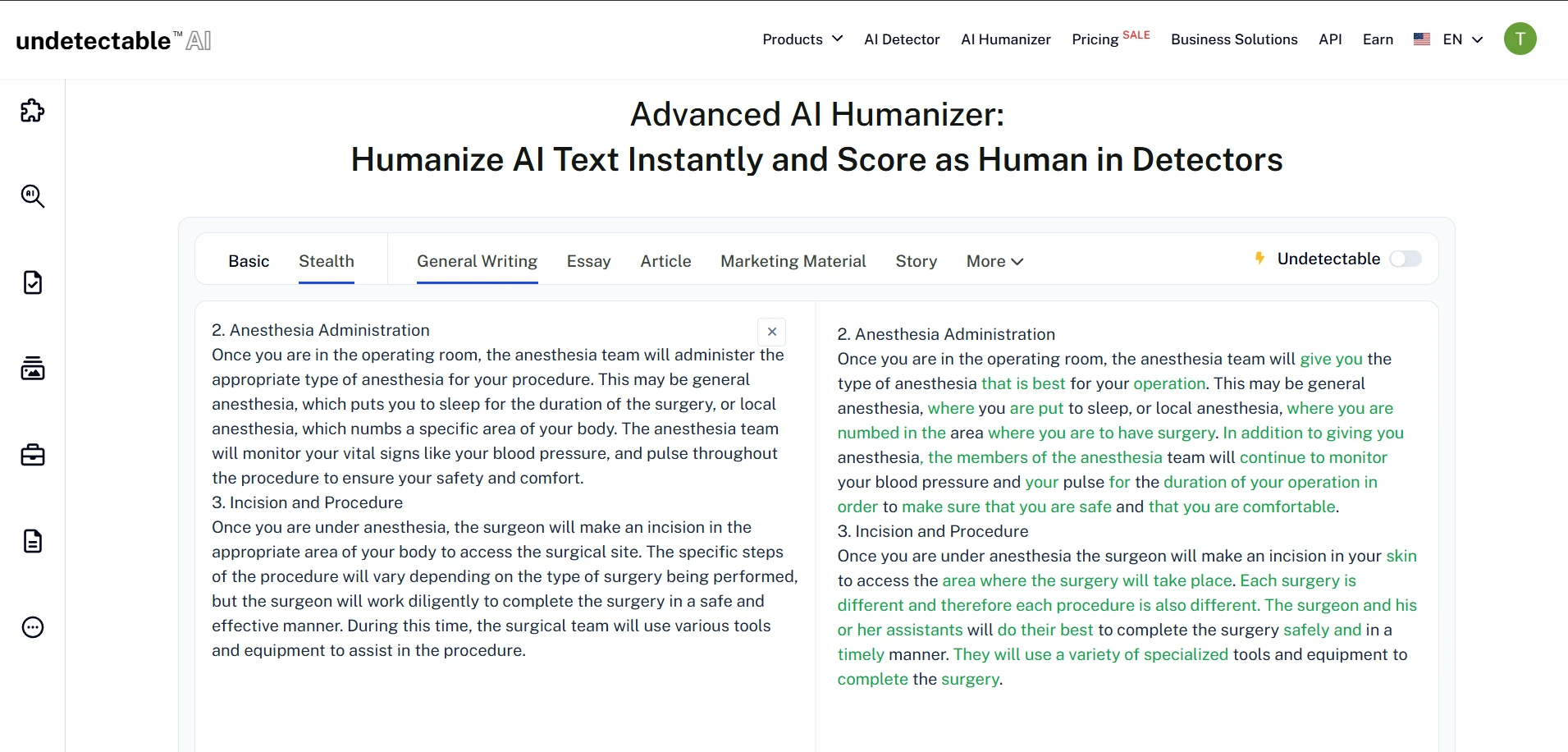
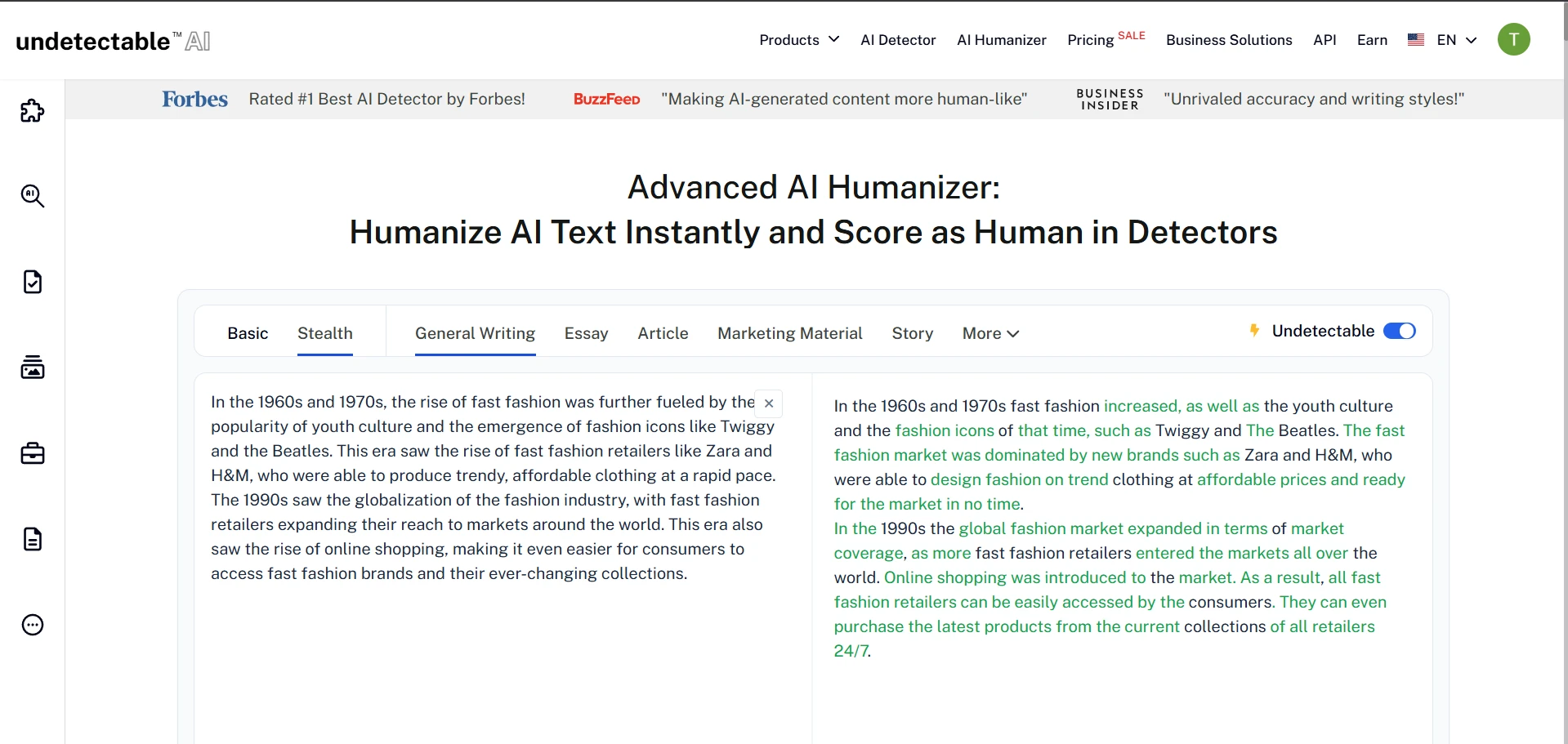
The screenshots support the same conclusion. Some outputs look smoother and more natural at a glance. Others become wordier, more generic, or less precise. That matters because a rewrite tool may improve surface-level phrasing while quietly weakening the content.
Final Verdict: Effective Sometimes, Risky Always
Undetectable AI was partly effective at bypassing Turnitin-style detection in this 100-sample test. The strongest evidence is that 51 rewrites scored 90% human or higher, and 31 reached a perfect 100% human score.
But the weak side is just as important: 25 rewrites scored 0% human, and many outputs had visible quality problems. For students, the real lesson is simple. A high human score does not prove that a piece of writing is accurate, ethical, or ready to submit. It only proves that one detector responded favorably to that version of the text. The final responsibility still sits with the writer: read it, check the meaning, fix the errors, and make sure the work is actually yours.