![[STUDY] Can Copyleaks Detect Undetectable AI?](/static/images/undetectable_ai_vs_copyleaks_featured_imagepng.webp)

TL;DR
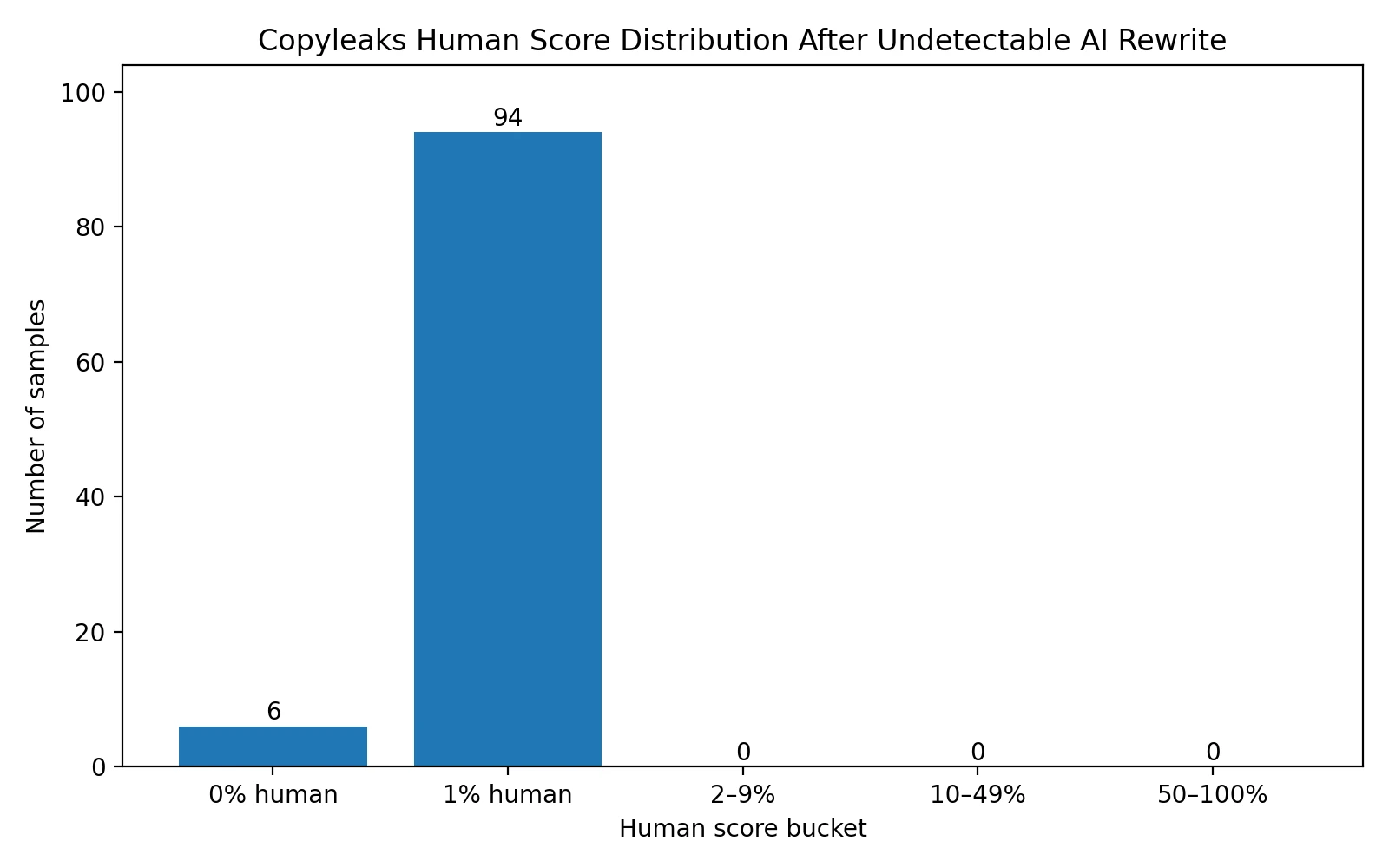
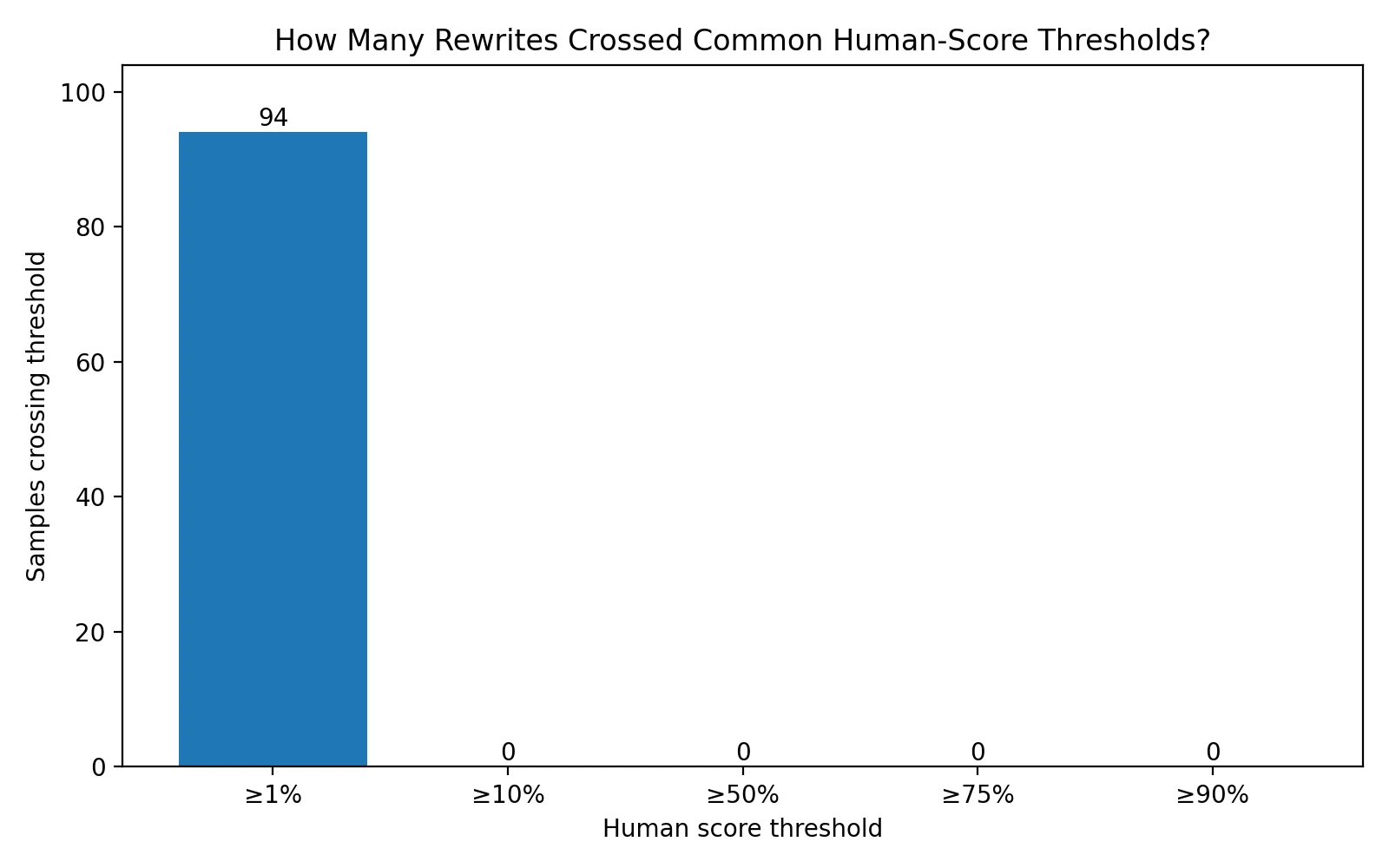
No, not in this test. Across 100 rewritten samples, Copyleaks still gave extremely low human scores. The average human score was only 0.94, the median was 1, and not even one sample reached a 10, 50, 75, or 90 human-score threshold. In simple terms, the rewrites did not look human enough to Copyleaks.
- 100 samples tested: each original text was rewritten using Undetectable AI.
- 94 samples scored 1: meaning Copyleaks treated them as almost entirely AI-like.
- 6 samples scored 0: meaning they performed even worse.
- 0 samples crossed 50: so the bypass success rate was 0% using a basic “more human than AI” cutoff.
- Rewrite quality was also inconsistent: some outputs had repetition, broken sentences, added claims, odd grammar, and meaning drift.
Why should students care about this test?
AI humanizers are often marketed like a simple fix: paste AI text, click rewrite, and get something that looks natural. For students, that promise sounds tempting because deadlines are real and writing assignments can feel stressful. But the real question is not whether the text is “changed.” The real question is whether it becomes better, more accurate, and less detectable.
This test is useful because it does not rely on one random example. It uses 100 samples and checks how Copyleaks scored the rewritten outputs. Since the scores were converted into human scores, a higher number means the detector saw the text as more human-written. A lower number means it looked more AI-written.
Also Read: [STUDY] Can Undetectable AI Bypass Grammarly's AI Detector?
What did the Copyleaks scores actually show?
The result was very one-sided. The entire dataset stayed between 0 and 1. That matters because a human score of 1 is still extremely low if the score is being read on a 0 to 100 scale. It is not “slightly human.” It is basically Copyleaks saying the rewrite still looks AI-generated.
The average score was 0.94 and the median was 1. The median is the middle value when all scores are arranged in order. Here, it tells us that the typical rewritten sample scored only 1. That makes the result easier to understand: this was not a case where a few bad samples pulled the average down. Almost every sample performed badly.
Also Read: Can Undetectable AI Bypass Turnitin? A 100-Sample Test Students Should Read Carefully
What was the bypass rate?
If we use 50 as a simple cutoff for “more human than AI,” the bypass rate was 0%. If we use a more generous cutoff like 10, the bypass rate was still 0%. Even the lowest meaningful bar was not crossed. That makes the finding unusually clear.
Sometimes detector tests are messy. A tool may work on short essays but fail on technical writing. It may perform better on casual text than academic text. It may pass one detector and fail another. But in this dataset, there was no such mixed result. Undetectable AI did not produce rewrites that Copyleaks treated as human-like.
Also Read: Can Undetectable.ai Really Slip Past Sapling AI? We Tested 100 Rewrites to Find Out.
Did Undetectable AI at least improve the writing?
Not consistently. A humanizer can fail a detector and still be useful if it improves clarity, tone, or flow. But the rewrites in this CSV also had several quality problems. That is important because students should not judge a rewrite only by detector score. A rewritten paragraph can be less detectable but still worse writing. In this test, the opposite happened: the detector scores stayed poor, and the quality problems remained visible.
What rewrite problems showed up in the samples?
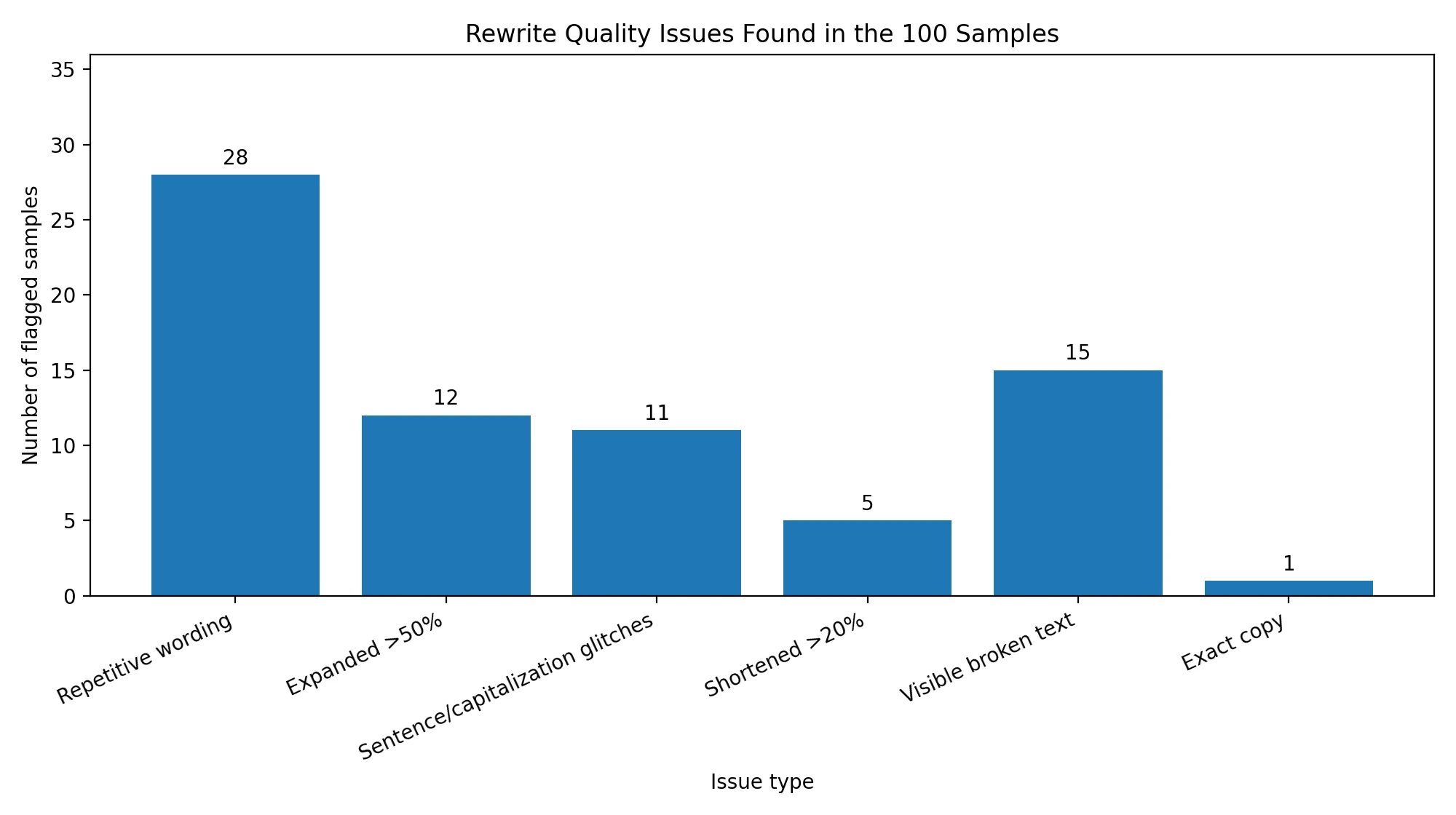
The most common problem was repetitive wording. Around 28 samples showed repeated phrases or circular phrasing. This made some rewrites feel padded rather than naturally written. For example, a Python-related rewrite repeated “less known features” and “developers” so often that the paragraph became heavier instead of clearer.
There were also length problems. In 44 samples, the rewrite became 20% to 50% longer than the original. In 12 samples, it expanded by more than 50%. Expansion is not automatically bad, but unnecessary expansion often adds fluff. It can make the text look like it is trying too hard to sound different.
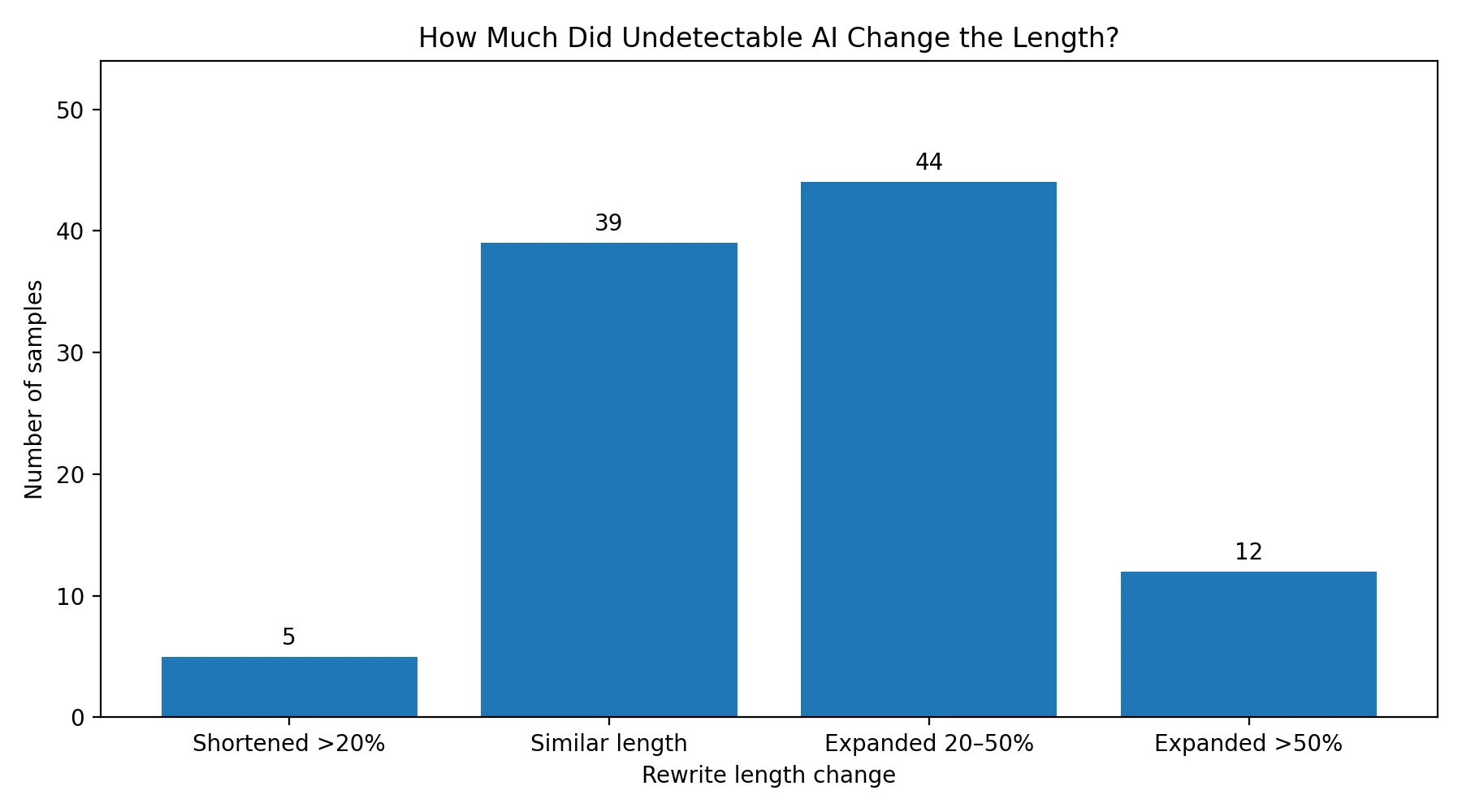
Some rewrites went the other way. Five samples became more than 20% shorter, which can remove useful details. In a student assignment, that matters because a shorter rewrite may accidentally drop examples, explanations, or important reasoning from the original.
Were there contradictions or meaning drift?
Yes, there were cases of meaning drift. Meaning drift happens when the rewritten version changes what the original text was trying to say. It may not always create a direct contradiction, but it still weakens accuracy.
For example, one GPS rewrite added a specific claim about 1996 that was not present in the original passage. A true crime rewrite introduced awkward and unclear wording about “previously given information about the reader,” which did not fit the meaning. A salary negotiation rewrite changed a useful heading into “What value you can bring to a job interview,” which sounds less precise than the original idea of highlighting your value during salary negotiation.
These problems matter because humanizing tools often rewrite aggressively. They may change structure, add filler, or replace simple wording with odd phrasing. That can make the final text less reliable, especially for academic or informational writing.
Also Read: [STUDY] Can Undetectable AI Bypass GPTZero? A 100-Sample Reality Check
Did the rewrites contain gibberish or formatting issues?
Some did. Visible broken-text issues appeared in about 15 samples. These included joined words, duplicate words, strange sentence fragments, and capitalization errors. Examples included phrases like “The1970s,” “The The Moon,” “environment.es,” and incomplete-looking text such as “Business using less harsh chemicals.”
There were also sentence boundary problems. Some sentences ended too early and the next word started in lowercase, such as “one server fail. your website.” In normal writing, this looks careless. In student writing, it can also make the reader question whether the work was reviewed properly.
What does this mean for students?
The biggest lesson is simple: a humanizer is not a safety net. In this test, Undetectable AI did not bypass Copyleaks, and it also introduced writing-quality problems that a teacher, editor, or careful reader could notice without using a detector.
Students should be especially careful because detector results are only one part of the risk. Bad paraphrasing can create other problems:
- It can change the meaning of the original idea.
- It can add unsupported details.
- It can make a paragraph longer without making it better.
- It can introduce grammar and formatting mistakes.
- It can make writing sound unnatural even when the words are different.
Final Verdict
Based on these 100 samples, no. The Copyleaks human scores were almost flat at the bottom of the scale, and the rewrite quality was not strong enough to make up for that. A tool that claims to humanize AI writing should ideally do two things: improve the text and make it appear more human. In this dataset, it did neither in a reliable way.
The most honest conclusion is that Undetectable AI was ineffective against Copyleaks in this test. More importantly, the rewrites show why students should not treat AI humanizers as a shortcut. Even when the wording changes, the output can still be detectable, awkward, inaccurate, and harder to trust.