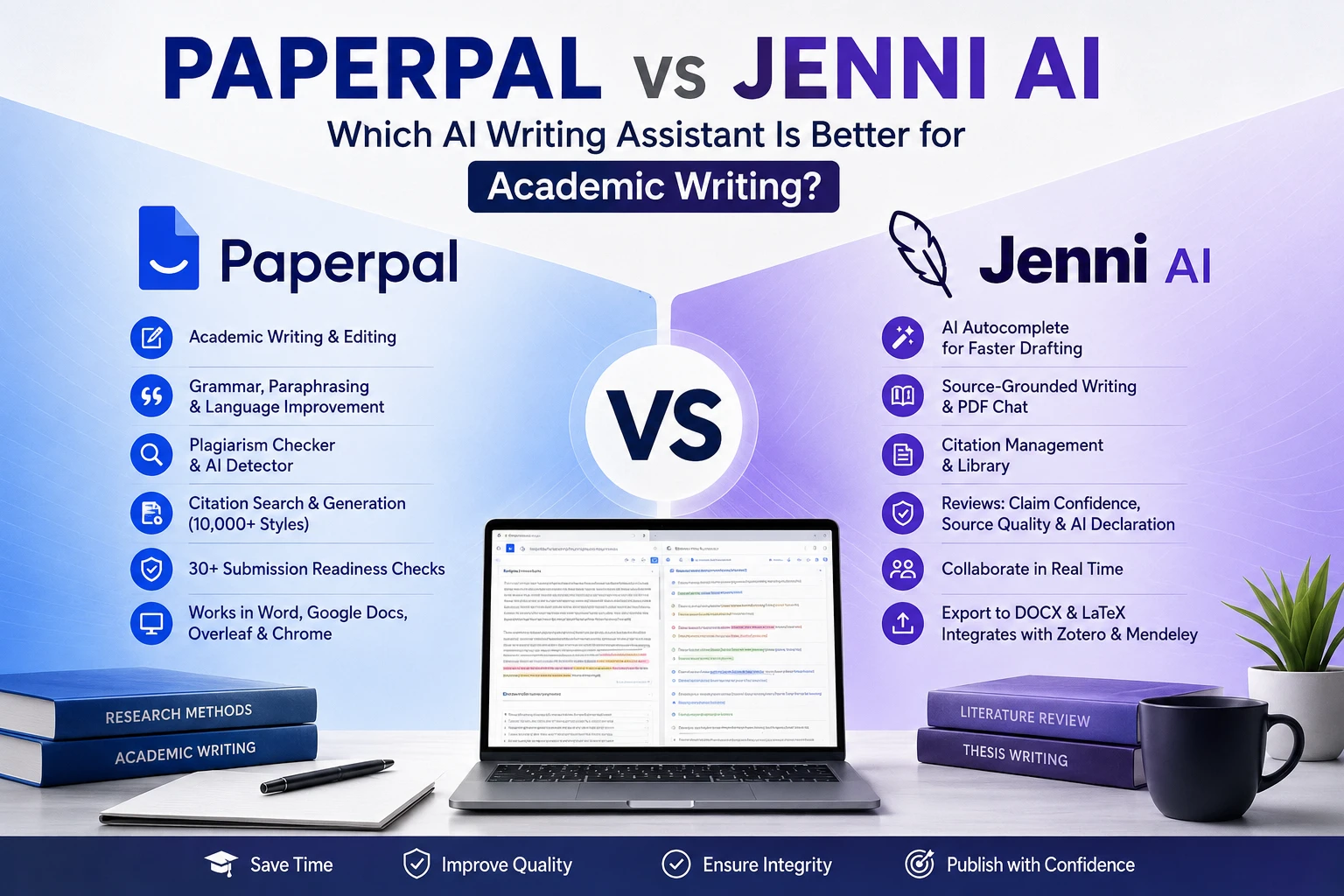

As of July 24, 2026, the short answer is this: Paperpal is the better overall choice for users who want a complete academic writing stack, while Jenni AI is the better choice for users who mainly need faster drafting from sources. Paperpal’s AI writing assistant emphasizes predictive academic writing, grammar and language correction, citation search across 250M+ papers, citation generation in 10,000+ styles, and Chat with PDFs, alongside a built-in plagiarism checker, AI detection, and 30+ submission-readiness checks that follow you into Word, Google Docs, Chrome, and Overleaf. Jenni AI, by contrast, is a browser-first workspace focused on AI autocomplete, source-grounded drafting, citation management, a research library for PDFs, document reviews, mobile browser support, and collaboration, with exports for DOCX and LaTeX and integrations with Zotero and Mendeley.
- Best for final polish and submission safety: Paperpal, because it bundles plagiarism checks, AI detection, reference checking, and submission checks in one place.
- Best for turning notes and PDFs into a draft: Jenni AI, because its citation-aware autocomplete, library, and review flow are designed around source-linked writing.
- Best overall if you can buy only one: Paperpal for researchers, thesis writers, and anyone submitting graded or publishable work. Jenni AI wins only if draft speed and source-grounded drafting are your biggest pain points. Independent reviewers reach much the same split when they ask whether Paperpal is worth it, whether Jenni is worth it, and when Fritz AI puts Jenni through a hands-on review.
Also Read: How accurate is Paperpal's plagiarism checker? - An Independent Review
Quick Comparison
| Attribute | Paperpal | Jenni AI |
|---|---|---|
| Core identity | Academic writing and editing, plus citation, plagiarism, AI detection, and submission checks. | Academic drafting, citation management, PDF library, reviews, collaboration. |
| Pricing | Free tier available; the official pricing page is partly hard to extract as text, with snippets showing paid plans starting around $12 per month on annual billing while other sources show higher premium figures. Treat exact live pricing as partially unspecified and verify before purchase. | Free $0, Plus $12 per month, Pro $29 per month. |
| Platforms | Web, plus MS Word, Google Docs, Chrome, and Overleaf. | Web app, browser extension, mobile browser, Zotero and Mendeley connections. |
| Academic integrity | Strongest of the two, with a plagiarism checker, AI detector, citation tools, and disclosure support. | Strong on traceable citations, claim confidence and source quality reviews, and AI declaration, but a first-party plagiarism checker is not prominently surfaced in the current docs. |
The pricing picture deserves a caveat. Jenni AI’s live pricing table is straightforward, including usage caps on the free and Plus plans. Paperpal’s current pricing page is live, but its exact tier breakdown is partly hidden in text extraction; official search snippets point to paid options beginning around $12 per month on annual billing, while a Paperpal-run legacy pricing page and independent 2026 reviews report ranges from roughly $9 to $25 per month depending on plan and billing. That makes Jenni easier to budget, while Paperpal is currently less transparent in text-only retrieval.
Also Read: Can Turnitin detect Paperpal? The Unfiltered Truth
Detailed Comparison
Core features
Paperpal is broader. Its official feature pages list predictive writing, templates, paraphrasing, translation, reference finding from 250M+ papers, citation generation in 10,000+ styles, Chat with PDFs, and grammar correction, on top of plagiarism checking, AI detection, and 30+ pre-submission checks. Jenni AI is narrower but deeper in drafting, with autocomplete, AI edit, citation management, AI chat, a research library, and PDF-grounded writing, plus reviews such as Claim Confidence and Source Quality and built-in collaboration. If your question is “Which helps me submit safer work?”, Paperpal wins. If your question is “Which helps me write from sources faster?”, Jenni often feels more focused.
AI models and output quality
Paperpal explicitly says it uses multiple AI models plus a proprietary suite trained on scholarly data, and it says customer data is never used to train those models. Jenni’s accessible documentation does not publicly name its model lineup, but it does say it relies on third-party LLM providers and does not use your text, prompts, citations, or files for training or fine-tuning. In practice, that means Paperpal is more transparent about scholarly specialization, while Jenni is more transparent about workflow behavior than model branding. Independent reviews reinforce the split: Manusights rates Paperpal as stronger for sentence-level academic editing and submission hygiene, while Effortless Academic praises Jenni for citation workflows, PDF handling, and drafting momentum.
Also Read: Perplexity AI vs. Jenni AI: Which One Is Worth It?
Integrations and platforms
Paperpal is better if you live inside established writing tools, since it supports Word, Google Docs, Chrome, Overleaf, and the web. Jenni is better if you are comfortable in a dedicated browser workspace: its docs cover a browser extension, mobile browser support, export to DOCX and LaTeX, and library connections to Zotero and Mendeley. I did not find clear public LMS integrations for either product, so that should be treated as unspecified.
Privacy, academic integrity, and trust
Both products make strong no-training commitments. Paperpal says it does not train on user data, highlights its privacy and security posture, and surfaces ISO certifications on product pages. Jenni’s privacy policy says drafts stay private and users retain ownership, and its documentation adds that neither Jenni nor its upstream providers train on user data, with files encrypted in transit and stored securely. Where they diverge is integrity tooling. Paperpal has the stronger visible compliance stack, pairing plagiarism checking with an AI detector and disclosure-oriented features. Jenni’s integrity posture is more source-traceability oriented, with traceable citations, source-quality reviews, claim verification, AI declaration, and a showcase of papers published with the tool. That is good for honest drafting, but less complete for final originality screening.
User experience, support, and target users
Jenni looks more modern and workflow-native for people who read PDFs, collect sources, and draft in one browser tab, an impression Fritz AI’s review echoes, and its paid plans clearly promise live chat or priority support. Paperpal feels more like an academic copilot wrapped around the places people already write, which is a big advantage for researchers working in Word, Google Docs, or Overleaf. Jenni is best for students, thesis writers, researchers building literature reviews, and professionals writing source-based reports. Paperpal is best for researchers, graduate students, journal authors, and non-native English writers who need both drafting help and final manuscript polishing.
Also Read: Is Jenni AI detectable? - The Surprising Truth!
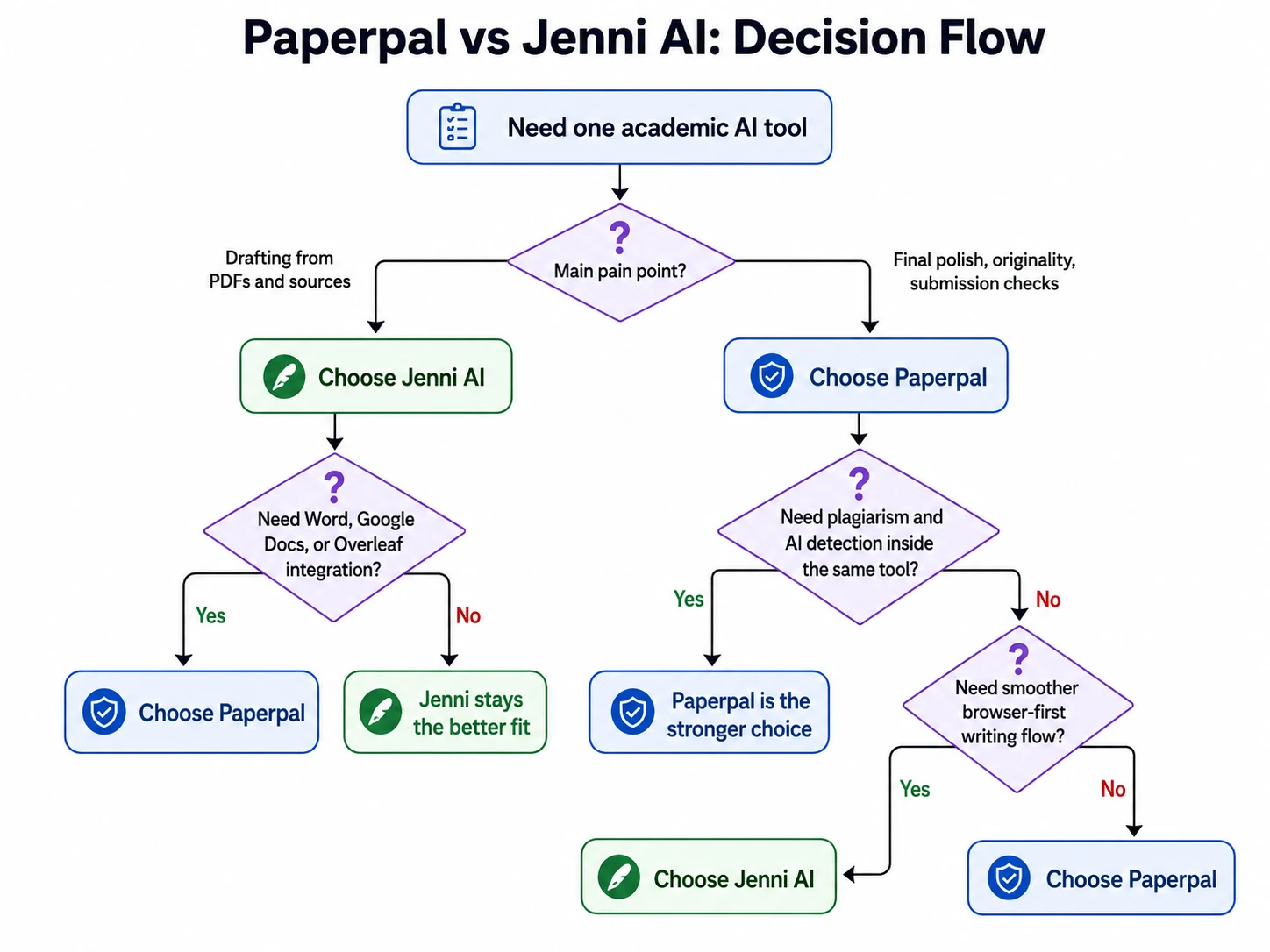
Decision Flow
Recommendation
If you want one verdict, Paperpal is better overall because it covers more of the real academic workflow, from draft generation and language cleanup to citation support, plagiarism checks, AI detection, and submission readiness. That breadth matters more than it first appears, because academic pain is rarely only about drafting. It is also about originality, formatting, risk reduction, and final polish, which is where Manusights lands too.
Choose Jenni AI if you are a student or researcher who already has sources and needs help turning them into a solid first draft, especially if you value PDF chat, source-linked autocomplete, Zotero or Mendeley import into a shared library, collaboration, and a clean browser-first editor. Choose Paperpal if you are closer to submission, need better academic editing, want visible originality tooling, or write inside Word, Google Docs, or Overleaf. If your budget is tight and pricing clarity matters, Jenni is easier to understand today. If academic risk reduction matters more than price transparency, Paperpal is the more rigorous buy.