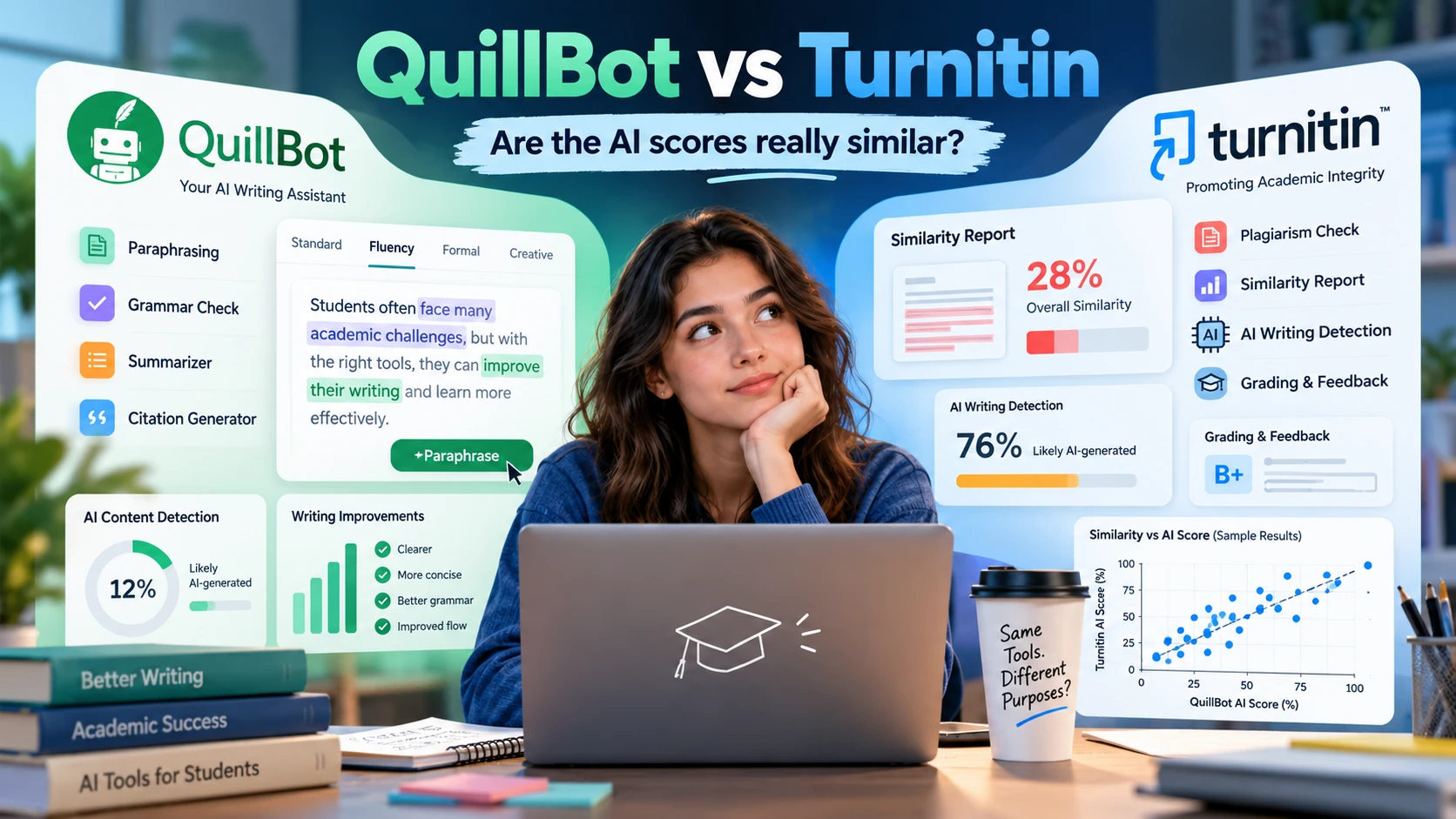

If you are a student, “Is QuillBot similar to Turnitin?” can actually mean two different things. You might be asking whether the two platforms offer the same kinds of writing and plagiarism tools. Or you might really be asking a more practical question: if QuillBot says my paper is 10%, 50%, or 100% AI-written, will Turnitin give me roughly the same AI score?
The short answer is: QuillBot and Turnitin overlap, but they are not equivalent products, and QuillBot should not be treated as a reliable Turnitin score predictor. QuillBot is mainly a writing-assistance platform that students can use directly. Turnitin is primarily an institutional academic-integrity, similarity-checking, grading, and feedback platform used by schools and universities.
To test the AI-detector part of the question, we also compared QuillBot and Turnitin scores across a dataset of 100 text samples. One sample had no QuillBot score, leaving 99 usable pairs. The results show moderate overall correlation, but much weaker agreement once the easy cases where both tools returned 0 are removed.
QuillBot vs Turnitin at a glance
| Category | QuillBot | Turnitin |
|---|---|---|
| Main purpose | Writing assistance and revision | Academic integrity, similarity checking, grading, and feedback |
| Typical users | Students, writers, professionals, individuals | Schools, universities, instructors, students through institutions |
| Direct student signup | Yes | Usually access is provided through an institution |
| AI detector | Yes, including free access with limits | Yes, when the relevant Turnitin Originality capability is licensed and enabled |
| Similarity / plagiarism checking | Available as part of Premium | Core part of the Turnitin ecosystem |
| Paraphrasing | Yes, a major QuillBot feature | Not primarily a rewriting tool; Turnitin instead identifies text similarity and can identify likely AI-paraphrased content in supported products |
| Grammar and writing assistance | Yes | Some writing support exists through products such as Draft Coach, but this is not the same type of all-purpose writing suite |
| Pricing model | Free tier plus individual Premium subscription | Institutional licensing and quote-based pricing |
What does QuillBot offer students?
QuillBot has expanded far beyond its original paraphrasing tool. Its current platform includes a paraphraser, grammar checker, summarizer, citation tools, translator, AI detector, AI humanizer, plagiarism checker, and other writing features. This makes it much closer to a general writing toolkit than to a university assessment platform.
QuillBot also makes its AI Detector available to free users. According to its current plan comparison, free users have limits on detector usage and text length, while Premium users get broader or unlimited access. QuillBot currently advertises Premium at $8.33 per month when billed annually on its US-priced Premium page, although the company notes that prices can vary by region.
Sources: QuillBot Premium, QuillBot free vs Premium, and QuillBot AI Detector.
What does Turnitin offer?
Turnitin is built around a different workflow. A university or school typically licenses the service, instructors create or connect assignments, and student submissions are processed through Turnitin's academic-integrity and feedback tools.
Its best-known feature is the Similarity Report, which compares a submission with sources such as internet pages, publications, and previously submitted student work. That similarity percentage is not the same thing as the AI-writing percentage. A paper can have a low similarity score and a high AI-writing score, or the other way around, because the two systems are measuring different things.
Turnitin also provides grading and feedback features, Draft Coach, integrity flags, and an AI-writing report where enabled. Turnitin says its AI-writing indicator estimates the percentage of qualifying text likely to be AI-generated or AI-generated and then modified using AI paraphrasing.
Unlike QuillBot, Turnitin does not normally sell Feedback Studio or Similarity directly to individual students. Institutions request pricing from Turnitin based on their size and requirements.
Sources: Turnitin Originality, Turnitin subscription guide, and Turnitin similarity score guide.
Also Read: Can Stealthwriter AI Beat QuillBot's AI Detector? We Tested 100 Rewrites
Are QuillBot's and Turnitin's AI scores similar?
This is where the comparison becomes much more interesting. We tested the two detector scores using 100 samples. Because one sample was missing a QuillBot result, the statistical comparison uses 99 paired scores.
The average scores initially look almost identical: QuillBot averaged 27.1% and Turnitin averaged 28.1%. But similar averages do not mean the tools agree on individual documents. One detector can score a text much higher while another scores a different text much lower, causing the averages to cancel out.
Across all 99 usable samples:
- Pearson correlation between scores: 0.615
- Mean absolute difference: 17.7 percentage points
- Root mean squared difference: 37.2 percentage points
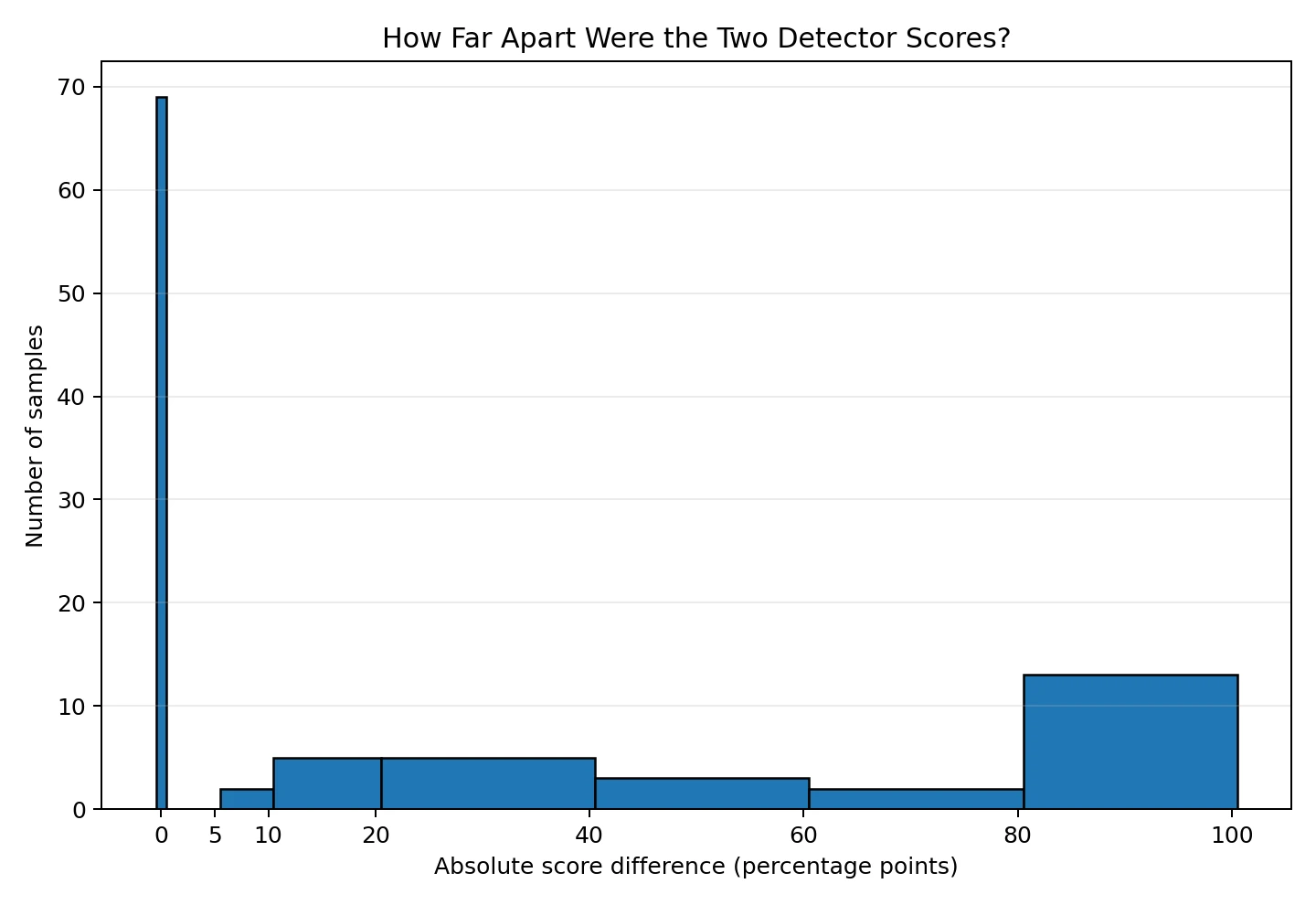
- Exact score matches: 69 of 99, or 69.7%
- Scores within 10 points of each other: 71 of 99, or 71.7%
- Scores within 20 points of each other: 76 of 99, or 76.8%
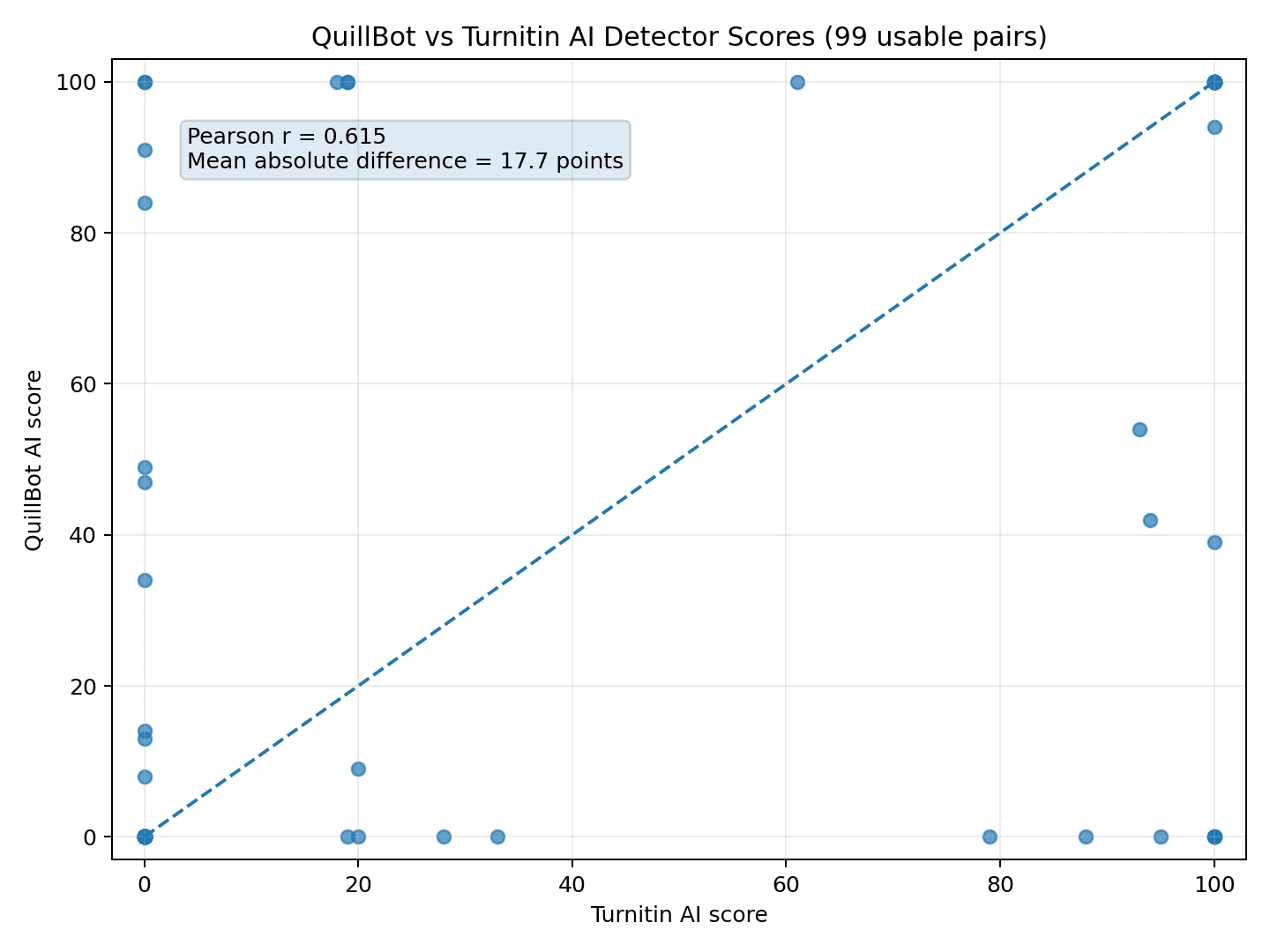
A correlation of 0.615 means the two systems have a real tendency to move in the same direction, but that is nowhere near the same as interchangeable scoring. There were several extreme cases where one tool produced a score near 100 while the other produced 0.
Also Read: [HOT] Can Turnitin Detect Quillbot Humanizer?
The 69.7% exact-match figure is misleading
The most important detail in the dataset is that 54 of the 99 usable samples received 0 from both detectors. Those shared-zero cases make the overall agreement look much stronger.
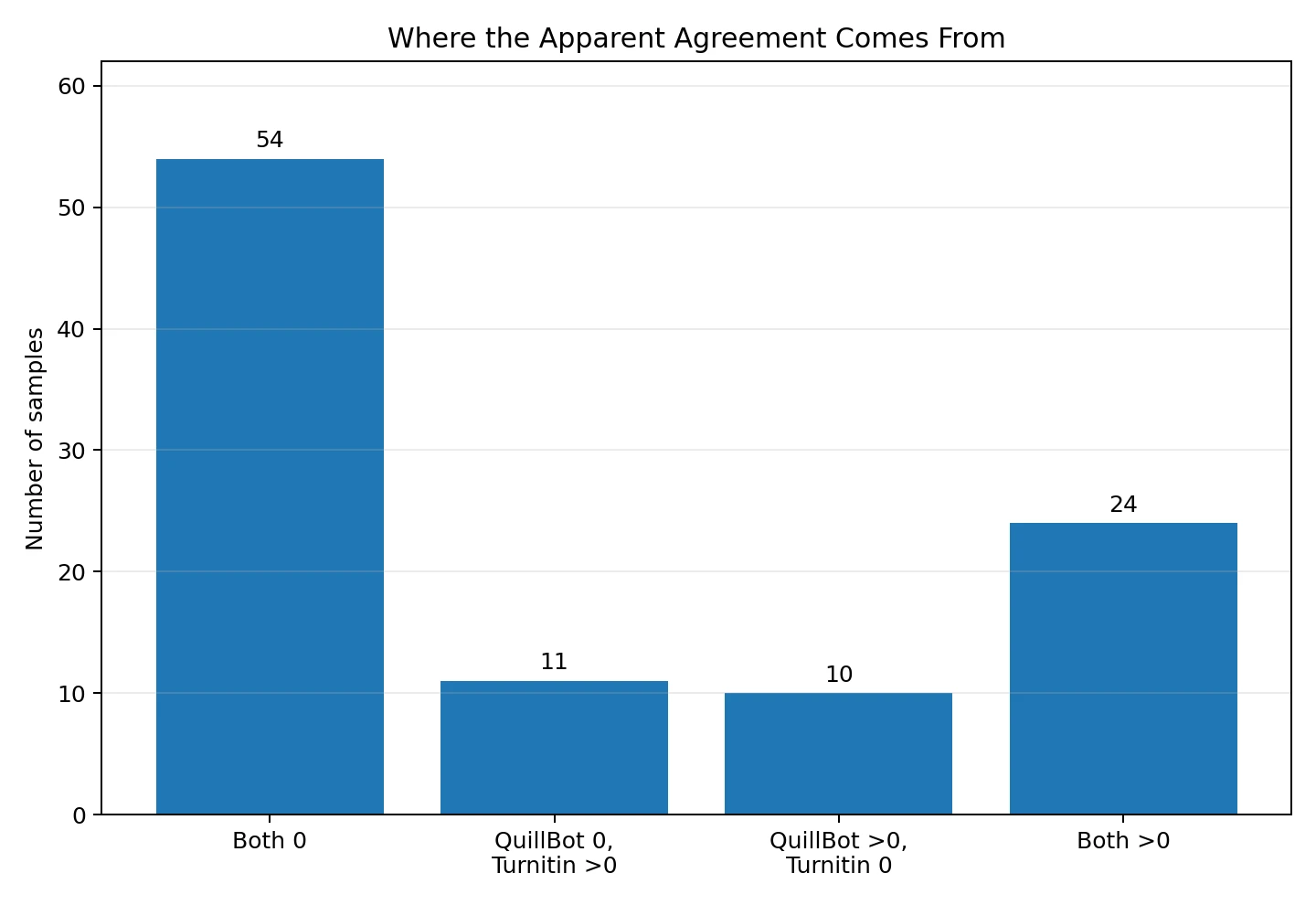
The breakdown was:
- Both detectors returned 0: 54 samples
- QuillBot returned 0 but Turnitin returned a positive score: 11 samples
- Turnitin returned 0 but QuillBot returned a positive score: 10 samples
- Both returned a positive score: 24 samples
If we remove the 54 samples where both simply returned 0, only 45 samples remain. On those harder cases, the Pearson correlation drops from 0.615 to just 0.212. The mean absolute difference jumps to about 39.0 percentage points, and only 15 of the 45 harder cases have exactly matching scores.
That matters much more to a student who is trying to answer, “Turnitin might detect AI here, so can QuillBot tell me approximately what Turnitin will say?” In precisely those non-trivial cases, the two tools can disagree substantially.
Also Read: [STUDY] QuillBot vs Winston AI: Which AI Detector Is Better for Students?
Can QuillBot tell you whether Turnitin will show a significant AI score?
Turnitin currently does not surface an exact numerical AI percentage from 1% through 19%. Instead, it displays an asterisk in that range because Turnitin says lower scores are less reliable and false positives are more likely. Exact percentages are shown from 20% upward.
That gives us a useful practical test. If we classify each sample as either below 20% or at least 20%, QuillBot and Turnitin agree on 78 of 99 samples, or 78.8%.
However, 21 samples fall on opposite sides of that line. Among the 31 samples where Turnitin scored at least 20, QuillBot also reached at least 20 on only 20 samples. In other words, QuillBot matched Turnitin's 20%-or-higher status in about 64.5% of those Turnitin-positive cases. QuillBot also produced at least 20 on 10 samples where Turnitin remained below 20.
This does not tell us which detector was objectively correct because this dataset compares detector outputs rather than comparing both tools with known human/AI ground truth. It does tell us something narrower and very useful: QuillBot is not a dependable emulator of Turnitin.
Why can two AI detectors disagree so much?
AI detectors are not looking up a universal database that contains the “correct AI percentage” for a piece of text. Each detector uses its own model, training data, thresholds, features, and rules for deciding what looks AI-generated.
QuillBot says its detector is trained on human, AI-generated, academic, and paraphrased material and looks for a range of AI-writing patterns. Turnitin has developed its detector specifically around student writing and its academic-integrity workflow. Different models can therefore interpret the same text very differently.
There is also no perfect detector. QuillBot itself says detector results are probability estimates rather than verdicts, and Turnitin warns about false positives at lower AI percentages. Independent research has reached a similar conclusion. A 2026 study in the International Journal for Educational Integrity found that commercial AI detectors struggled particularly with hybrid human-AI writing, while another 2026 systematic evaluation in Computers & Education concluded that detector performance was not adequate for high-stakes assessment on its own.
Research sources: International Journal for Educational Integrity study and Computers & Education systematic evaluation.
So, can students use QuillBot as a proxy for Turnitin?
Only as a very rough second opinion, not as a Turnitin score predictor.
The data shows that QuillBot can agree with Turnitin on obvious cases, especially when both systems see little or no AI-like writing. But once either detector sees something suspicious, the score relationship becomes much weaker. In the non-zero subset, the average difference was almost 39 percentage points and the correlation was only 0.212.
So if QuillBot gives you 0%, you should not assume Turnitin will give you 0%. If QuillBot gives you 80%, you also should not assume Turnitin will give you something close to 80%. The scatter plot shows examples in both directions.
For students, QuillBot's free detector is still useful as an accessible check that may flag passages worth reviewing. But it is better used to ask, “Does this passage look unusually machine-like to one detector?” rather than, “What score will Turnitin give me?”
If your institution gives you access to Turnitin Draft Coach, a pre-submission Turnitin workflow, or another official university tool, that will be more relevant to the system your institution actually uses. And regardless of the detector, a percentage should not be treated as proof that a student did or did not use AI.
Final verdict
QuillBot and Turnitin overlap in AI detection and plagiarism-related features, but their core purposes are different. QuillBot is a consumer writing assistant designed to help you draft, rewrite, correct, summarize, cite, and check text. Turnitin is an institutional academic-integrity and assessment platform.
Their AI detectors are also not interchangeable. In our 99 usable comparisons, the overall correlation was moderate at 0.615, but shared zero scores explained a large part of that apparent similarity. When those cases were removed, correlation fell to 0.212 and the average absolute difference rose to 39 points.
Bottom line: QuillBot can be useful for a quick AI-detection check, but it is not reliable enough to predict an individual Turnitin AI score.