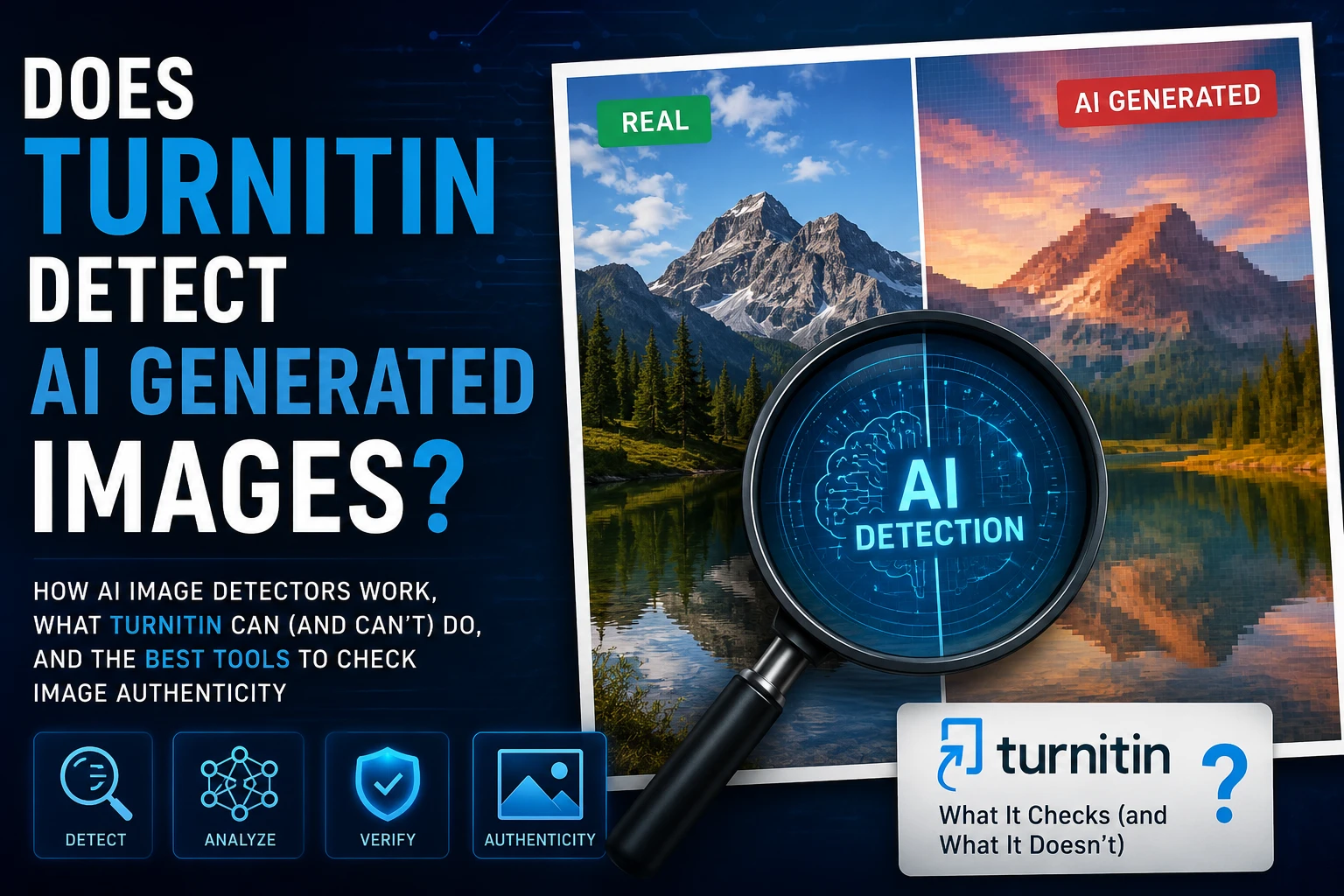

If you are wondering whether Turnitin can catch an image made in Midjourney, DALL-E, GPT image generation, or Stable Diffusion, the short answer is that Turnitin’s public documentation describes an AI Writing Report for prose text, not a documented image-authenticity detector. As of July 14, 2026, I could not find an official Turnitin page that says it detects whether an attached image itself was AI-generated. That does not mean images are irrelevant in Turnitin workflows. It means the company’s documented AI capability is about text, file requirements, and educator review, not pixel-level image forensics. This post assumes a general educated audience and uses inline source links rather than a formal citation style.
- Turnitin’s official scope is long-form prose text, with accepted AI-writing-report file types limited to DOCX, PDF, TXT, and RTF, and at least 300 words of prose.
- Image AI detectors usually work in two broad ways: passive detectors that inspect artifacts in the image itself, and provenance or watermark systems that verify embedded evidence from the creation pipeline.
- No single detector is foolproof. Cropping, compression, screenshots, adversarial perturbations, stripped metadata, and new generators all reduce reliability.
- The best practical approach for educators and creators is layered: combine policy, context, provenance, reverse search, and human review instead of trusting one score.
Also Read: [STUDY] Is Pangram AI Detector Similar to Turnitin?
What Turnitin officially says
Turnitin’s own AI Writing Report says the company’s AI detection capability is designed to help instructors identify text that might be prepared by a generative AI tool. The same documentation defines the score in terms of qualifying text, meaning prose sentences in long-form writing, and warns that the model can misidentify human-written, AI-generated, and AI-paraphrased text and therefore should not be the sole basis for adverse action.
The file requirements reinforce that scope. Turnitin says an AI writing report requires fewer than 100 MB, at least 300 words of long-form prose, and one of four accepted file types. Separately, Turnitin’s general submission rules say PDF image files and scanned documents that do not contain highlightable text are not accepted for similarity checking. Turnitin also notes that PowerPoint uploads are converted to static PDFs that preserve images, but the product documentation still describes AI analysis in terms of readable prose, not image provenance or synthetic-image classification.
So the most defensible reader-facing conclusion is this: Turnitin has a documented AI detector for writing, not a documented detector for whether an image itself was AI-generated. If a student inserts an AI-made picture into a paper, Turnitin may still analyze the surrounding text, captions, or essay prose if those portions satisfy the documented requirements, but that is different from saying Turnitin can authenticate the image.
Also Read: How often does Turnitin update its database?
How image AI detectors work
Image AI detection now splits into two families. Passive detectors act like forensic classifiers, looking for artifacts, statistics, or learned patterns left by generators. Provenance-based systems and watermarking systems instead try to verify evidence embedded at creation time. A useful way to think about it is that passive systems ask “does this look synthetic,” while provenance-first systems ask “is there trustworthy evidence about where this came from.”
flowchart LR A[Input image] --> B[Basic checks] B --> C[Pixel and frequency analysis] B --> D[Metadata and provenance checks] C --> E[Classifier and generator attribution] D --> F[Credential or watermark verification] E --> G[Risk score] F --> G[Risk score] G --> H[Human review and context]
- Fingerprinting and model attribution. Some systems try to identify generator-specific traces, sometimes down to a likely source model. The FingerprintNet paper and later surveys describe “fingerprints” in the frequency domain, while vendors such as Hive and Sightengine expose per-generator scores.
- Statistical artifacts and frequency signatures. Many detectors analyze Fourier, DCT, or wavelet behavior because generative models often reproduce high-frequency detail differently from camera pipelines. Reviews describe spectrum discrepancies, periodic artifacts, and aliasing patterns as recurring clues.
- Noise patterns. A major line of work checks whether an image carries camera-like residual noise or the smoother, more isotropic noise left by synthesis. Surveyed methods such as Learned Noise Patterns, PatchCraft, SSP, and IPD-Net all extract high-frequency residuals and inter-patch dependencies.
- Compression artifacts. JPEG and resizing matter twice. First, they create clues that weak detectors may overfit to. Second, they are common real-world transformations that can wipe out useful evidence. The Fake or JPEG? paper showed that many benchmarks unintentionally taught detectors to notice dataset compression differences rather than genuine generation traces.
- Metadata and provenance. Metadata can hint at origin, but it is easy to strip or edit. That is why provenance frameworks such as C2PA and Content Credentials use signed manifests, not plain EXIF alone. OpenAI says C2PA metadata is cryptographically signed and tracks editing history for DALL-E images, while the C2PA explainer stresses that credentials establish provenance, not truth.
- Watermarking and model signatures. Google’s SynthID embeds an invisible watermark during generation and says it is designed to survive common edits such as cropping and lossy compression. Research benchmarks increasingly compare these watermark-based systems against passive detectors, often finding that watermarking is stronger when the image came from a participating model and the signal survives the edits.
Also Read: [DIRECT] Can Turnitin Read Images? What Students & Educators Should Know?
Where detectors break down
The hardest part of this field is not building a detector that works in a curated benchmark. It is making one that still works after screenshots, messaging-app recompression, partial edits, or a brand-new generator release. A recent Brookings review argues that good detectors need low false positives, robustness against evasion, and clear trust models, while also warning that even apparently small error rates can be unacceptable in education or high-volume moderation.
False positives remain a serious issue because some detectors latch onto shortcuts. The Fake or JPEG? paper found that common datasets differed in compression and image size, meaning a model could learn “PNG versus JPEG” instead of “AI versus camera.” That is a cautionary tale for educators and journalists alike. A confident score can still be wrong if the benchmark was biased.
Adversarial attacks are also real. The Vulnerabilities in AI-generated Image Detection paper shows state-of-the-art detectors can be attacked in white-box and black-box settings, while the Smudged Fingerprints study found fingerprint removal attacks often work disturbingly well. Another 2025 paper introduced the RAID benchmark specifically because robustness testing had been too inconsistent.
Two recent case studies make the limitations vivid. First, Reuters found that Meta’s preview detector identified all original Muse Image outputs but failed on 55% of the same images after moderate cropping, despite a watermarking system designed to survive common edits. Second, an RSNA Radiology study found that radiologists and multimodal models both struggled to identify AI-generated X-rays, with only 41% of radiologists noticing the fakes before being told they were present, and 75% mean accuracy after disclosure. The lesson is simple: highly realistic images can fool both humans and machines.
Privacy and ethics add another layer. Uploading sensitive files to a detector can expose personal data if the service retains content or processes it on third-party servers. Some vendors respond directly to that concern: AI or Not says checked content is deleted immediately, and Adobe says files uploaded to its Inspect tool are not stored. Meanwhile, C2PA itself says it respects privacy, but independent researchers have argued that provenance systems still need careful handling because creator identity, timestamps, and locations can become sensitive metadata.
Also Read: [HOT] Does Turnitin compare your paper against paywalled journals?
Which tools are most credible
The tools below are the ones I would treat as the most credible starting points because they have relatively solid documentation, public product pages, or industry adoption. One row is a provenance verifier rather than a pixel classifier, because when valid credentials exist, cryptographic verification is often more defensible than guessing from image artifacts alone.
| Name | Detection method | Accuracy claims | Supported formats | Pricing or access | Primary source link |
|---|---|---|---|---|---|
| AI or Not | Passive, pixel-level, multi-model classifier with confidence and model insights. | 98.9% vendor claim on recent public datasets. | PNG, JPG, WEBP, GIF on public tool. | Free tier with 20 image checks; Pro $5/month with 500 image checks; enterprise custom. | AI or Not API docs |
| Hive | Passive detector plus deepfake model, generator attribution, and C2PA field surfacing when present. | Hive cites 98.03% accuracy and 0% false positives from an independent art benchmark; the underlying UChicago study found Hive performed very well but weaker under adversarial perturbations than expert artists. | gif, jpg, png, webp; video mp4, webm, avi, mkv, wmv, mov. | $6 per 1,000 image requests on the model page. | Hive image and video detection docs |
| Sightengine | Passive pixel-content classifier, no EXIF dependency, returns per-generator scores. | No percentage on the core API page, but the site cites an independent benchmark where it ranked highest among tested tools. | JPEG, PNG, WebP, GIF and image URLs. | Free 2,000 ops/month; Starter $29/month; Pro $99/month. | Sightengine AI image detection |
| Reality Defender | Ensemble detection with image models, context-aware analysis, and metadata or C2PA signals. | No single headline percentage on main product pages; public notes mention a 4% balanced-accuracy improvement on compressed images. | .jpg, .jpeg, .png, .gif, .webp. | Web app and API; free tier offers 50 detections per month. | Reality Defender docs |
| Sensity AI | Multilayer forensic engine using visual artifacts, metadata, file structure, and cross-modal inconsistencies. | 98% on public datasets, according to the company. | jpg, jpeg, png, tiff, gif, webp, jfif. | API, SDK, web app, cloud or on-prem; 7-day trial, pricing via sales. | Sensity API docs |
| Content Credentials Verify | Cryptographic provenance verification using C2PA manifests, not a probabilistic pixel classifier. | No classifier accuracy claim. It verifies signed credentials when they exist. | AVI, AVIF, DNG, HEIC, HEIF, JPEG, M4A, MOV, MP3, MP4 and more. | Free web verifier. | Content Credentials Verify |
If you want one sentence of evaluation, here it is: for broad passive detection, AI or Not, Hive, and Sightengine look best documented for general image screening; for enterprise fraud and investigative work, Reality Defender and Sensity offer richer multimodal and forensic workflows; and for content that already carries provenance, Content Credentials Verify is often the cleaner answer because it checks a signed claim instead of making a guess.
Also Read: [HOT] Can Teachers See Edit History On Turnitin?
Best practices for educators and creators
If you are an educator, the most sensible policy is not “trust the detector,” but “document the workflow.” Ask students to submit drafts, source files, prompts if institutionally required, and a short disclosure explaining any AI assistance. That is much closer to Turnitin’s own posture, which repeatedly says AI scores should be a data point for human judgment, not a final verdict.
- For educators: treat Turnitin as a writing-signal tool, not an image-forensics platform; if image authenticity matters, add a separate review step using provenance tools, reverse search, and an image detector outside Turnitin.
- For creators: where possible, publish with Content Credentials or another provenance layer, because signed origin data can be more persuasive than arguing with a black-box score after the fact.
- For everyone: do not treat missing metadata as proof an image is human-made. C2PA itself says credentials provide provenance, not value judgments, and many platforms strip metadata.
- For sensitive images: check the service’s privacy posture before uploading. Adobe’s inspect tool says uploads are not stored, and AI or Not says checked files are deleted immediately.
The practical bottom line for you is simple. Turnitin is currently a text-integrity tool with AI-writing detection, not a publicly documented detector for AI-generated images. Image AI detection itself is real, but it is a moving target shaped by artifacts, fingerprints, provenance, watermarks, and a constant cat-and-mouse game with compression, edits, and adversarial attacks. The most reliable posture is layered verification, not blind faith in any single score.