![[STUDY] Is Pangram AI Detector Similar to Turnitin?](/static/images/is_pangram_ai_detector_similar_to_turnitinpng.webp)

When students compare AI detectors, one of the biggest questions is whether different tools behave in roughly the same way. I checked a dataset of 100 samples that had both Pangram and Turnitin results. My goal was simple: see whether these two detectors move together closely enough to feel similar, or whether they behave differently in practice.
The short answer is not really. They do overlap at the extremes, especially when both tools land on very low or very high scores, but the overall pattern says Pangram is much more all or nothing in this dataset. Turnitin spreads scores across more levels, while Pangram usually jumps straight to 0 or 100.
Also Read: StealthWriter vs Pangram: Can a "Humanized" Rewrite Really Escape Detection?
What was in the dataset?
- 100 total text samples
- 97 rows where both tools could be compared numerically
- 3 rows where Turnitin showed Unsupported
- Pangram used only three score values here: 0, 68, and 100
- Turnitin used a wider range of values, including 0, 18, 19, 20, 28, 33, 61, 79, 88, 93, 94, 95, and 100
Also Read: [STUDY] Can Pangram Detect Undetectable AI?
The first big clue
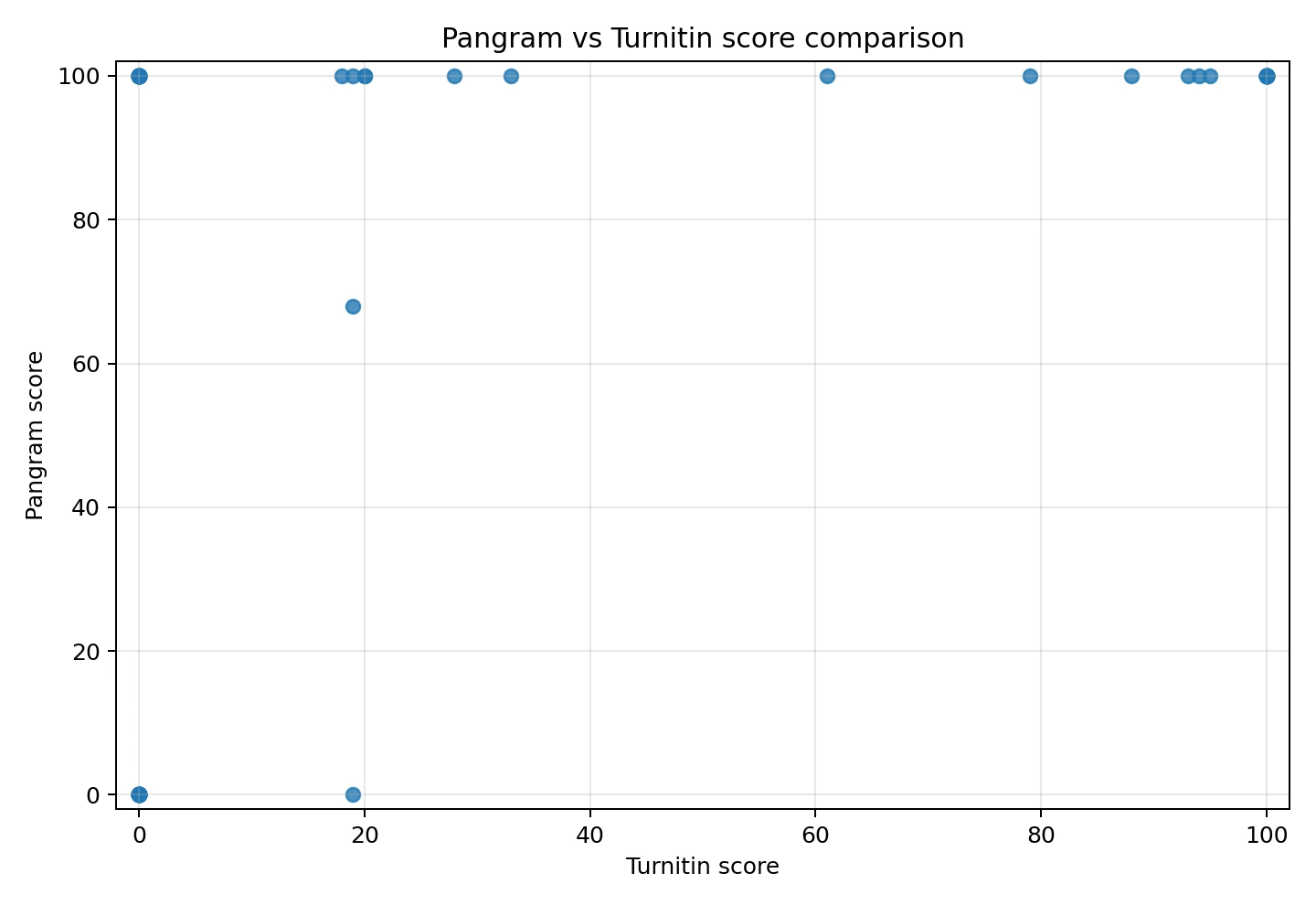
If two detectors are truly similar, you would expect their scores to cluster close to a diagonal line on a scatter plot. That would mean when one goes up, the other usually goes up by about the same amount. Here, that only happens part of the time.
The scatter plot below shows some relationship, but not a tight one. In plain English, Pangram and Turnitin are not acting like near copies of each other.
What the numbers say
Here are the main statistics from the comparison:
- Pearson correlation: 0.43
- Spearman correlation: 0.43
- Exact score agreement: 49 out of 97 comparable rows, or 50.5%
- Broad high vs low agreement: 56 out of 97 rows, or 57.7%
- Cohen's kappa: 0.28
- Average absolute gap between the two scores: 41.4 points
These numbers matter because they show that there is some overlap, but not enough to call them strongly similar. A correlation around 0.43 is only moderate. The average score gap of more than 41 points is also pretty large. That means the two tools often give noticeably different readings on the same text.
Also Read: Are Turnitin and TurnDetect the Same?
The biggest pattern in the dataset
The most common mismatch was not a tiny disagreement. It was a major one. In 34 samples, Turnitin gave a score of 0 while Pangram gave 100. That is not a small drift. That is a completely different judgment pattern.
The next chart makes this easier to see. I grouped Turnitin into low, mid, and high bands, then checked what Pangram did inside each band.
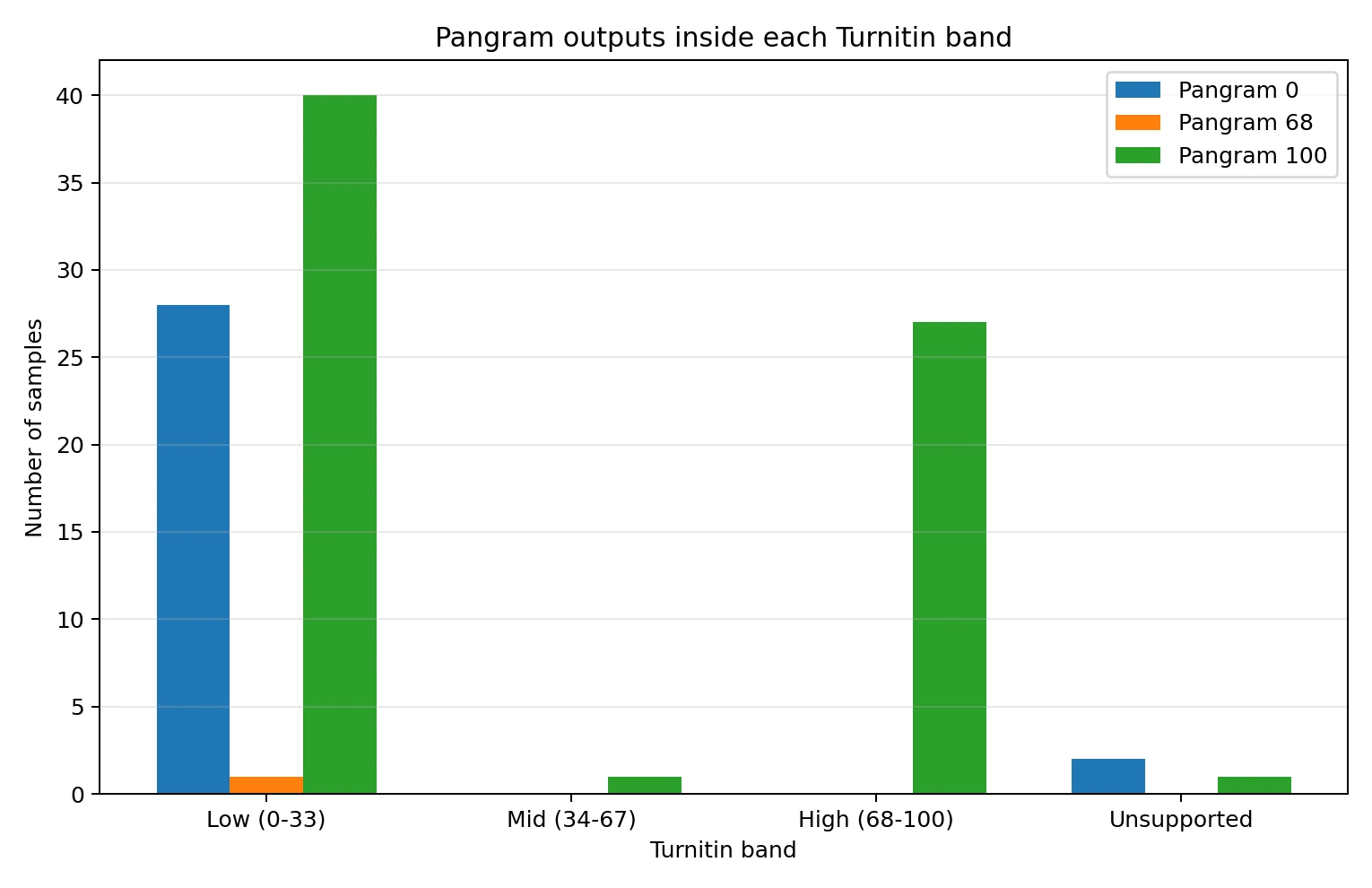
- When Turnitin was in the high band, Pangram was also high every time in this dataset.
- When Turnitin was in the low band, Pangram was split. It matched the low reading in 28 cases, but it still jumped to 100 in 40 cases.
- The mid range was barely used by either tool here, which makes Pangram look especially blunt.
This suggests Pangram is much more likely to push a sample to an extreme score, while Turnitin leaves more room for partial or in-between readings.
Also Read: How often does Turnitin update its database?
Which score pairings happened most often?
Looking at the most common pairings is another good way to test whether two tools feel alike. If they are similar, the leading pairings should mostly be matching values. Instead, one of the biggest bars below is the mismatch between Turnitin 0 and Pangram 100.
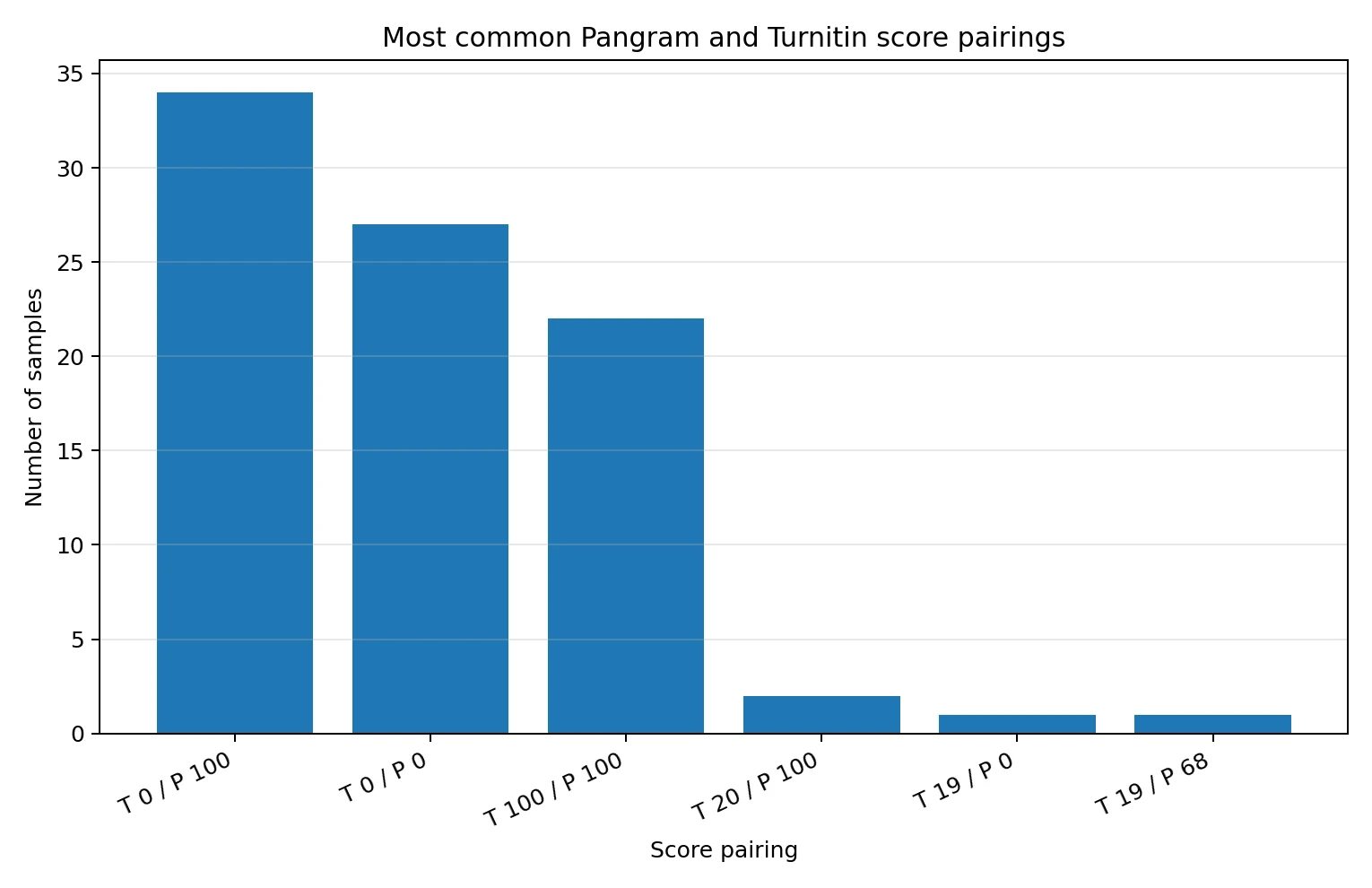
The most common pairings were:
- Turnitin 0 and Pangram 100: 34 samples
- Turnitin 0 and Pangram 0: 27 samples
- Turnitin 100 and Pangram 100: 22 samples
That tells us something important. Yes, both tools can agree strongly at times. But one of the most common outcomes in the whole dataset is still a full disagreement at the opposite end.
So, is Pangram similar to Turnitin?
Based on this dataset, the honest answer is only partly. They are similar enough that they sometimes move in the same direction, especially on very strong cases. But they are not similar enough to be treated like interchangeable detectors.
- Pangram looks more binary and extreme
- Turnitin looks more graded and spread out
- The tools agree on some strong cases, but they also diverge a lot on low Turnitin scores
- The moderate correlation is not strong enough to say they behave almost the same
For students, the practical takeaway is simple. Do not assume that a result from Pangram will mirror a result from Turnitin. A text that looks safe or risky in one system may not land the same way in the other.
Final takeaway
If I had to answer the question in one sentence, I would say this: Pangram and Turnitin are related in a loose way, but not similar enough to trust them as near-equivalent AI detectors.
In this dataset, Pangram behaves like a much more all or nothing tool, while Turnitin shows a bit more nuance. That difference matters because students often assume one detector can stand in for another. This analysis suggests that assumption would be risky.