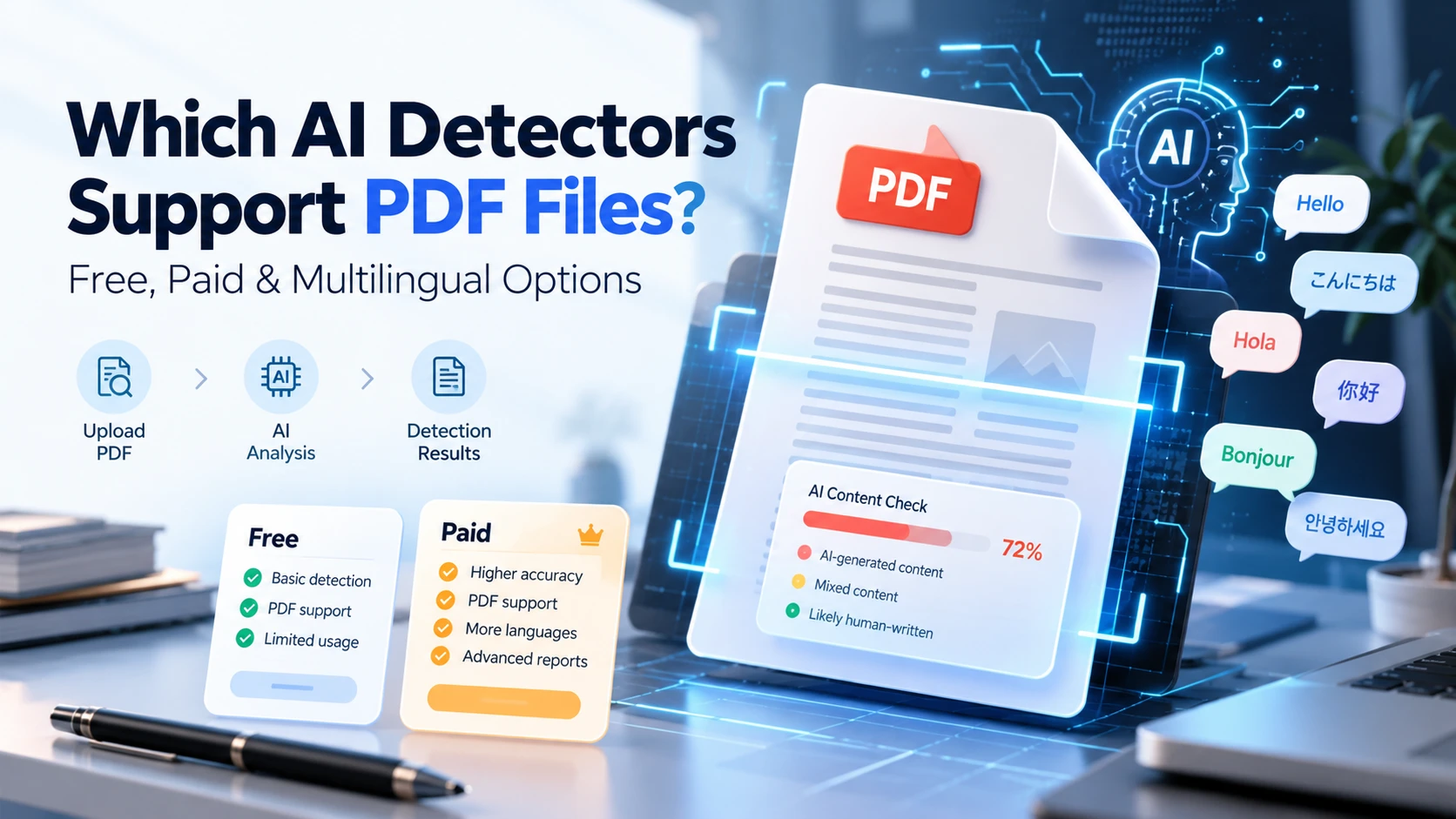

If your work arrives as PDFs, the important question is not simply whether an AI detector exists. You need to know whether it can actually ingest a PDF, whether it works outside English, and whether those features disappear behind a paid plan.
I checked current product documentation, pricing pages, help centers, and vendor-published testing material as of October 19, 2026. Six products have sufficiently clear primary-source evidence of PDF support to include here: Turnitin, GPTZero, Copyleaks, Originality.ai, Winston AI, and Pangram. Of these, Originality.ai is unusually generous because its current Basic free plan explicitly includes DOCX, PDF, and DOC file uploads. GPTZero also supports PDF documents and has a free allowance, while Pangram reserves file upload and OCR for its paid Individual plan. Turnitin is the institutional option: PDF submissions are supported, but AI writing detection requires a Turnitin Originality license rather than a public free account.
Multilingual coverage varies dramatically. Turnitin currently supports seven languages. Originality.ai supports a 30-language multilingual model. Copyleaks advertises AI detection in 30+ languages, Pangram supports more than 20, and GPTZero's September 2026 documentation lists English plus more than 20 additional languages. Winston AI supports 16 languages. Those numbers should not be treated as proof that accuracy is identical in every language.
Also Read: Can AI Detectors Detect Filipino?
PDF and multilingual support at a glance
| Detector | PDF / URL support | Multilingual AI detection | Free or paid? | Relevant pricing |
|---|---|---|---|---|
| Turnitin — institutional | PDF upload: Yes. PDF URL import: Unspecified. | Yes: English, Spanish, Japanese, Arabic, German, Dutch, Turkish. | Paid only; requires Originality with AI writing enabled. | Custom institutional pricing. |
| GPTZero | PDF upload: Yes. PDF URL import: Unspecified. | Yes, 20+ additional languages. | Free scans exist and document upload is supported. Premium explicitly lists multilingual detection; exact multilingual feature gating on Free is not clearly specified. | Free allowance; Premium $12.99/month billed annually. |
| Copyleaks | PDF upload: Yes. API workflows support URL submissions, but AI-only PDF-URL behavior is not clearly specified. | Yes, 30+ languages. | Free browser text checks exist; free PDF upload entitlement is Unspecified. Paid Personal supports multi-file upload and 30+ languages. | Personal $16.99 monthly or $13.99/month billed annually. |
| Originality.ai | PDF upload: Yes. Generic URL scanning: Yes; PDF-specific URL import is not separately documented. | Yes, 30-language model. | PDF upload is available on the free Basic plan. Free-tier access to the Multi Language model is not explicitly mapped in pricing documentation. | Basic free; Pro $14.95/month or $12.95/month billed annually. |
| Winston AI | PDF upload: Yes; Google Drive PDF import: Yes; webpage URL import: Yes. Direct PDF-URL import: Unspecified. | Yes, 16 languages. | 14-day free trial includes AI detection, but the documentation does not clearly guarantee PDF/multilingual access for every trial account. | Essential $18/month or $120/year. |
| Pangram | PDF upload: Yes on paid plans. PDF URL import: Unspecified. | Yes, more than 20 languages. | Multilingual text checks have a free allowance; file upload and OCR require Individual or higher. | Up to 20 free checks/day; Individual $20/month with a 7-day trial. |
What each detector actually offers
Turnitin
Turnitin deserves to be treated separately from consumer detectors. Its AI Writing Report accepts PDF, DOCX, TXT, and RTF files. A submission must contain at least 300 words of qualifying prose, stay below 30,000 words and 100 MB, and use one of seven supported languages. German, Dutch, and Turkish were added on October 6, 2026, joining English, Spanish, Japanese, and Arabic. Access is not a consumer subscription: institutions need the Turnitin Originality add-on with AI detection enabled.
Turnitin's limitation language is unusually important. It says the model can misidentify human, AI-generated, or AI-paraphrased writing and should not be the sole basis for adverse action. Scores from 1% through 19% are deliberately suppressed and shown as “*%” because false positives are more likely in that range. Turnitin also says the system is designed for long-form prose rather than poetry, code, scripts, tables, bullet-heavy text, or annotated bibliographies. Its reported document-level false-positive rate is below 1% for documents containing at least 20% AI writing; that qualification matters.
Also Read: Do Em Dashes Mean AI Wrote It?
GPTZero
GPTZero's technical overview explicitly accepts PDF, DOCX, image files, and pasted text, with batch analysis of up to 50 files. Its current support documentation lists English plus more than 20 languages, although some older product pages still describe only five languages as “fully supported.” That documentation mismatch is worth noticing when language support is central to your purchase.
GPTZero reports a false-positive rate of no more than 1% in its AI-versus-human evaluation and 96.5% accuracy on mixed human/AI documents. These are vendor-reported figures rather than guarantees for your particular PDF. GPTZero itself says detection is more dependable on longer passages and that results should be used as evidence for review rather than a final verdict. Its Premium plan currently starts at $12.99 per month when billed annually and explicitly includes multilingual detection.
Copyleaks
Copyleaks' developer documentation explicitly lists PDF among files supported for AI-generated-content detection. The consumer product supports AI detection in 30+ languages. Its free web detector allows limited text checking, but the primary pricing documentation does not clearly promise PDF upload on the free tier, so that detail is best recorded as Unspecified rather than assumed.
The paid Personal plan includes 30+ language AI detection and multi-file uploads. Copyleaks' published testing methodology is useful because it shows the trade-off behind a detector score: more aggressive sensitivity catches more AI writing but also increases false positives. That is a healthier way to interpret detector accuracy than treating one headline percentage as universal.
Originality.ai
Originality.ai currently has one of the clearest free PDF offers. Its Basic plan allows three AI-detection scans per day, up to 2,000 words per scan, and explicitly lists PDF, DOC, and DOCX uploads. Pro adds broader workflow features such as full-site and URL scanning.
Its September 2026 Multi Language 2.0 benchmark covers 30 languages and 127,150 samples. Originality reports 97.81% overall accuracy, a 2.40% false-positive rate, and a 1.99% false-negative rate. Those numbers come from Originality.ai's own benchmark, so they are best understood as vendor testing, not an independent certification. The company also explicitly says an AI score should be one signal rather than proof of misconduct.
Also Read: What Is AI Residue? Definition, Examples, and Why It's Spreading
Winston AI
Winston has perhaps the most flexible document-ingestion workflow in this group. Its text-analysis guide supports direct PDF upload, PDF import from Google Drive, bulk PDF uploads, and ordinary webpage URL import. Bulk jobs can include up to 50 files, with a 10 MB limit per file. Its AI detector supports 16 languages.
Winston warns that sentence-by-sentence predictions are less accurate than its overall Human Score, and its language documentation says performance can vary by language. It recommends longer, continuous natural prose rather than tiny fragments. There is a 14-day, 2,000-credit free trial; after that, Essential costs $18 monthly or $120 annually. The help center does not clearly map every PDF and multilingual feature to the trial, so those specific trial entitlements remain Unspecified.
Pangram
Pangram supports PDF, DOCX, CSV, and RTF uploads, with OCR for scanned documents on paid plans. Its pricing page makes the boundary unusually clear: regular free users can run limited detector checks, while file upload and OCR start with the $20-per-month Individual plan.
Pangram's multilingual detector supports more than 20 languages and offers up to 20 free AI checks per day. Pangram publishes language-specific test results above 99% for many languages, including Arabic, German, Spanish, Persian, French, Hindi, and Chinese. Again, these are vendor-reported benchmark results. For uploaded documents, Pangram also imposes practical requirements such as a minimum amount of text, so a tiny one-page PDF may not be a meaningful detector input.
Also Read: Are Politicians Using AI? What the Evidence Actually Shows
How to read the accuracy claims
The biggest mistake you can make is to compare these products using one accuracy percentage. The vendors test different datasets, different mixtures of human and machine writing, different languages, and different decision thresholds. A 99% figure on clean, fully AI-generated essays is not equivalent to 99% accuracy on a human essay containing three AI-edited paragraphs.
PDF support also does not guarantee good PDF extraction. A normal digitally generated PDF contains extractable text; a scanned PDF may consist only of images and therefore needs OCR. Pangram explicitly sells OCR with file upload, while Winston supports OCR-oriented bulk workflows. For the other products, do not assume that an image-only PDF will behave exactly like a text PDF unless the relevant documentation says so.
Most importantly, the better vendors openly acknowledge false positives. Turnitin says its model should not determine misconduct by itself. GPTZero describes its results as a starting point rather than a verdict. Originality.ai says probability should not be interpreted as guilt. That is the sensible standard for any detector you use.
Recommendations
For a free PDF-first workflow, I would start with Originality.ai: its current free-plan documentation explicitly promises PDF uploads, which removes much of the ambiguity found in competing freemium plans. GPTZero is also attractive when you want a larger general free allowance and a mature document workflow, although its current documentation is less clean about exactly which multilingual capabilities belong to each free tier.
For large multilingual workloads, compare Originality.ai, Copyleaks, GPTZero, and Pangram using real samples from your own languages. Published language counts tell you coverage, not equal performance. Pangram is especially straightforward if multilingual checking is needed for free text but PDF/OCR work can justify a paid plan.
For universities already using an LMS and formal academic-integrity processes, Turnitin remains the most institution-oriented choice. Its downside is access: there is no ordinary free consumer tier, pricing is quotation-based, and the AI capability depends on the Originality license being enabled.
For PDF-heavy editorial or document-review teams, Winston AI is worth a close look because it combines direct PDF upload, Google Drive import, bulk files, and URL ingestion in one workflow.
Bottom Line
Yes, several serious AI detectors now support PDFs, but the feature is implemented very differently. Turnitin, GPTZero, Copyleaks, Originality.ai, Winston AI, and Pangram all have primary-source evidence of PDF handling. Originality.ai currently has the clearest genuinely free PDF-upload tier; Pangram clearly puts PDF upload behind Individual; Turnitin is paid institutional software; and the exact free-tier boundaries for some GPTZero, Copyleaks, and Winston features are less explicitly documented.
The practical rule is simple: choose first for document ingestion and language coverage, then test accuracy on representative material before trusting a score. And whether a detector says 5% or 95%, keep a human reviewer in the decision loop. The companies building the better detectors say essentially the same thing themselves.