
TL;DR
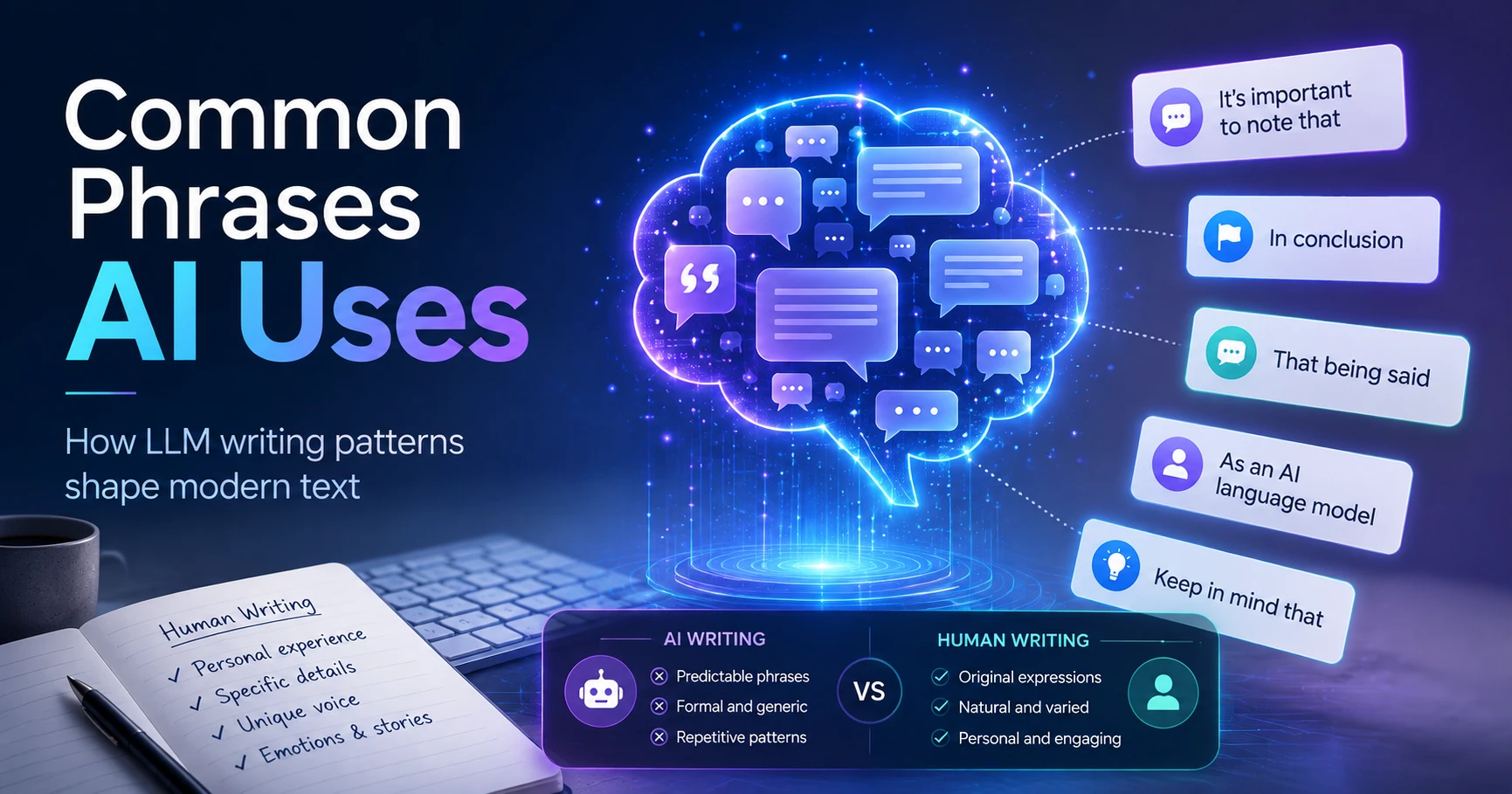
AI writing does have recognizable verbal habits, but there is no magic phrase that proves a passage was written by AI.
Across research papers, controlled model comparisons, public corpora, and years of user observations, the strongest recurring signals include words such as delve
, intricate
, underscore
, crucial
, and pivotal
; phrases such as it’s important to note
, in summary
, not only ... but also
, a testament to
, and here’s a breakdown
; and openings such as certainly
, here
, and below is
.
The useful signal is the bundle of vocabulary, sentence templates, formatting, and structure, not any one expression.
Research also shows that different model families have different linguistic fingerprints, that those fingerprints change as models and system prompts change, and that humans are beginning to absorb some LLM-associated vocabulary themselves.
Also Read: Do College Admissions Use AI Detectors?
Quantitative Evidence
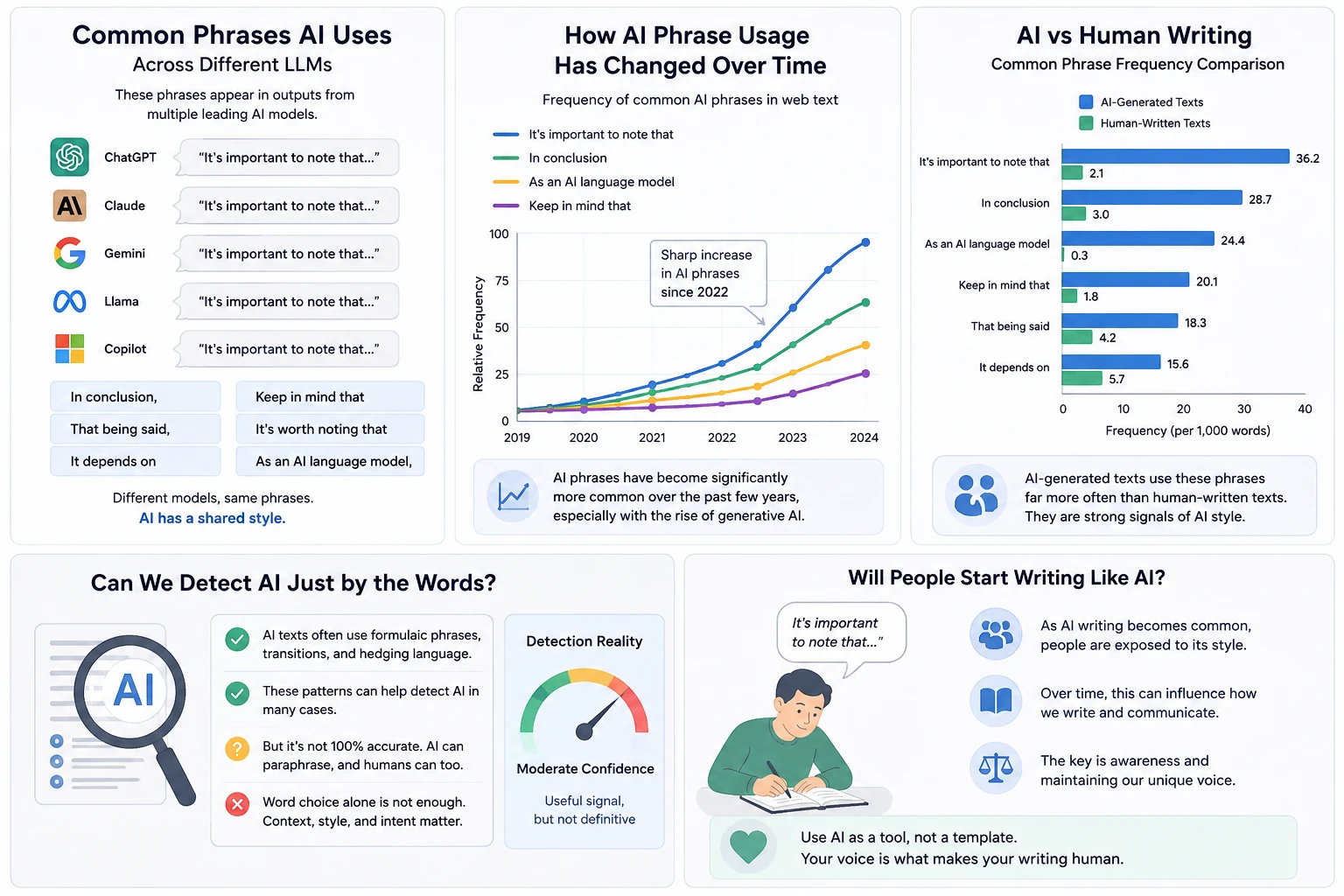
The most striking quantitative evidence comes from academic publishing. A large biomedical study covering more than 15 million PubMed abstracts found an abrupt post-ChatGPT rise in certain style words and estimated that at least 13.5% of 2024 abstracts had been processed with LLM assistance. A separate study of 950,965 scientific papers estimated LLM modification in as many as 17.5% of computer-science papers in its sample. These are population-level estimates, not tools for deciding whether one particular paragraph was AI-generated.
- Some AI-associated words really are measurable.
Delve
,intricate
,underscore
,meticulous
,pivotal
,crucial
,notably
, andadditionally
recur in multiple empirical studies. - Phrase habits differ by model. A controlled comparison of GPT-4o, Claude 3.5 Sonnet, Grok-2, Gemini 1.5 Pro, and DeepSeek-V3 found enough model-specific linguistic structure to classify their outputs with 97.1% accuracy in its held-out five-model experiment.
- The tells are moving targets. Some famous markers surged after 2022 and then weakened.
Delve
, for example, rose dramatically through 2024 but declined in a 2025 academic corpus, while forms ofunderscore
kept increasing. - Word choice alone is not reliable authorship proof. Humans use the same vocabulary, detectors can be evaded by paraphrasing, and detector errors disproportionately affect some non-native English writers.
The phrases people notice first
Ask regular ChatGPT users what makes a passage feel AI-written and a remarkably stable list appears. A long-running Reddit discussion about overused ChatGPT language called out it’s important to note
, delve into
, tapestry
, in summary
, remember that
, navigating the landscape
, a testament to
, and in the world of
. The same discussion later accumulated complaints about intricate
, meticulous
, underscores
, not just ... but ...
, and certainly
. These observations are anecdotes rather than controlled measurements, but several of them independently overlap with words and phrases identified in academic experiments.
That distinction matters. There are really three categories of supposed “AI phrases”: expressions supported by corpus statistics, expressions found as model-specific features in controlled experiments, and expressions that mostly come from community pattern recognition. Mixing those together produces the misleading internet lists that claim every instance of moreover
or in conclusion
must be ChatGPT.
Also Read: “Must Pass AI Detector” vs. “No AI Used”: The Contract Trap Destroying Freelancers
| Word or phrase | Evidence | What the evidence actually says |
|---|---|---|
delve/ delve into |
Strong corpus evidence, plus community reports | One of the clearest post-ChatGPT lexical spikes in scientific writing, and repeatedly identified by experienced users. |
intricate |
Strong corpus evidence | Among the words whose scientific usage rose sharply after the arrival of mainstream LLMs. |
underscore/ underscores |
Strong corpus evidence | A particularly strong academic marker whose frequency continued rising even after some better-known markers declined. |
crucial, pivotal, meticulous |
Multiple empirical studies | Frequently enriched in LLM-influenced academic text or cited by expert AI-text annotators. |
certainly |
Controlled model-output evidence | A characteristic feature and opening associated with some models, notably GPT-family and DeepSeek outputs in one cross-model experiment. |
according to/ based on |
Controlled model-output evidence | Characteristic of Claude 3.5 Sonnet responses in the same controlled comparison. |
here’s a breakdown |
Controlled model-output evidence | A distinguishing Gemini phrase in that experiment. |
in summary/ below is |
Controlled model-output evidence, plus community reports | Distinguishing features of DeepSeek-V3 in the controlled comparison, while in summaryalso appears repeatedly in community lists. |
not only ... but also |
Controlled evidence, plus community reports | Parts of this construction were characteristic of Grok-2, while expert annotators and users independently list the broader template as AI-like. |
it’s important to note |
Expert-annotation and community evidence | A common perceived tell, but not an exclusive or independently diagnostic AI marker. |
a testament to |
Expert-annotation and community evidence | Testamentwas explicitly identified by expert annotators as overused AI vocabulary. |
tapestry, realm, landscape |
Mostly community and expert-heuristic evidence | Strongly associated with “AI voice” among frequent users, but weaker as stand-alone corpus-level evidence than delveor underscore. |
One particularly useful source here is a 2025 study of experienced human AI-text detectors. Its detection guide contained not just single words such as tapestry
, testament
, realm
, delve
, enhance
, crucial
, and vibrant
, but full constructions such as in summary
, it’s important to note
, not only ... but also
, remember that
, and when it comes to
. The authors found that experienced annotators were more likely than inexperienced annotators to recognize specific lexical habits instead of treating every “fancy” word as suspicious.
A deliberately exaggerated composite example: “Certainly. Here’s a comprehensive breakdown. It’s important to note that this intricate landscape is not only complex, but also a testament to the crucial role of...”
No paper cited here claims that exact sentence is an AI signature. It is a synthetic mash-up of documented tendencies. That is exactly why it sounds so familiar: the “AI feel” often comes from several individually ordinary constructions being stacked together.
Also Read: Paraphrasing vs. Deep Restructuring: Why Simple Synonym Swapping Fails
Why these expressions feel so conspicuous
Many of the recurring words do similar rhetorical jobs. They signal importance (crucial
, pivotal
, significant
), complexity (intricate
, multifaceted
, nuanced
), organization (in summary
, here’s a breakdown
), expansion (delve into
, explore
), or interpretation (underscores
, highlights
). They make prose sound organized, polished, and explanatory even when the underlying point is simple. The expert-annotation study found that vocabulary was its human experts' most common clue, followed closely by formulaic sentence and document structures and perceived lack of originality.
That last point is important. AI style is not merely a bag of suspicious words. Research on syntactic templates in generated text found that model-generated material contained recurring grammatical templates at higher rates than human reference text. In that study, 76% of templates found in generated text could also be located in pretraining data, compared with 35% of templates in the human-authored references. The authors' method could distinguish patterns among models, tasks, and domains.
How the major models differ
Talking about “AI writing” as though every model speaks the same dialect hides one of the more interesting findings in recent research: models from different companies can be surprisingly distinguishable.
A cross-model study of LLM idiosyncrasies compared stable versions of GPT-4o, Claude 3.5 Sonnet, Grok-2, Gemini 1.5 Pro, and DeepSeek-V3. For each model and prompt dataset, the researchers collected 11,000 responses, primarily using UltraChat prompts for the chat and instruction-tuned systems. Their five-way classifier identified which of the five chat models produced a held-out response with 97.1% accuracy, versus a 20% chance baseline.
The interesting part for ordinary readers is that a simpler model using only TF-IDF unigram and bigram features still reached 85.5% accuracy on those chat APIs. In other words, a large portion of the fingerprint was visible in word and short-phrase distributions. Even after the researchers shuffled the words and destroyed normal sentence order, their more powerful classifier retained 88.9% accuracy on the five chat models.
| Model in the study | Characteristic wording | What stands out |
|---|---|---|
| OpenAI GPT-4o | such as, certainly, overall, enhance, various |
Explanatory and elaborative transitions were prominent. |
| Anthropic Claude 3.5 Sonnet | according to, based on, the text, here, appears to |
More explicit reference back to supplied material. |
| xAI Grok-2 | not only, but also, remember, might, helps in |
Contrastive and conversational constructions appeared among its distinguishing features. |
| Google Gemini 1.5 Pro | here’s a breakdown, crucial, essentially, key improvements |
Direct decomposition and importance-marking language stood out. |
| DeepSeek-V3 | below is, in summary, for example, certainly |
Strong answer-framing and summary language. |
The same experiment found differences in sentence openings. The authors specifically noted that ChatGPT favored phrases such as such as
, certainly
, and overall
, while Claude favored here
, according to
, and based on
. They also found model-specific differences in markdown, including headers, bold text, enumeration, bullets, and italics. ChatGPT tended toward more elaborated formatting, while Claude was more restrained in the researchers' qualitative comparisons.
The pattern extends beyond commercial chat systems. Among instruction-tuned open models in the study, Llama 3.1-8B was distinguished by words such as including
and such as
, while Gemma 2-9B showed conversational fragments such as let me
and know if
. Qwen 2.5-7B prominently featured certainly
and below is
.
These fingerprints are not permanent brand voices
There is a major catch. What you observe is not just the raw neural network. It is the model plus post-training, system instructions, product defaults, prompting, sampling settings, and sometimes tool orchestration. The same underlying model can therefore sound noticeably different in different products or under different instructions.
Major model vendors explicitly document this flexibility. Anthropic says its output styles alter the system prompt to control role, tone, and output format. Google's Gemini documentation demonstrates system instructions that change tone and response length. OpenAI's current model guidance even notes a generational default-style difference, saying GPT-5.6 tends to be more concise by default than GPT-5.5.
That makes any frozen “ChatGPT always says X” list perishable. A phrase that is a strong clue for one model snapshot, product configuration, or year may become much less useful after a model update or a change in system instructions.
How AI phrasing has changed over time
The history is already long enough to see an evolution. ChatGPT's public arrival at the end of 2022 created what researchers can treat as a linguistic discontinuity. Several independent groups subsequently found abrupt increases in LLM-associated words in scientific papers, peer review, and eventually spoken language.
The largest recent multi-database analysis tracked 12 LLM-associated terms across six scholarly databases. Between 2022 and 2024, delve
increased by about 1,500%, underscore
by about 1,000%, and intricate
by about 700% across the databases studied. In more than 2.4 million PubMed Central open-access papers examined through July 2025, unusually repeated uses of several of these words also rose sharply.
timeline title The changing visibility of LLM-associated wording 2022 : Pre-ChatGPT baseline in the academic comparisons 2023 : Post-release increases become visible across several LLM-associated terms 2024 : "delve" about +1500% vs 2022 across six scholarly databases : "underscore" about +1000% : "intricate" about +700% : Public awareness of these words as AI tells grows 2025 : "delve" declines in some academic data : forms of "underscore" continue increasing : Many other LLM-associated terms flatten or decline 2026 : Published research increasingly treats AI vocabulary as a moving, coevolving signal
delvedeclined while forms of
underscorecontinued to rise.
That 2025 divergence is especially revealing. A later paper found that many LLM-associated terms decreased in 2025 relative to 2024. Forms of delve
rose in 2024 and then fell, while forms of underscore
continued upward. The authors give several possible explanations: writers may deliberately avoid conspicuous AI-associated vocabulary, people may be using different models, or providers may have changed model behavior. The study does not establish which explanation dominates.
An earlier human-LLM coevolution study found a similar pattern in roughly 1.29 million arXiv papers from 2018 through 2024. Frequencies of several well-publicized LLM-style words started decreasing around April 2024, while less conspicuous terms continued to grow. The authors hypothesize that writers began editing out words that had acquired an “AI” reputation. That explanation is plausible, but it remains an inference rather than a demonstrated cause.
Why does “delve” happen in the first place?
Even the origin of famous AI words is not as obvious as it looks. Juzek and Ward's study of lexical overrepresentation identified 21 focal words whose increased appearance in scientific abstracts was likely connected to LLM use. But when they investigated why models overproduce them, they did not find evidence that model architecture, algorithms, or training data alone explained the phenomenon. Their model comparisons were consistent with reinforcement learning from human feedback contributing to the effect, while their human experiment complicated that hypothesis.
So delve
is not simply a secret token stamped into ChatGPT. Its prominence is an emergent result of training, post-training, user preferences, product behavior, and subsequent human reaction. Once millions of users notice it and start telling models not to use it, the linguistic ecosystem changes again.
Can words alone tell you a text was written by AI?
No, not reliably at the level of an individual passage. That conclusion is compatible with the finding that AI vocabulary can be extremely useful statistically. A word can be strongly overrepresented in a population of AI-assisted writing while remaining perfectly normal in an individual human sentence.
This distinction is explicit in the scientific literature. The 950,965-paper analysis describes its method as a corpus-level statistical framework and notes that population-level estimation is more robust than inference on individual instances. The biomedical excess-vocabulary study likewise estimates the amount of LLM-assisted writing across millions of documents rather than claiming that delve
can convict one author.
There is nevertheless real information in linguistic fingerprints. The cross-model experiment's 97.1% five-way classification result shows that models can leave systematic signatures when outputs are collected under controlled conditions. The syntactic-template work likewise found higher rates of repeated grammatical structures in generated text. But “a trained classifier can exploit a high-dimensional distribution over thousands of examples” is a very different claim from “this person wrote crucial
, therefore they used ChatGPT.”
Also Read: Are There Industry Standards for AI Detector Accuracy? The Truth Behind the Scores
Experienced humans can do much better than one-word heuristics
The strongest counterpoint comes from Russell, Karpinska, and Iyyer's human detection experiment. Five annotators who frequently used LLMs for writing collectively misclassified only one of 300 nonfiction English articles when their judgments were combined by majority vote. The generated material came from GPT-4o, Claude 3.5 Sonnet, and o1-Pro, and the experiment also included paraphrasing and “humanization” conditions.
But their experts were not simply hunting for delve
. Their explanations combined exact lexical clues with formulaic sentence structure, document-level organization, vague conclusions, originality, and other patterns. The paper even reports false positives in which human authors happened to use AI-associated words such as delve
and crucial
.
That is the better mental model: experienced readers can sometimes recognize an ensemble of habits. A single habit is weak evidence.
| Signal | Potentially useful for | Not sufficient for |
|---|---|---|
One word such as delve |
Corpus-level trend analysis | Attributing one document to AI |
| Several AI-enriched words together | Raising a probabilistic suspicion | Proving authorship |
| Phrase, syntax, structure, formatting, and vocabulary combined | Model classification or expert human judgment under controlled conditions | Guaranteed real-world attribution outside the tested distribution |
| Commercial “AI detector” score | Possibly one input to further review | A stand-alone accusation, disciplinary decision, or authorship verdict |
| Verified provenance or generation metadata | Much stronger attribution evidence | Nothing beyond what that provenance actually records |
Paraphrasing and false positives make detection harder
A TMLR study on AI-text detection showed that recursive paraphrasing could substantially reduce the effectiveness of multiple types of detectors while causing only modest quality degradation in many experiments. The paper also establishes a theoretical connection between the best possible detector's performance and the statistical distance between human and model text distributions. As those distributions overlap, perfect post-hoc detection becomes fundamentally difficult.
False positives are not merely hypothetical. A Stanford-led study of GPT detectors found that several detectors disproportionately misclassified writing by non-native English speakers as AI-generated. The researchers also found that simple prompting strategies could bypass detectors, leading them to caution against detector use in evaluative settings where false accusations matter.
That should make anyone wary of “AI phrase checklists” used as enforcement tools. The person who writes furthermore
, crucial
, or in conclusion
may simply write formal English. Penalizing ordinary rhetorical vocabulary because a chatbot also likes it creates exactly the type of false-positive problem the detection literature warns about.
When humans start sounding like the models
There is an even deeper problem with linguistic detection: the causal arrow does not point in only one direction. LLMs learn from human language, but humans who interact with LLMs may then adopt some of the models' preferred language. The result is a feedback loop in which “AI words” gradually become human words again.
A remarkable large-scale study of spoken communication examined 360,445 academic YouTube videos and 771,591 podcast episodes, representing billions of transcribed words. After the release of ChatGPT, the researchers observed significant increases in several words that ChatGPT itself disproportionately favored, including delve
, comprehend
, boast
, swift
, and meticulous
. Among the most GPT-associated words, many increased at roughly 25% to 50% per year, although not every candidate word changed significantly.
The podcast results are especially interesting because they reduce, though do not eliminate, the possibility that researchers were simply reading AI-written manuscripts aloud. Delve
rose significantly relative to synthetic controls in Science and Technology, Business, and Education podcasts, while the effect was not statistically significant in Religion and Spirituality or Sports. The authors interpret the broader pattern as evidence that LLM-associated language may be diffusing into spontaneous human communication, while acknowledging that the mechanism of adoption is uncertain.
This creates a detection paradox. Imagine that in 2023 a model uses delve
ten times more often than humans. Users read millions of model outputs, start using delve
themselves, and eventually the human baseline rises. The very feature that once separated AI from humans becomes less discriminative because the model helped change human language.
The same dynamic may operate through editing behavior in the opposite direction. Once humans learn that delve
is perceived as an AI tell, they delete it from AI-assisted drafts. The arXiv coevolution analysis observed declines in several widely publicized AI-associated words beginning in spring 2024 and proposed conscious avoidance as one possible explanation. Meanwhile, less notorious words continued increasing.
Put those two mechanisms together and you get a linguistic arms race:
- Models develop statistically noticeable preferences.
- Humans notice and publicize those preferences.
- Prompt writers tell models to avoid them.
- Model providers change training and default style.
- Human writers adopt some model-associated wording anyway.
- Old markers weaken while new markers emerge.
The empirical research on declining and rising terms, customizable model styles, and human vocabulary shifts supports the pieces of this cycle, although no single study proves that every step occurs universally.
A practical way to read “AI-ish” prose
For readers, editors, teachers, and publishers, the most sensible approach is to stop asking, “Does this contain an AI word?” and instead ask, “Does this contain an unusual concentration of mutually reinforcing AI-associated habits?” That framing fits the research much better.
A passage becomes more plausibly AI-influenced when several signals arrive together: a high concentration of enriched words such as crucial
, intricate
, pivotal
, and underscore
; canned discourse markers such as it’s important to note
and in summary
; symmetrical constructions such as not only ... but also
; repeated importance claims; conspicuously tidy headings and bullets; generic conclusions; and sentence structures that repeat with unusual regularity. Those categories echo the lexical, syntactic, formatting, and document-structure signals found across the cited studies.
Even then, the correct conclusion is usually “this resembles patterns often found in LLM output”, not “AI wrote this.” It might be fully generated, lightly edited by AI, translated or polished by a model, written by a human who has absorbed LLM conventions, deliberately written in a generic SEO style, or simply authored by someone whose natural vocabulary overlaps with the model.
A useful evidence hierarchy
- Weak evidence: one suspicious word or transition.
- Moderate evidence: several statistically enriched phrases plus repetitive AI-like structure.
- Stronger but still probabilistic evidence: a validated classifier or experienced multi-cue human analysis applied within conditions resembling its evaluation data.
- Strongest evidence: reliable provenance, edit history, generation logs, or disclosure showing that an LLM actually participated.
The difference between “AI-generated” and “AI-assisted” also deserves more attention. The biomedical vocabulary research describes abstracts as having been processed with LLMs. A human-written paper whose English was polished through ChatGPT can acquire the same vocabulary shift as a paragraph generated from scratch. Style analysis generally cannot tell you how much intellectual work came from the author.
That distinction will become more important as AI becomes a normal layer in word processors, email clients, search tools, coding environments, and editing workflows. The scientifically defensible question is increasingly not “human or AI?” but “what kind of human-AI production process most plausibly produced this text?”
The bottom line
Yes, AI models use common phrases, and many of those habits can be measured. The strongest research-supported examples include delve
, intricate
, underscore
, meticulous
, crucial
, pivotal
, certainly
, such as
, according to
, based on
, here’s a breakdown
, in summary
, it’s important to note
, not only ... but also
, and a testament to
. Which ones matter most depends on the model, prompt, domain, and time period.
The more important discovery is that AI voice exists at several levels simultaneously. Models differ in vocabulary, sentence openings, grammatical templates, formatting, verbosity, and rhetorical organization. In controlled settings, those combined fingerprints can be strong enough to distinguish one model from another with high accuracy.
But the fingerprint is not a permanent watermark. Official OpenAI guidance, Anthropic documentation, and Google documentation all illustrate that response style can be changed through model versions, system instructions, or explicit style controls. Empirical studies already show famous markers rising, peaking, and sometimes declining.
And now humans are changing too. The evidence that LLM-associated vocabulary has begun appearing more often in human speech means the boundary is becoming linguistically porous. A phrase can start in human writing, become disproportionately favored by a model, become notorious as an “AI word,” get edited out of AI drafts, and meanwhile spread back into ordinary human conversation.
So the most useful answer to “what phrases does AI use?” is not a blacklist. It is a pattern-recognition rule: look for clusters, compare against the relevant model and era, distinguish statistical association from proof, and never mistake one ordinary English phrase for evidence of authorship.