
TL;DR
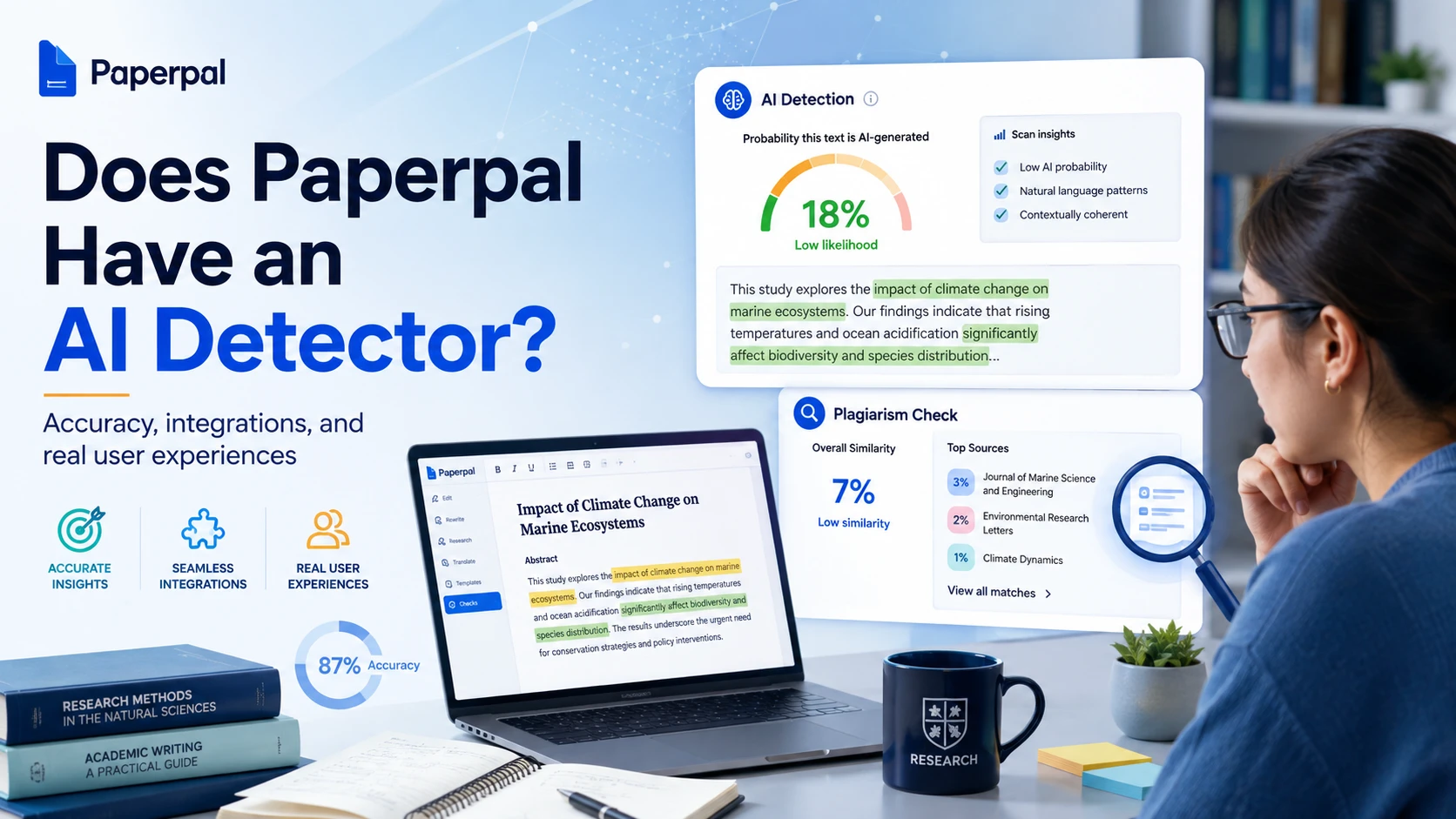
Yes. Paperpal has its own AI detector, launched in late 2025 and designed mainly for academic writing. It analyzes papers, essays, theses, and other documents and labels passages as human-written, AI-written, or a human-AI blend. Paperpal says its detector was trained on more than 100,000 human and AI-written academic samples, including outputs from ChatGPT, Claude, and Gemini. The company has also claimed 99% accuracy and says its multi-model approach reduces false positives by more than 40%.
There is an important catch: there is currently no independently audited study confirming Paperpal's 99% figure. One August 2026 third-party review specifically looked for an independently verified false-positive and false-negative rate and could not find one. Paperpal itself now stresses that AI detection is not 100% reliable and should not be treated as definitive proof of AI use.
A few key takeaways:
- Paperpal's plagiarism checker is reported as being integrated with Turnitin, including by Queen Mary University of London.
- Paperpal's AI detector appears to be separate from Turnitin's AI detector. Paperpal describes it as its own multi-model system; the sources reviewed did not show that Turnitin powers Paperpal's AI detection.
- Reddit users have reported confusing Paperpal AI scores, including one case where manually rewriting flagged passages caused the score to rise from 23% to 50%.
Does Paperpal Actually Have an AI Detector?
Paperpal does have an AI content detector, and it is no longer simply an academic editing tool with plagiarism checking.
Its AI Detector is designed specifically around academic content. Instead of giving only one overall percentage, Paperpal provides document-level results along with sentence-level indicators. It separates content into categories that represent human writing, AI writing, and mixed human-AI writing, making it possible to see which passages caused the score.
Paperpal says the detector was trained on 100,000+ human-written and AI-generated scholarly samples. Its training data includes content produced by ChatGPT, Claude, and Gemini. Paperpal also says it uses multiple models to cross-check results rather than relying on a single classifier. According to the company's current product page, these checks reduce false positives by more than 40%.
A false positive simply means human-written material is incorrectly labeled as AI-generated. A false negative is the opposite: genuinely AI-generated material passes as human.
Paperpal's detector is primarily positioned as a pre-submission self-check for students, researchers, and authors rather than a tool for universities to use as evidence in misconduct investigations. That distinction becomes important when looking at its accuracy.
Also Read: How accurate is Paperpal's plagiarism checker? - An Independent Review
How Accurate Is Paperpal's AI Detector?
What Paperpal claims
When Paperpal announced the detector on December 25, 2025, it made a striking claim: the detector was trained to identify text generated by ChatGPT, Claude, and Gemini with 99% accuracy.
Its current AI Detector page focuses more heavily on two other claims: training on more than 100,000 scholarly samples and reducing false positives by more than 40% through multiple-model checking.
But Paperpal's own educational material adds a significant qualification. Its June 2026 AI Detector FAQ says AI detection cannot be considered 100% reliable or accurate. The company acknowledges both false positives and false negatives and recommends treating detector output as a starting point for review rather than conclusive evidence.
Paperpal has even published an article explaining why completely original writing polished with tools such as Paperpal may nevertheless be flagged by AI detectors. More consistent and predictable academic prose can resemble statistical patterns associated with AI writing, according to the company.
So, the most accurate interpretation of Paperpal's marketing is not "the detector is right 99% of the time in every real-world situation." The 99% number is a company-reported performance claim, while Paperpal itself acknowledges that actual results depend on the text, training data, degree of editing, and other circumstances.
Also Read: Which is Better Paperpal or Jenni AI?
What independent sources found
The biggest limitation is the lack of a strong independent benchmark specifically validating Paperpal.
CASRAI's August 2026 review says it could not verify any independently audited accuracy figure for Paperpal's detector and could not locate Paperpal in independent testing literature providing a properly measured false-positive and false-negative rate. CASRAI therefore recommends treating Paperpal's result as a signal requiring further investigation, not a verdict on authorship. The review also discloses that some of its Paperpal links are referral links, which is worth knowing when evaluating the source.
One smaller hands-on third-party test from The Effortless Academic produced encouraging—but far from definitive—results. The reviewer fed Paperpal part of a manuscript known to be 100% AI-generated, and Paperpal labeled it 93% AI-written. After human editing, the score fell to 79%. A real paper created with some AI assistance was rated as having 25% AI-writing patterns. However, a paper written entirely by humans before the generative-AI era was also assigned some AI-writing characteristics, although it did not contain the strongest "AI-heavy" category.
That is useful real-world testing, but it is not equivalent to a controlled study involving hundreds or thousands of documents.
More broadly, peer-reviewed research gives good reason to be cautious with all AI detectors. A major study of 14 detection systems found the tools tested were neither consistently accurate nor reliable, while Stanford-led research found that AI detectors could disproportionately misclassify writing by non-native English speakers. Neither study tested Paperpal specifically, so these findings should be viewed as evidence about the limitations of the technology category—not as a measurement of Paperpal itself.
Where Are Paperpal's AI and Plagiarism Checkers Integrated?
There are two different meanings of "integration" here: what technology is powering the checks and where users can access them.
For plagiarism, the strongest independent evidence of a technology relationship comes from Queen Mary University of London. Its Digital Education Studio describes Paperpal as an AI writing assistant and plagiarism checker that is integrated with Turnitin, suggesting students can use it to assess work before submission when a practice Turnitin area is unavailable.
Paperpal itself says its plagiarism checker compares writing against approximately 99 billion webpages and 200 million open-access research articles, producing similarity scores and source-by-source comparisons. Paperpal's own small benchmark of 20 passages reported 90% plagiarism-detection accuracy—18 correctly classified passages out of 20—but because Paperpal designed and published this test itself, it should be considered a vendor benchmark rather than independent validation.
For AI detection, the situation is different. Paperpal describes its system as using its own scholarly training data and multi-model checks. Based on the sources reviewed, there is no evidence that Paperpal's AI detector is Turnitin's AI-writing detector. The Turnitin relationship appears to concern plagiarism/similarity checking instead.
In terms of everyday workflow, Paperpal says its broader writing toolkit is available through:
- Paperpal Web
- Microsoft Word
- Google Docs
- Chrome
- Overleaf
Paperpal also combines AI detection, plagiarism checking, grammar, references, and other pre-submission checks within its "Check & Finalize" workflow, meaning you do not necessarily need separate tools for each check.
What Are Reddit Users Saying About Paperpal?
Reddit provides anecdotes rather than controlled evidence, so these experiences cannot prove that Paperpal is inaccurate. They can, however, show what real users find frustrating.
The clearest Paperpal-specific AI-detector complaint appeared in an r/AskAcademia discussion in 2026. The poster was concerned because several detectors were identifying about 23% of a research manuscript as AI-related. They had used Claude and Paperpal for some editing rather than having AI create the underlying research. After manually rewriting passages they thought might look AI-generated, they checked the revised version with Paperpal—and Paperpal's score increased from 23% to 50%. The poster said the result was confusing and that they no longer knew which detector to trust.
That anecdote fits Paperpal's own warning that AI-edited or highly polished academic language can sometimes resemble AI-generated writing.
Another r/UniUK discussion included a much blunter reaction: one commenter advised the student not to use Paperpal because repeatedly checking scores was only increasing their anxiety rather than telling them anything genuinely useful. In the same discussion, users talked about Paperpal specifically as a way to pre-check plagiarism using Turnitin-related similarity checking.
Interestingly, targeted searches produced far fewer credible first-hand complaints specifically about Paperpal's plagiarism checker than complaints about AI-detection anxiety and inconsistent AI percentages. Some Reddit users actually recommended Paperpal as an accessible way to obtain a Turnitin-style plagiarism check. One such recommendation appeared in r/OriginalityHub, although that subreddit contains promotional-style tool recommendations, so it should be treated cautiously.
The absence of many plagiarism complaints does not prove the checker is flawless. It simply means the Reddit evidence found was much stronger for concerns about AI detection than about Paperpal's plagiarism matching.
Is Paperpal's AI Detector Worth Trusting?
For students and professionals, the best way to think about Paperpal is to separate its two checks.
A plagiarism report can point you toward identifiable matching sources. You can open the match, determine whether wording was copied, check whether a quotation is properly marked, and add a missing citation. A similarity percentage itself is not automatically proof of plagiarism, but the underlying source matches give you something concrete to inspect. Paperpal itself recommends reviewing matches rather than treating every similarity as misconduct.
An AI-detection percentage is fundamentally less certain. It estimates whether the statistical patterns in your writing resemble material generated by AI; it cannot inspect your thought process or prove who actually wrote a sentence. Paperpal itself now explicitly warns against treating such scores as definitive evidence.
So, yes, Paperpal has a fairly sophisticated academic AI detector, and its sentence-level human/AI/mixed classifications may be useful when reviewing your own draft. Its plagiarism checker also benefits from a large comparison database and reported Turnitin integration.
But the headline 99% AI-detection accuracy claim should be treated cautiously until independent researchers reproduce it under realistic academic-writing conditions. As of August 24, 2026, there is no publicly verified independent benchmark establishing that Paperpal achieves 99% accuracy across real student papers, professional manuscripts, AI-edited text, and different types of writers.
For now, Paperpal makes the most sense as what the company increasingly says it is: a pre-submission warning system, not a judge of authorship.