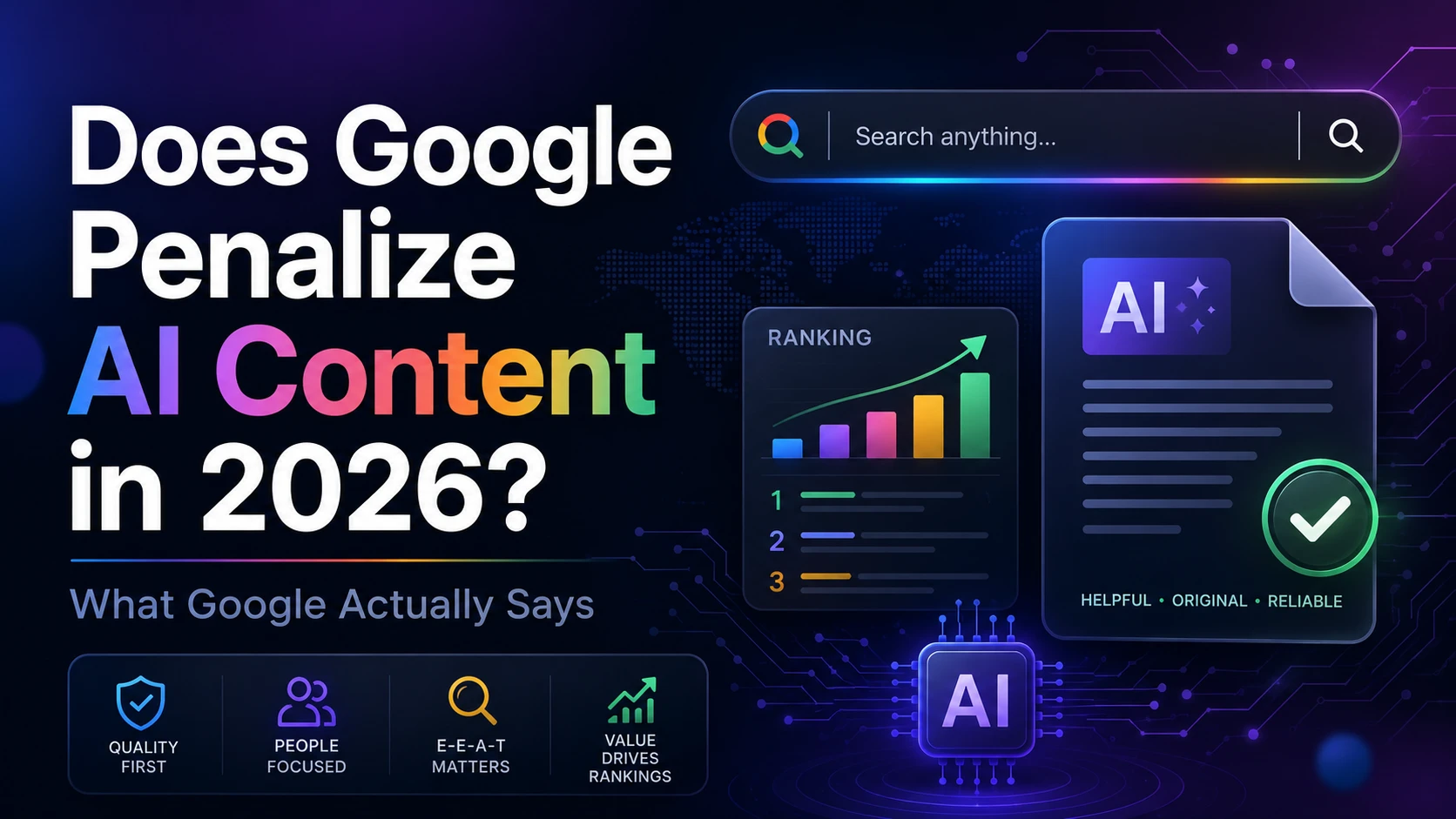

The short answer is no: Google does not penalize content simply because it was created with AI. What Google does penalize is spammy, scaled, low-value, misleading, or unhelpful content. It doesn't matter that content was written by AI, by humans, or by a mix of both.
That distinction matters because a lot of publishers still frame the issue the wrong way. The real question is not, “Was AI involved?” The real question is, “Does this page help users, show real value, and deserve to rank?” In 2026, Google’s public position is still focused on quality, usefulness, originality, trust, and search spam, not on punishing AI as a category.
- Google does not have a blanket “AI content penalty.”
- Google does act against scaled content abuse, including pages made mainly to manipulate rankings.
- Helpful, reliable, people-first content can rank even if AI helped create it.
- Thin, generic, mass-produced content is the real risk, especially when it adds little original value.
- In 2026, there are still no extra requirements just to appear in AI search experiences like AI Overviews or AI Mode.
Short answer: Does Google penalize AI content?
No, not for being AI content. Google has said for years that its systems focus on the quality of content rather than how the content was produced. That means AI is treated as a tool, not as an automatic violation.
But there is an important second half to that answer. Google absolutely can downgrade, deindex, or manually penalize pages when they are created mainly to manipulate search, flood the index with low-value variations, or publish unoriginal content at scale. And AI makes that kind of abuse much easier to produce.
Google’s position is basically this: AI is allowed. Spam is not.
What Google actually says
1) Google’s main standard is content quality
In Google Search Central guidance, Google explained that its focus is on the quality of content, not the method used to create it. That was the clearest early answer to the “Will Google ban AI content?” question, and that principle still holds in 2026.
Google’s “people-first” and “helpful content” guidance reinforces the same idea. The goal is to publish content that helps readers, demonstrates expertise or experience when needed, and gives users a reason to trust what they are reading.
2) Google does penalize scaled abuse
The biggest shift came in March 2024, when Google expanded its spam policies around scaled content abuse. The wording was important: Google said large amounts of low-value, unoriginal content can violate policy no matter how it is created.
That means Google intentionally moved away from a narrow “auto-generated content” framing and toward a broader, more practical rule: if content is being mass-produced mainly to manipulate rankings and it doesn’t genuinely help users, it is risky.
3) Google still applies the same SEO fundamentals in AI search
In 2025 and 2026, Google published more guidance around AI search experiences, including AI Overviews and AI Mode. The key takeaway was not “build for a new AI algorithm.” The key takeaway was that the same fundamentals still matter: crawlability, clarity, originality, usefulness, and trust.
Google also said there are no additional requirements just to appear in those AI search surfaces. So there is no special “AI-safe content format” or hidden compliance tag you need to add.
Why do some AI-heavy sites lose rankings then?
Because many sites are not losing rankings due to “AI detection.” They are losing rankings because the content ends up showing the same problems Google has always disliked:
- Thin pages with little substance
- Rewritten summaries of what other sites already said
- Huge numbers of near-duplicate pages
- Weak factual accuracy and poor editorial review
- No first-hand experience, testing, or original insight
- Low trust signals on sensitive topics like health, money, or safety
- Pages created mainly to capture long-tail keywords instead of helping people
In other words, AI often becomes the scaling mechanism behind low-quality publishing. That is why some publishers think Google is “penalizing AI.” What Google is really targeting is the outcome: unhelpful, unoriginal, manipulative content at scale.
What changed after 2024?
March 2024 was the turning point. Google paired a major core update with stronger spam enforcement and said the combined effort was designed to reduce low-quality, unoriginal results. Later updates in 2024, 2025, and 2026 continued to push in the same direction.
The pattern is consistent:
- Google keeps refining systems that reward genuinely useful content.
- Google keeps tightening rules around manipulative scaling and reputation abuse.
- Google keeps saying AI use by itself is not the problem.
So the market changed, but the principle did not. In 2026, Google is not saying, “Don’t use AI.” It is saying, “Don’t use AI to flood Search with pages nobody needed.”
What this means for SEO teams in 2026
The safest way to think about AI content is this: AI can speed up production, but it cannot replace originality, expertise, accountability, or trust.
That means strong publishers should use AI as an assistant, not as an unchecked publishing engine. AI can help with outlining, research support, summarization, editing, content refreshes, and idea generation. But the final page still needs human judgment.
This is especially true for YMYL topics, pages about health, finance, legal issues, safety, or major life decisions. On those topics, weak or generic AI-generated copy is much more dangerous because Google puts more weight on trust and expertise.
- Low risk: AI-assisted content reviewed by experts, improved with original analysis, and clearly owned by humans.
- Medium risk: AI-drafted informational pages with light editing and weak differentiation.
- High risk: Mass-produced query pages, affiliate fluff, city/service page spam, or unverified YMYL content.
A simple publisher checklist
Before publishing AI-assisted content, ask these questions:
- Why does this page deserve to exist? Does it add something useful, or is it just another rewrite?
- What is original here? Did you include data, experience, examples, screenshots, testing, or analysis?
- Who is accountable? Is there a real author, editor, or subject-matter reviewer behind it?
- Can users trust it? Are facts checked, sources credible, and claims clear?
- Was the page made for people first? Or was it made mainly to capture keyword demand?
- Would this still feel valuable if search engines did not exist?
If those answers are weak, the content is risky whether AI wrote 20% of it or 100% of it.
Should you disclose AI use?
Google does not require a blanket disclosure on every AI-assisted article. But it does suggest that transparency is useful when readers would reasonably want to know how a piece of content was created.
In practice, the better approach is often not a giant “This was written by AI” badge. A stronger approach is building a real editorial trust layer:
- clear bylines
- reviewer names
- methodology sections
- testing notes
- fact-checking standards
- update history
- author expertise pages
Those signals usually do more for trust than a vague disclosure alone.
The biggest misconception in 2026
The biggest misconception is that Google has some simple AI detector and automatically demotes anything that looks machine-written. That is not what Google has publicly said, and it is not the most useful way to understand how ranking systems work.
From a practical SEO perspective, Google’s approach is outcome-based. It cares about what users see and whether the page is worth surfacing in Search. That is why strong AI-assisted content can still perform well, while generic, mass-scaled content often fades after updates.
Final verdict
Conclusion
Google does not penalize AI content in 2026 just because it is AI content.
What Google actually penalizes is content that is low-value, unoriginal, manipulative, misleading, or published at scale mainly to game rankings. AI can be part of that problem, but it is not the problem by itself.
The winning strategy in 2026 is not “hide the AI.” It is publish content that is demonstrably useful, trustworthy, original, and responsibly edited. If AI helps you do that better, Google’s own guidance does not suggest you should fear a penalty. If AI helps you mass-produce shallow pages, then yes, you are taking a real risk.
Also read
Google Search’s guidance about AI-generated content
Google’s March 2024 core update and spam policy changes
Google’s 2026 resource for optimizing content for AI search experiences