![[STUDY] Which AI Detection Tool Has the Lowest False Positive Rate?](/static/images/which_ai_detection_tool_has_the_lowest_false_positive_ratepng.webp)

As a student, there is nothing more nerve-wracking than hitting "submit" on an essay you worked on for hours, only to worry that an algorithm might "hallucinate" and flag your original work as AI-generated. This phenomenon is known as a False Positive, and it's becoming a major concern in classrooms worldwide.
If you’ve ever wondered which tools are the most "forgiving" to human writers and which ones are the most likely to get it wrong, we’ve crunched the numbers for you. We tested four major players—GPTZero, Turnitin, Winston AI, and ZeroGPT—to see which one has the lowest false positive rate.
What is a False Positive Rate (FPR)?
In simple terms, a False Positive occurs when an AI detector looks at human-written text and incorrectly labels it as "AI." A False Positive Rate of 1% means that for every 100 human-written papers, one will be wrongly accused. For students, a high FPR is a nightmare because it leads to unnecessary academic integrity investigations.
Also Read: Does ZeroGPT gives false positives?
The Results: Who Can You Trust?
After analyzing our test data (which included 160 samples of both AI and human-written content), the results were clear.
| Tool | False Positive Rate (Lower is Better) | Overall Accuracy |
|---|---|---|
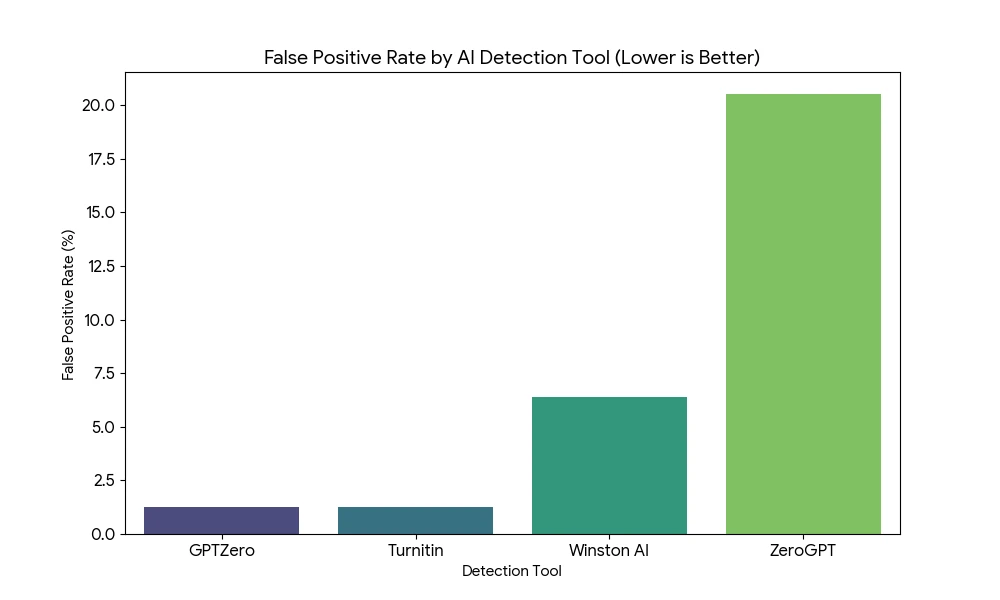
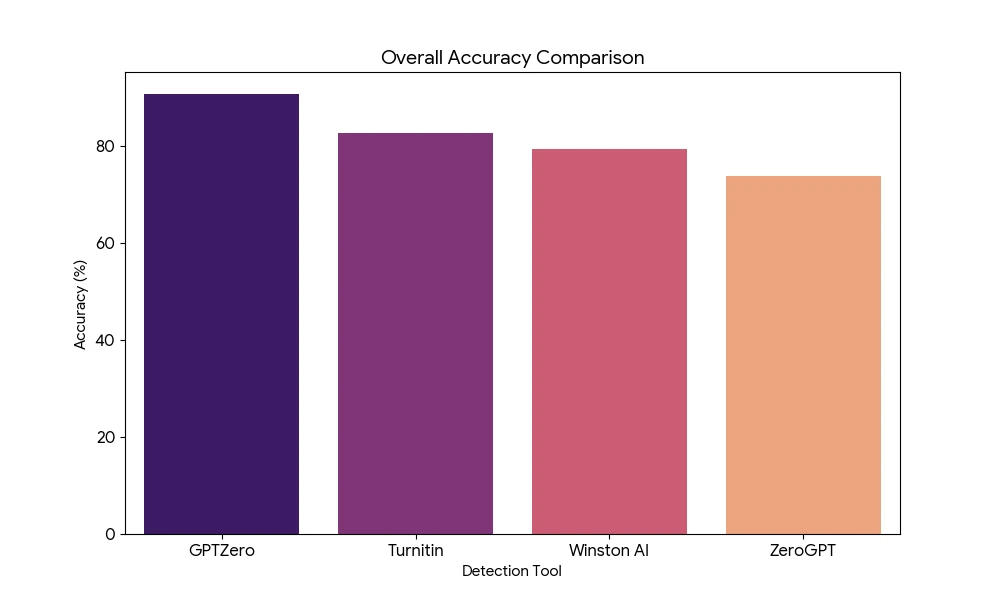
| GPTZero | 1.28% | 90.63% |
| Turnitin | 1.28% | 82.50% |
| Winston AI | 6.41% | 79.38% |
| ZeroGPT | 20.51% | 73.75% |
The Winners: GPTZero and Turnitin
Both GPTZero and Turnitin tied for the lowest False Positive Rate at a very respectable 1.28%. This means they are the most reliable tools when it comes to protecting honest students from false accusations. GPTZero also took the crown for the highest overall accuracy, making it the most balanced tool in our testing suite.
Also Read: Is Winston AI or GPTZero more accurate?
The Warning: ZeroGPT
On the other end of the spectrum, ZeroGPT struggled significantly. With a False Positive Rate of 20.51%, it incorrectly flagged human text as AI more than 1 out of every 5 times. For students, this is a major red flag—if your school uses ZeroGPT, there is a much higher chance of your original work being called into question.
Also Read: Is Winston AI accurate like Turnitin?
Visualizing the Data
- False Positive Rate Comparison
The bar chart below illustrates the gap between the tools. While GPTZero and Turnitin remain near the bottom (where you want them to be), ZeroGPT spikes dangerously high. - Overall Accuracy
Accuracy isn't just about avoiding false positives; it's also about catching actual AI. GPTZero led the pack here, followed by Turnitin. Winston AI and ZeroGPT trailed behind, often missing AI-generated content or confusing it with human writing. - How "Confident" are these tools?
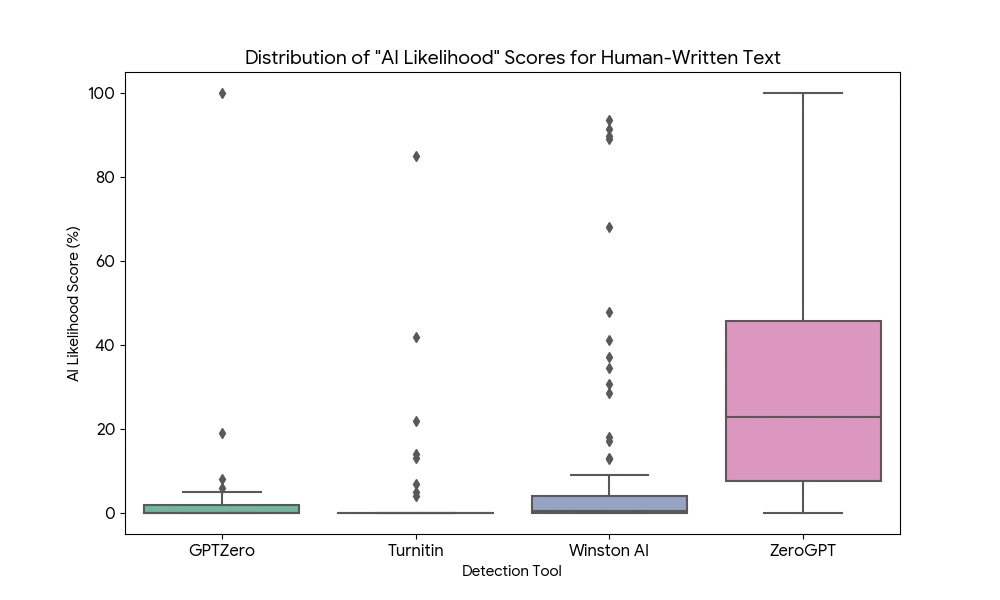
We also looked at the "AI Likelihood" scores these tools gave to human-written text. GPTZero and Turnitin typically give human text a score near 0%, whereas ZeroGPT's scores are often pushed deep into "AI" territory.
Why This Matters for Students
If you are a student, knowing which tool your professor uses can help you understand the "risk" of a false accusation.
- If they use Turnitin or GPTZero: You can breathe a little easier. These tools are specifically tuned to minimize false positives.
- If they use ZeroGPT: Be extra careful. Always keep your "receipts"—such as your Google Docs version history or rough drafts—to prove you wrote the work yourself in case of a false positive.
Summary: The Final Verdict
When it comes to protecting students from false accusations, GPTZero and Turnitin are the top choices. They offer the most protection against false positives while maintaining high detection accuracy. ZeroGPT, despite its popularity, remains the most "aggressive" and least reliable tool for human writers.
Our Advice
Always write honestly, but keep your edit history active just in case!
Data analysis based on internal accuracy tests involving 160 text samples. Individual results may vary based on writing style and complexity.