
TL;DR
- On this 160-text test, Pangram performed better overall than GPTZero.
- Pangram reached 93.1% accuracy, while GPTZero reached 90.6%.
- The biggest difference was in catching AI text. Pangram caught 87.8% of AI samples, while GPTZero caught 82.9%.
- Both tools were very careful with human writing. Each one wrongly flagged only 1 human sample as AI.
- GPTZero had a slightly better AUC, which means its raw score ranking separated human and AI text a little better across many possible cutoffs. But for the verdict students actually see on screen, Pangram came out ahead.
Students are now judged by machines that often act like they can see inside a sentence and know exactly where it came from. That is a serious problem, because a detector does not need to be perfect to affect a grade, a scholarship, or a teacher's trust. It only needs to sound confident. So the real question is not which tool has the flashier interface or louder marketing. The real question is simple: which detector actually does a better job on real writing samples?
To answer that, this comparison used the same 160 texts in both spreadsheets. The set included 82 AI-written samples and 78 human-written samples. One important detail had to be fixed before comparing scores: in Pangram, a score of 100 means the text looks AI-written, but in GPTZero, a score of 100 means the text looks human-written. So GPTZero's score direction was reversed during analysis so both tools could be read in the same way.
How this comparison was done
This review looked at two things: the final label each tool gave, and the score behind that label.
- Accuracy: how often the detector was correct overall.
- Precision: when the tool says "AI," how often it is actually right.
- Recall: how many of the real AI texts it successfully catches.
- F1 score: a balance between precision and recall.
- AUC: a score-ranking measure. In plain language, it checks how well the score separates human and AI writing across many possible cutoffs, not just one final verdict.
This matters because a detector can look good in one way and still fail in another. For example, a tool might be very careful about not accusing humans, but still miss a lot of AI text. Another tool might catch more AI text, but be too aggressive and hurt real student writing. A useful detector needs balance.
The short answer: yes, Pangram was better on this dataset
The first chart shows the headline result. Pangram beat GPTZero on overall accuracy, AI recall, and F1 score. The precision numbers were nearly identical, which means both tools were very reliable once they decided to call a text AI. The real gap came from how many AI-written pieces they let slip through.
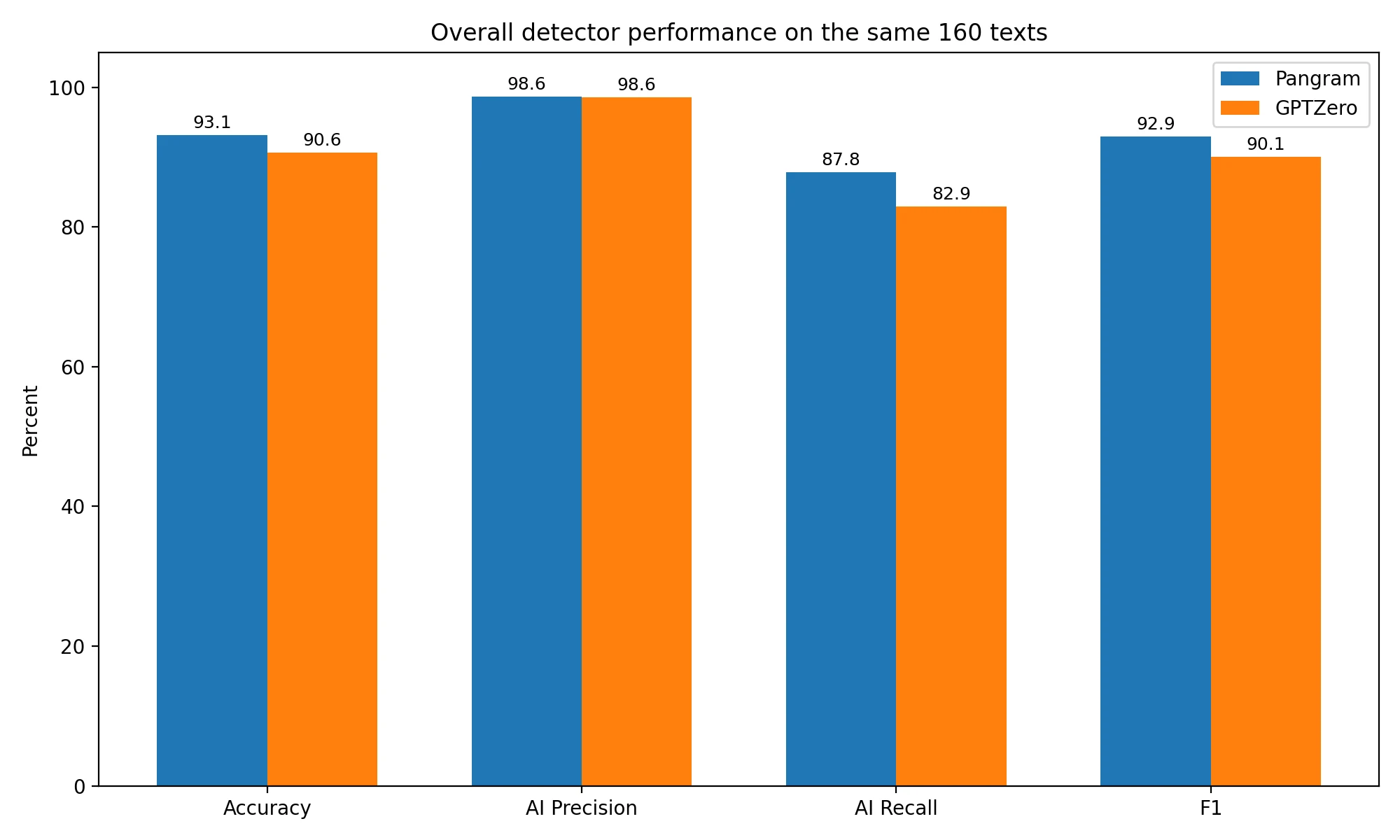
Pangram reached 93.1% accuracy, compared with 90.6% for GPTZero. That gap may not look huge at first, but on a test set this size, it means Pangram made fewer wrong calls overall. It also posted a better F1 score, which is important because F1 rewards tools that stay strong on both correctness and coverage.
Where Pangram pulled ahead
The biggest difference was in detecting AI-written text. Pangram correctly caught 87.8% of AI samples, while GPTZero caught 82.9%. In raw numbers, Pangram missed 10 AI texts, while GPTZero missed 14. That is the main reason Pangram won this comparison.
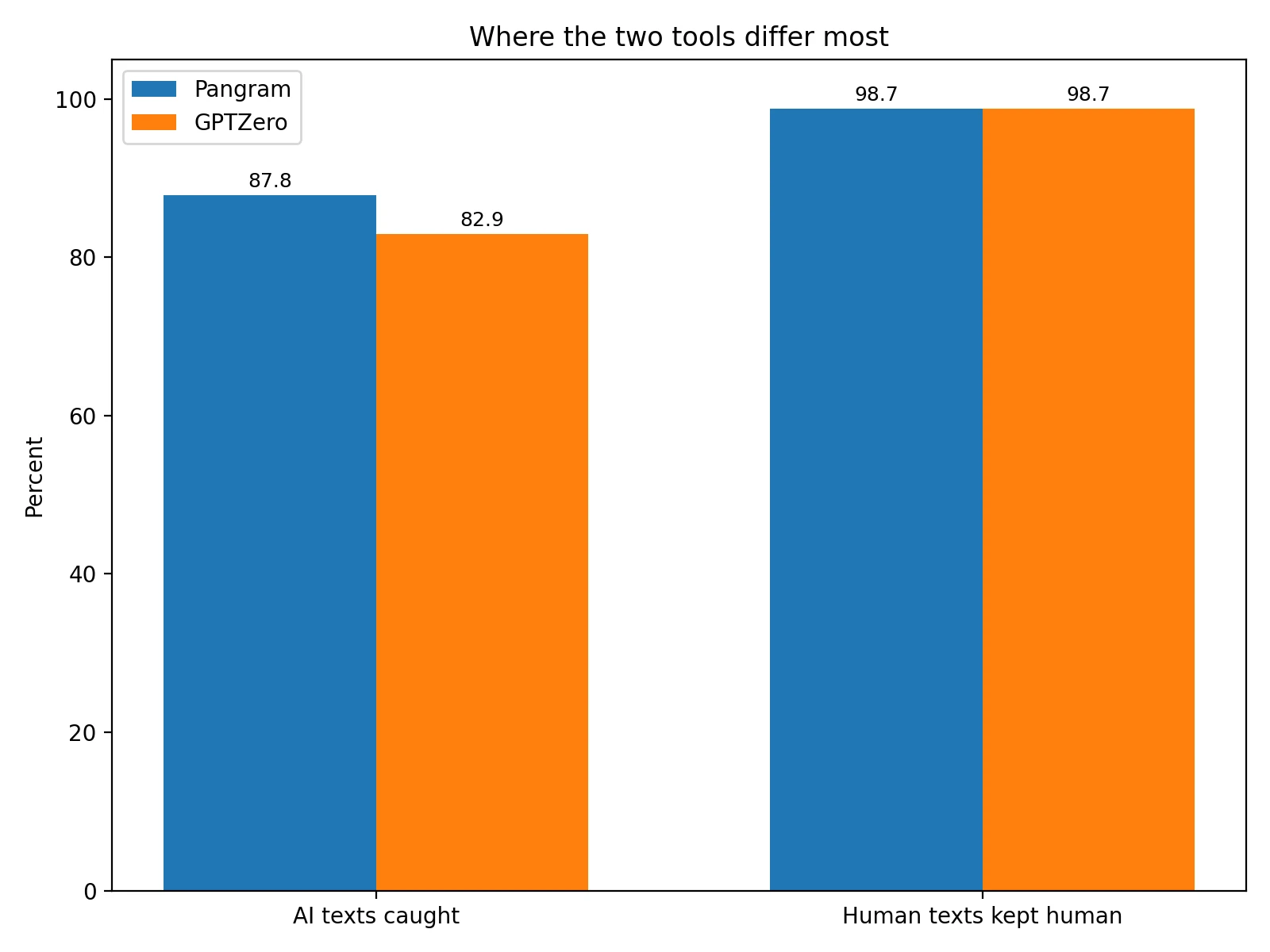
At the same time, neither tool was reckless with human writing. Each one only falsely labeled 1 human sample as AI. That means the two detectors were equally cautious on the human side, but Pangram was stronger on the AI side. If the goal is to decide which tool does the better job as a practical detector, that gives Pangram the edge.
What the score patterns reveal
The score chart adds an interesting twist. Pangram's scores were extremely decisive. Most of the time it pushed texts very close to 0 or 100. GPTZero, on the other hand, used a wider spread of values. That makes GPTZero feel more nuanced, and it helps explain why its AUC was slightly higher: 94.7 versus 93.8.
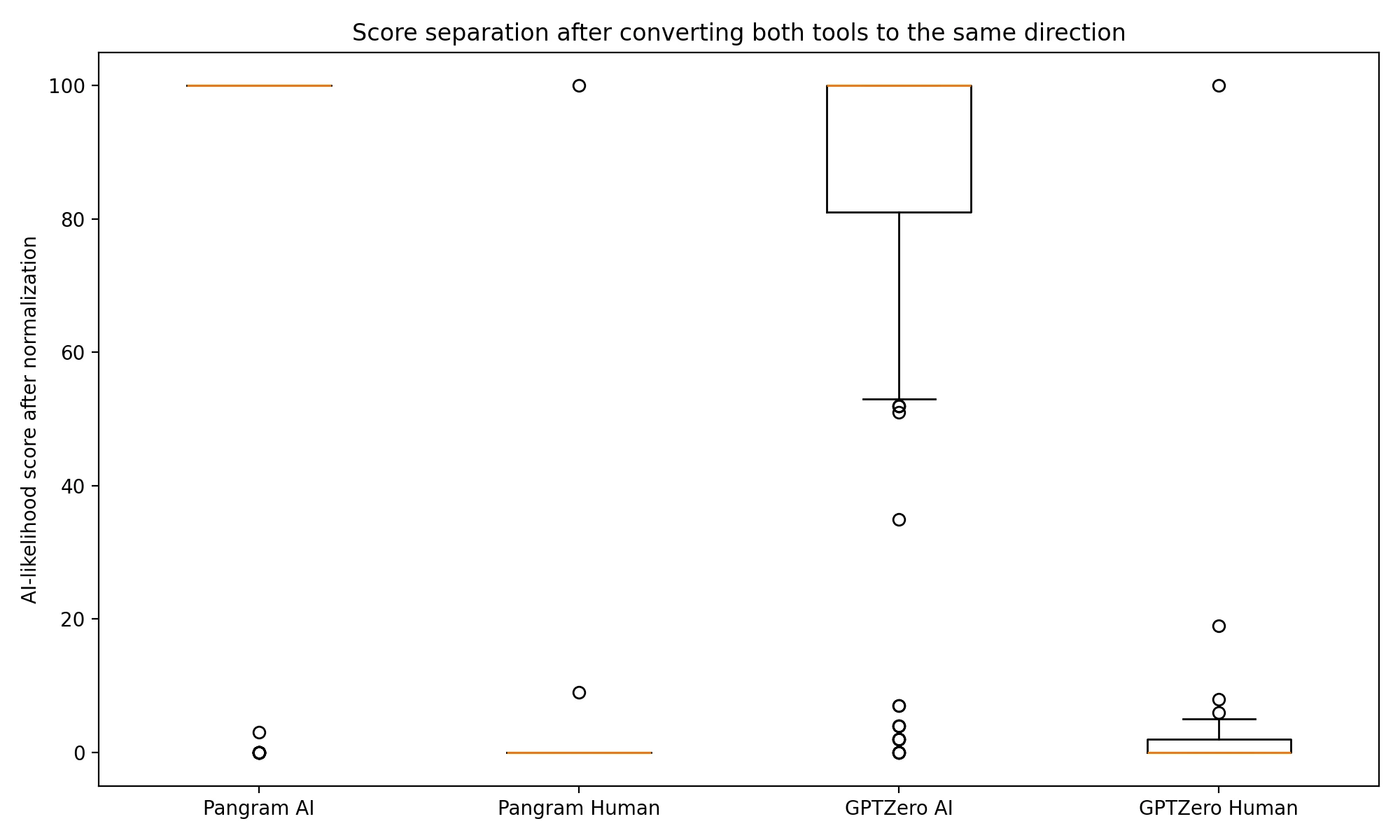
That does not mean GPTZero was better overall here. It means GPTZero's raw score has slightly better ranking behavior if someone wants to experiment with different thresholds. But most students, teachers, and admins do not do that. They look at the final verdict. On the actual verdicts in these sheets, Pangram performed better.
Head-to-head on the same texts
When both tools were judged on the exact same samples, they were both correct on 140 texts. Pangram alone got 9 texts right that GPTZero got wrong. GPTZero alone got 5 texts right that Pangram missed. They were both wrong on 6 texts.
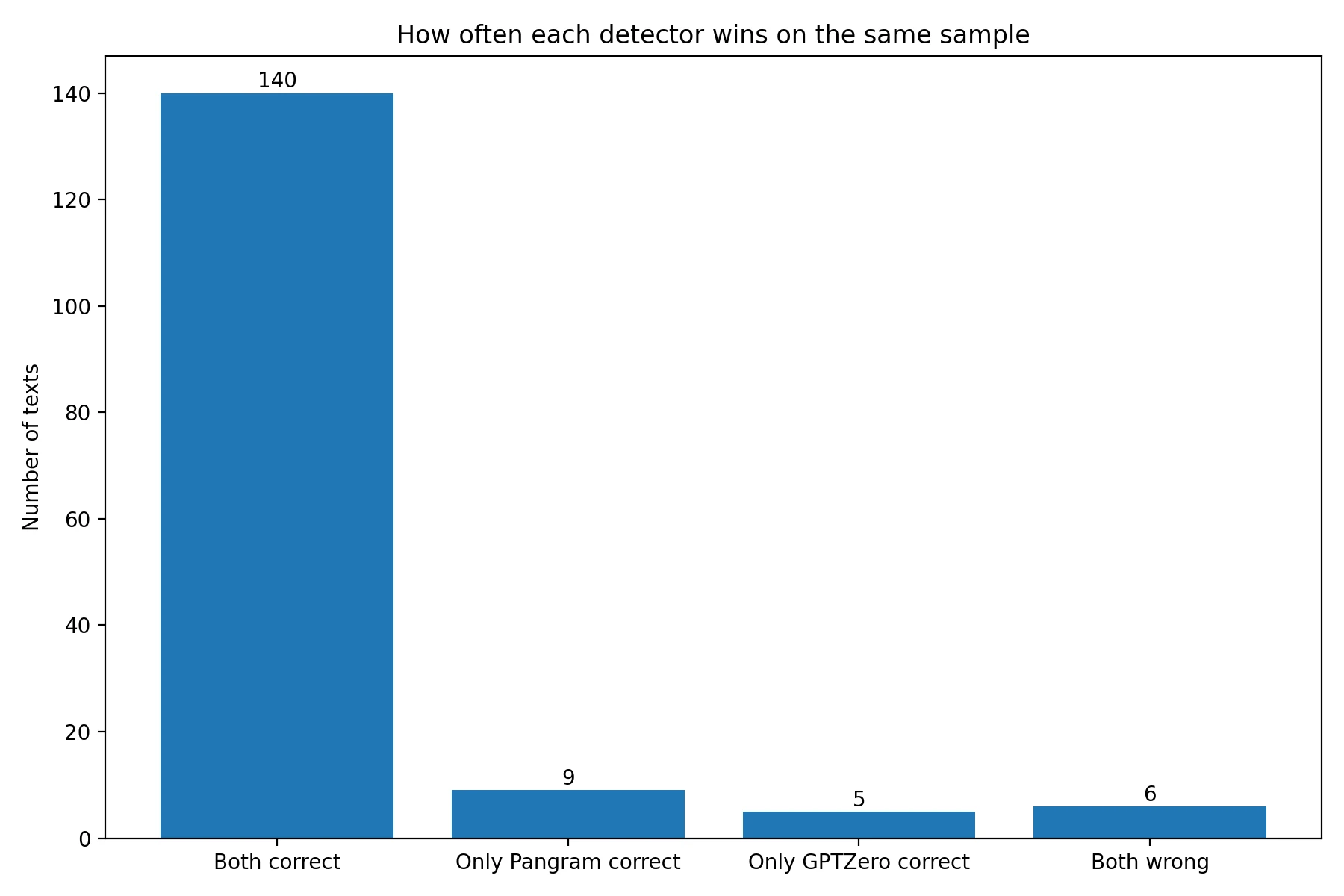
That head-to-head result matters because it shows Pangram was not just winning due to one lucky metric. It actually beat GPTZero more often on the same pieces of writing. That is a much stronger argument than looking only at average scores.
Confusion matrices
A confusion matrix is just a simple mistake map. It shows how many human texts stayed human, how many human texts were wrongly called AI, how many AI texts were missed, and how many AI texts were caught correctly. These two charts make the tradeoff easy to see.
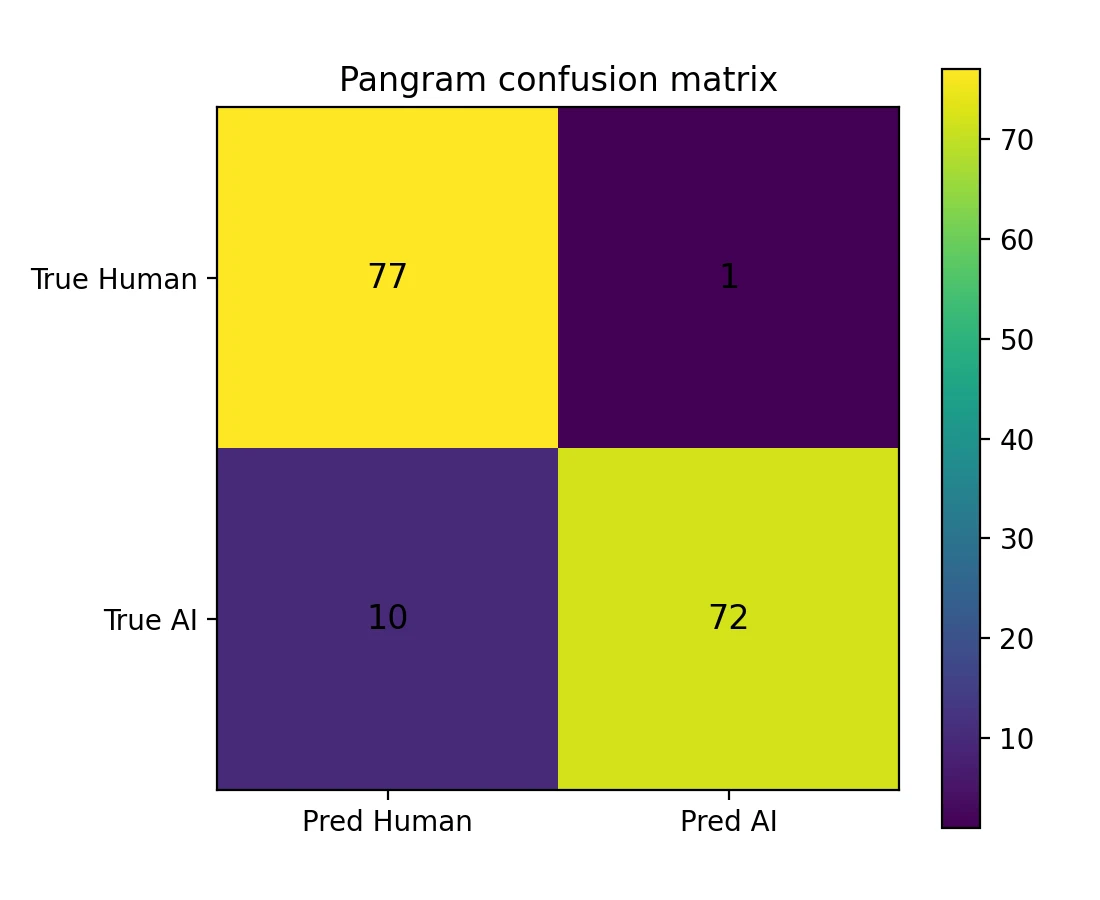
Pangram and GPTZero tied on protecting human writing, but Pangram caught more of the AI material. That is why the bottom-left error box, which represents missed AI text, is smaller for Pangram than for GPTZero.
So, is Pangram better than GPTZero?
On this dataset, yes. Pangram was the better detector overall. It had higher accuracy, better AI recall, and a better F1 score, while staying just as careful with human writing. GPTZero still deserves one point in its favor: its score scale was slightly better at ranking texts from more human-like to more AI-like. But that is a secondary advantage unless someone is actively tuning thresholds.
For students, the practical takeaway is uncomfortable but important. Even the better-performing tool here was not perfect. Pangram still missed AI texts, and both tools still made at least one false accusation against a human writer. So the lesson is not that one detector can be fully trusted. The lesson is that if someone insists on using these tools, they should at least understand what the numbers mean, where the errors happen, and why a single detector score should never be treated like proof.
Final takeaway
- Best practical performer here: Pangram
- Best at catching AI: Pangram
- Best at avoiding false accusations on humans: Tie
- More nuanced score scale: GPTZero
- Best answer to the title question: Yes, Pangram was better than GPTZero on this test set, but neither one was reliable enough to be treated as final proof.